Digital automation caused manufacturing employment rates to decline in Country X after 2010
What's this about?
People disagree about whether smart machines caused factory job rates to drop in Country X after 2010. Smart machines can do tasks that people once did.
What supporters say
- Studies in the United States found that more robots led to fewer jobs and lower pay in some areas.
- Studies in Germany and Colombia show that robots can change jobs and the tasks workers do.
- Robots have become more common in factories across many parts of the world.
- If Country X added robots while factory jobs fell, robots might have replaced some simple, repeat tasks.
What critics say
- Country X gives no job data or study that can show robots caused its job drop.
- Two events happening together do not prove that one event caused the other.
- Trade rivalry, a bad economy, or changes in what people buy could also cut factory jobs.
- Robots can help firms make more goods, lower costs, and create jobs to run or fix machines.
The bottom line
Smart machines can cut some factory jobs, especially jobs with simple repeat tasks. But we do not have enough Country X facts to say they caused the job rate to fall after 2010.
Digital automation may have contributed to job losses in manufacturing in some places, but the available evidence does not show that it caused Country X’s manufacturing employment rate to fall after 2010. The key problem is that no Country X-specific data or causal analysis is provided.
The case for
There is strong evidence that automation can displace workers, especially in industries and regions where robots take over tasks previously done by people. A widely cited study of US commuting zones found that greater exposure to industrial robots reduced both employment and wages between 1990 and 2007. That offers direct support for the idea that robot adoption can hurt workers in heavily exposed local labor markets (see Figure 1). 1
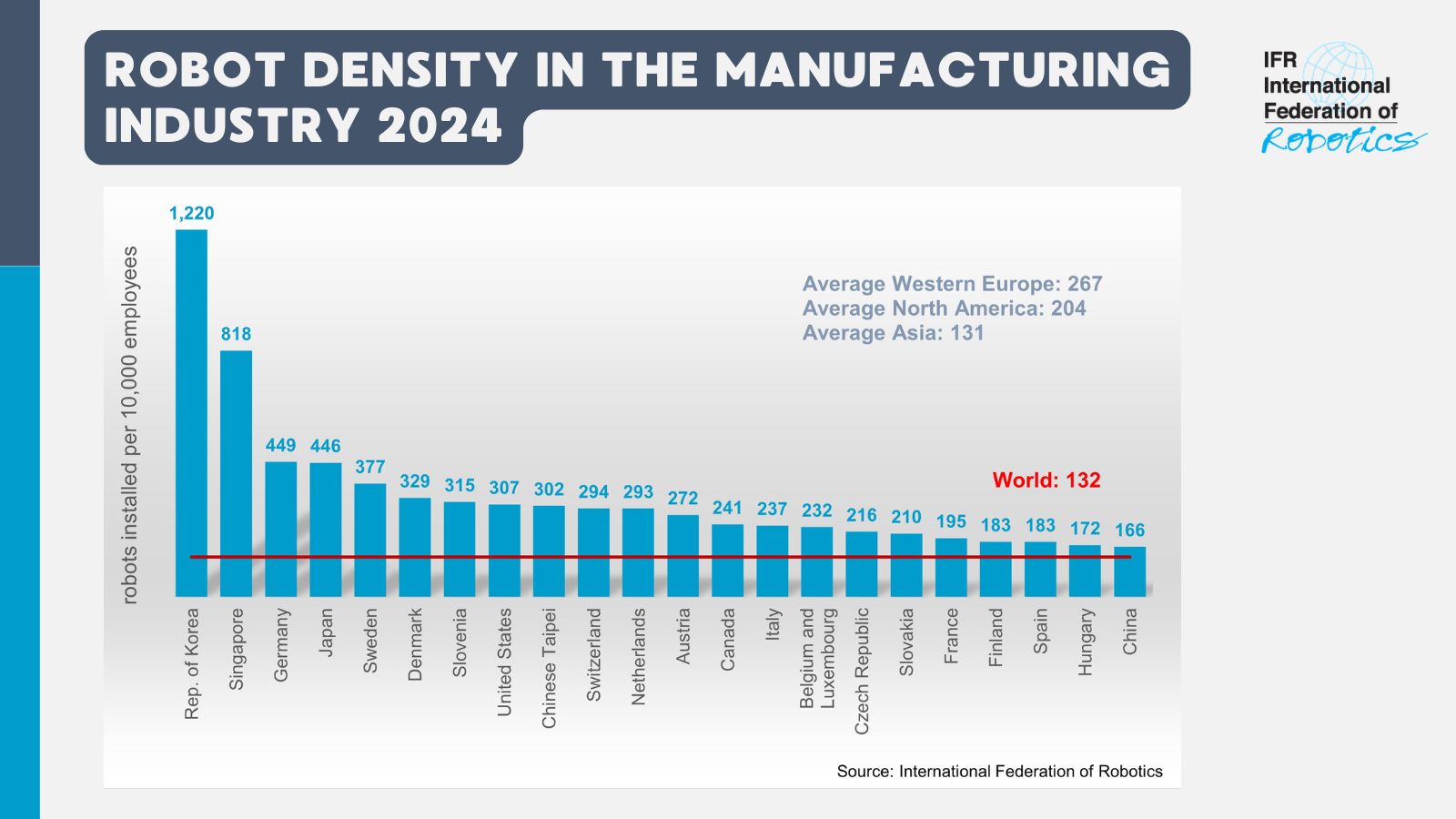
Research in Germany and Colombia also shows that robot exposure can reshape labor markets, often through changes in occupations and tasks. As industrial robots have become more common across Europe, Asia and the Americas, there is clearly a growing source of automation pressure on manufacturing work (see Figure 3). 2
If Country X saw automation adoption rise at the same time that manufacturing employment fell, that pattern would be consistent with the claim. It could suggest that firms used technology to replace some routine jobs, particularly where work was easy to automate.
But coincidence is not proof of cause. A decline in manufacturing employment might also reflect trade competition, a recession, changing consumer demand, or other economic shifts. The available record does not provide the information needed to separate those explanations.
The case against
The main objection is that automation does not automatically mean fewer manufacturing jobs overall. Robots can replace workers on particular tasks, but they can also make factories more productive, lower costs and allow companies to produce more. That expansion can create new work, including jobs that support, maintain or work alongside new technology. 3
Research across countries and industries links industrial robots with higher productivity and value added. Studies of developing economies and individual industries likewise suggest that greater output, competitiveness and the movement of workers into new roles can offset some of the jobs lost directly to automation (see Figure 2). A factory may need fewer workers to make each unit of a product, yet still employ as many—or more—people if it sells much more.
Evidence from individual firms also challenges a simple story of automation leading straight to job cuts. Studies in Canada and France indicate that firms adopting new technology may grow, gain market share and alter the kinds of workers they employ. Some may hire people for complementary roles even as machines take over other tasks. 4
The effects also vary widely by country, industry, region and stage of technological change. German research points toward occupational and task reallocation rather than an outright collapse in manufacturing employment. Other European evidence suggests that early job displacement can later be followed by expansion, new tasks or wider adjustment within the sector. Studies from Turkey and Colombia similarly indicate that local economic and institutional conditions matter.
Most importantly, the evidence supplied does not identify Country X, define what counts as “digital automation,” or specify how the manufacturing employment rate is measured. It also lacks figures on automation adoption, employment trends and a comparison showing what would have happened without automation. Without those elements, it is not possible to say automation was the cause rather than one factor among many.
The bottom line
The evidence supports the broader conclusion that automation can displace manufacturing workers in exposed labor markets. But it does not establish that digital automation caused a decline in Country X’s manufacturing employment rate after 2010.
The conclusion is held with high confidence because research consistently finds mixed and context-dependent effects. Automation may reduce some jobs, but productivity gains, higher output and new complementary work can offset those losses. A credible answer for Country X would require country-specific data, analysis of earlier trends, controls for trade and economic shocks, and a method that accounts for the fact that firms do not adopt automation at random.
Pros — Supporting Arguments
Figures & data

All contributions are reviewed for clarity, balance, and evidence. The strongest insights are elevated into the argument graph — with credit to you.
Help improve this analysis →