The gig economy is fundamentally changing the structure of traditional employment
What's this about?
People disagree about whether gig work has changed the whole job system.
Gig work includes short jobs found through apps, like ride share or food drop-off.
What supporters say
- App work creates new work links between people who need jobs and people who need help.
- Apps can set pay, give out tasks, track work, and rate workers through computer rules.
- Gig work can push workers to pay for tax, cover, and aid on their own.
What critics say
- We do not have enough proof that gig work has changed jobs across the whole economy.
- We may not know the true size of gig work because people count these jobs in unlike ways.
How to read this
The number of points does not show who is right; the key is how strong the proof is.
The bottom line
Gig work has changed how some jobs work, mainly in some fields.
But the proof does not show that it has replaced the old job system across the whole economy.
The gig economy is changing how some work is organized, managed and protected—but the evidence does not show that it has replaced traditional employment across the economy. The clearest changes are visible in particular sectors and employment practices, while the overall scale remains uncertain.
The case for
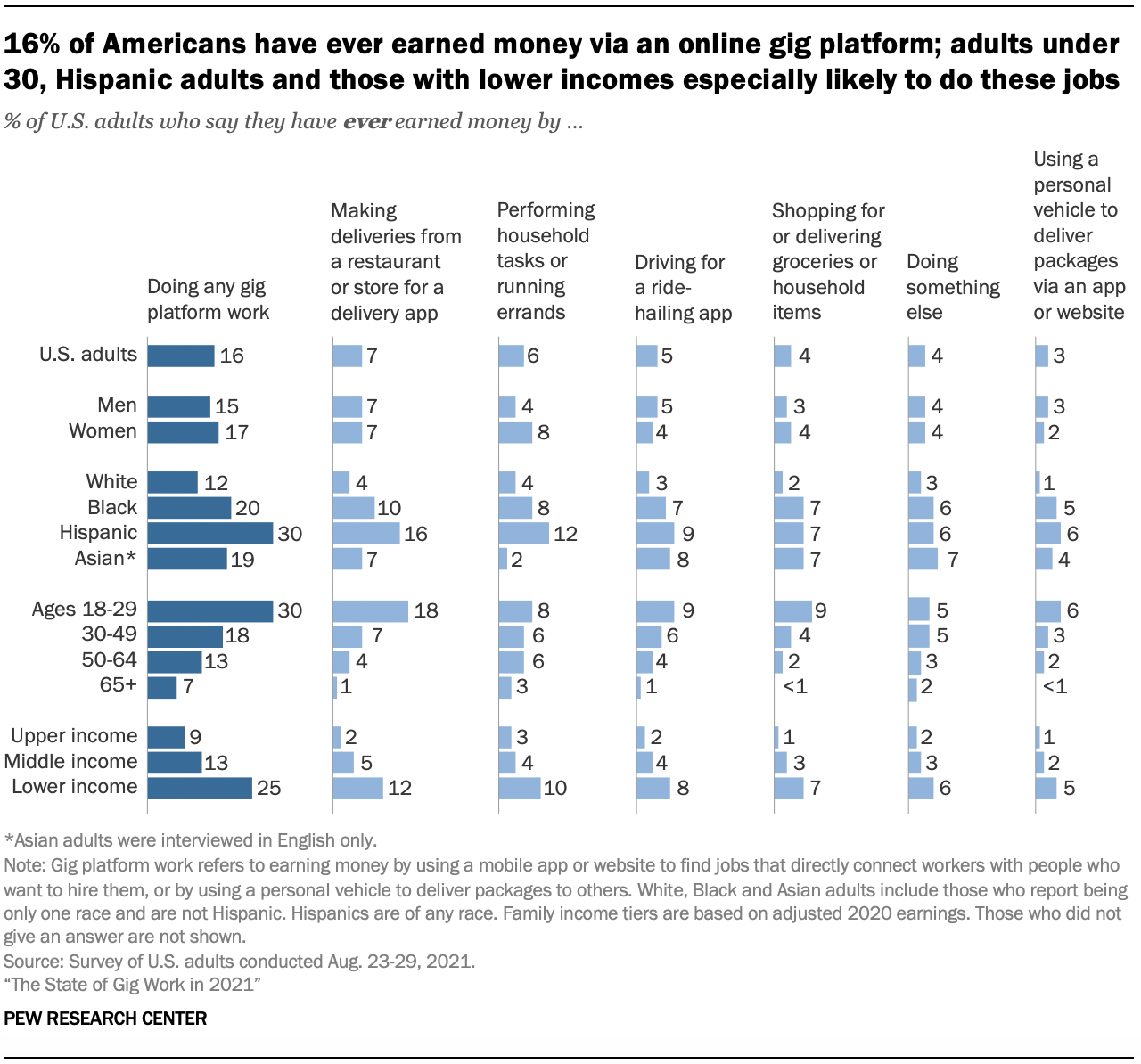
Platform work has created new employment relationships. Digital platforms can connect workers and customers while avoiding the traditional role of an employer. They may control recruitment, scheduling, pay and performance ratings, yet classify workers as independent contractors rather than employees. This separates day-to-day control from the legal status and responsibilities normally associated with employment. 1 (see Figure 1)
That shift can also move risks away from companies and toward workers. Contractors may be responsible for their own taxes, insurance and benefits, rather than receiving them from an employer. Research on self-employment taxes shows the financial consequences of this arrangement, while wider work by the International Labour Organization places platform work within debates over employment standards and social protection. 3 The evidence is less extensive here, but it points to a real challenge for systems built around standard jobs.
Algorithmic management provides stronger evidence of structural change. Platforms can use apps and automated systems to assign work, set prices, monitor performance and evaluate workers. Research on India’s gig economy describes automated, app-based management working alongside human oversight. Other research on tools designed by workers is consistent with concerns about unclear platform decisions and digital surveillance. In this model, management does not disappear; it is partly built into software. 2
These developments show that a minority form of work can still have wider effects. Platform practices may influence wage-setting, hiring, workplace monitoring, skills and the way companies organize labor, even where traditional employment remains common. In that narrower, sector-by-sector sense, the gig economy is changing the structure of employment.
The case against
The main objection is that evidence about particular platform jobs does not prove an economy-wide transformation. The cited research covers settings such as skills and work organization in India, attitudes among nursing students in Saudi Arabia, and a study of recruitment and organizational performance that is only indirectly related. These sources do not provide representative estimates of how many traditional jobs platform work has displaced or changed. 4
Measurement problems make the broader claim harder to test. Conventional labor statistics may not fully capture platform work, while bibliometric research shows where scholars are studying the subject rather than how large the employment shift is. The available evidence also offers limited detail for some studies and includes a preprint and a working paper. Institutional discussion, including from the International Labour Organization, does not always come with a specific finding about the size of the change. 5
As a result, it is still unclear how much gig work replaces conventional employment, how much it supplements it, and how much influence it has outside platform-based sectors. The cited literature does not show that the changes are uniform across occupations or countries. Nor does it establish that they are permanent.
The bottom line
The evidence supports the claim in a qualified, sectoral sense, but not as a proven economy-wide transformation. There is strong support for the narrower conclusion that platforms create new employment relationships and introduce new forms of managerial control. They can change who carries employment risks and how work is assigned, monitored and paid.
Confidence is therefore high that platform models have produced consequential changes in some employment practices, but only moderate that they have fundamentally restructured traditional employment throughout the economy. The strongest uncertainty is not whether gig work can change employment. It is how widespread, lasting and representative those changes are.
Pros — Supporting Arguments
Cons — Opposing Arguments
Figures & data
All contributions are reviewed for clarity, balance, and evidence. The strongest insights are elevated into the argument graph — with credit to you.
Help improve this analysis →