The skilled trades shortage is leading to increased wages and a resurgence of interest in vocational training
What's this about?
People disagree about whether a lack of skilled trade workers raises pay a lot and draws more people into job training.
The facts support some parts of this idea, but they do not prove the whole story.
What supporters say
- Home builders report that they have trouble finding skilled workers for home building jobs.
- When firms need more workers, those workers may gain more power to ask for better pay.
- Job data can show pay, job growth, open jobs, and the training each trade needs.
- A review of many studies found that trade training can help people get work and earn more.
What critics say
- The facts do not prove that worker shortages caused large pay rises in every trade.
- Job data can track pay and open jobs, but numbers alone cannot prove why pay changed.
- Trade training programs do not all give students the same results.
- The expert review does not show clear proof of a huge new rise in interest in trade training.
The bottom line
Skilled worker shortages seem real, and trade training can help people find jobs.
But we are not sure yet that shortages caused big wage jumps or a broad new rush into training.
The claim is that a shortage of skilled workers is pushing up trade wages significantly and sparking a broad new interest in vocational training. The available evidence supports parts of that picture, but it does not prove the full chain of cause and effect.
The case for
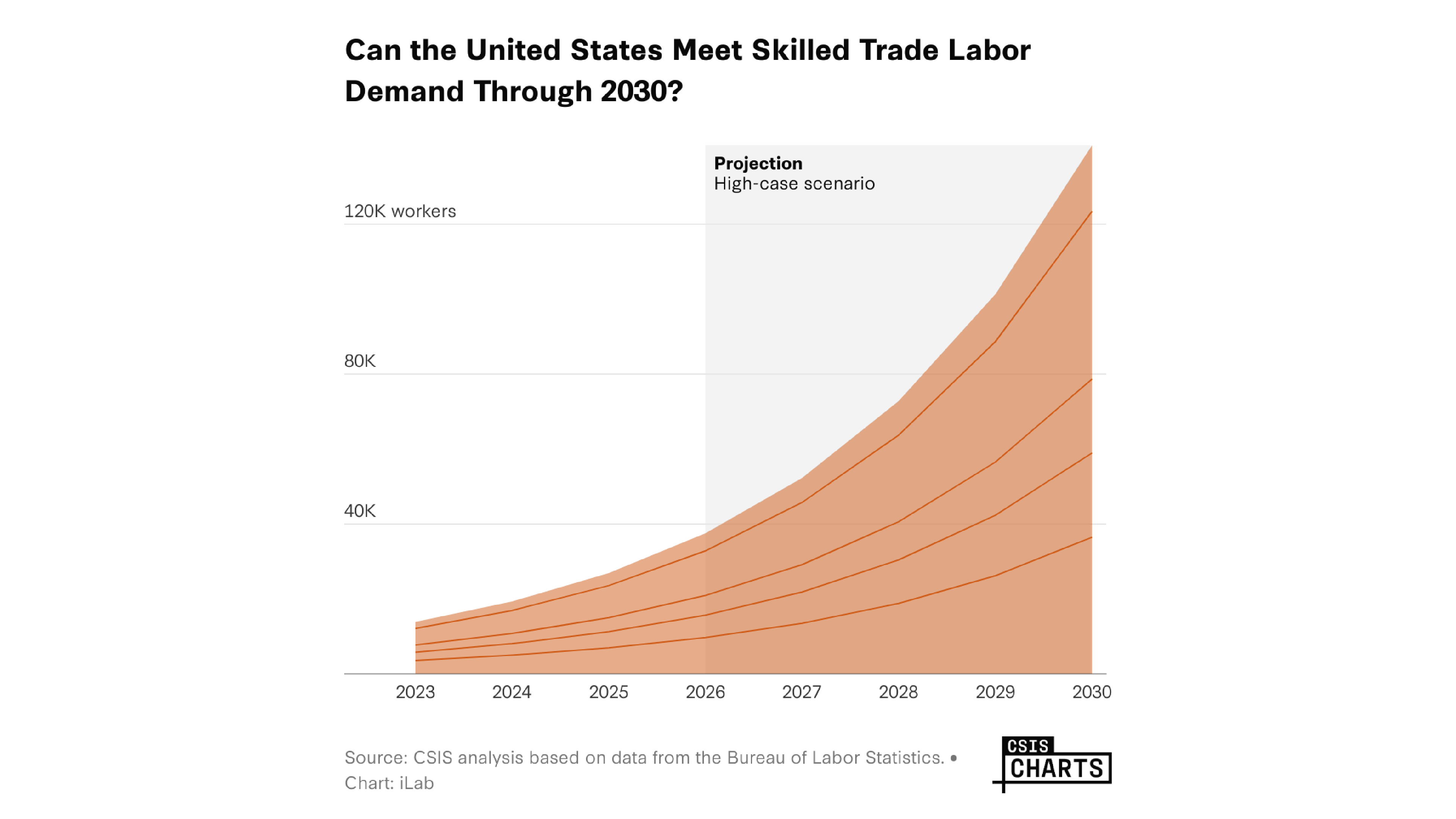
Employers in construction and related fields do appear to be struggling to find workers. The Home Builders Institute’s Fall 2024 report points to workforce needs in residential construction, offering industry-based evidence that recruiting skilled workers is difficult (see Figure 2). Persistent demand for tradespeople can, in principle, give workers more bargaining power. 1
Federal labor-market data are also designed to track the ingredients needed to assess this issue. The Bureau of Labor Statistics’ Occupational Outlook Handbook provides occupation-by-occupation information on pay, job growth, projected openings and education requirements. That makes it a useful source for identifying where demand is strong and whether certain trades are paying more.
There is stronger evidence that vocational education and apprenticeships can offer meaningful routes into work. A meta-analysis of formal vocational education and training found that such programs can improve labor-market outcomes, supporting the idea that trade training has real economic value. 2 That does not mean every program produces the same results, but it does show that vocational pathways can help workers move into jobs.
Employers and public institutions are also maintaining and expanding structured apprenticeship systems. The Department of Labor’s apprenticeship portal and job finder show active registered programs and openings across occupations and locations (see Figure 3). 3 Some programs combine paid workplace training with further education. One documented manufacturing apprenticeship, for example, links hands-on skills with pathways into engineering-technology study.
The case against
The biggest weakness in the claim is the lack of proof that a reported shortage has led to significant wage growth across the skilled trades. Construction-industry reporting is relevant to workforce needs, but it comes from an organization connected to the industry and cannot by itself establish broad wage effects. The federal sources that could provide an independent answer were identified, but the material reviewed did not include trade-specific pay figures, historical wage trends or inflation-adjusted comparisons. 4
That missing information matters. A rise in pay on paper may not amount to a meaningful real-wage gain once inflation is considered. And conditions can differ sharply by trade and region: electricians, welders, construction workers and manufacturing technicians may not face the same demand or receive the same pay increases.
The evidence also does not show a nationwide resurgence of interest in vocational training. Registered apprenticeship programs and advertised positions demonstrate that opportunities exist. They do not show that more people are actually enrolling, completing programs or choosing vocational routes than in previous years. 5
Nor does the record establish that any rise in participation was caused by labor shortages. Enrollment could be influenced by employer recruiting, public subsidies, local economic conditions, changes in reporting or the appeal of particular programs. The vocational-training studies cited focus mainly on the benefits of taking part in training, not on recent U.S. enrollment growth or the reasons behind it.
International research provides another reason for caution. Studies of vocational systems in Kenya, Ireland and Greece show that outcomes depend heavily on national institutions, industries and education systems. Those findings may be relevant background, but they cannot be used to prove current U.S. trade wage gains or shortage-driven enrollment growth. 6
The bottom line
There is credible evidence of workforce needs in the skilled trades and solid support for vocational education and apprenticeships as useful labor-market pathways. Employers are offering structured training, and trade careers can provide value for participants.
But the evidence does not establish that a skilled-trades shortage is significantly raising wages across the sector or causing a broad national revival of interest in vocational training. The crucial missing evidence is long-term, trade- and region-specific data linking shortages to inflation-adjusted wage increases and to actual enrollment or completion trends. Confidence is high in that limited conclusion: the available sources point to the right measures, but do not provide the trend data needed to prove the claim.
Figures & data


All contributions are reviewed for clarity, balance, and evidence. The strongest insights are elevated into the argument graph — with credit to you.
Help improve this analysis →