Whether governments should impose sanctions on individuals or entities involved in West Bank settlement activity
What's this about?
People disagree about whether governments should punish people and groups tied to unlawful or violent settlement acts in the West Bank. The key question is whether these steps can help people without causing wider harm.
What supporters say
- Sanctions can hold people to account when local courts fail to act.
- Focused steps, such as travel bans or money freezes, may help stop harm to people.
- World law groups say the growth of settlements breaks world law.
What critics say
- Sanctions have had mixed results when used to change major government plans.
- Sanctions may cause anger, harm trust, or lead to more harsh rule.
How to read this
The number of points on each side does not show who is right; look at how strong the proof is for each point.
The bottom line
Reports show harm from settlement growth, land loss, attacks, forced moves, and weak local action. World law also gives governments a clear reason to target linked people and groups.
Sanctions may help hold them to account, but we are not sure yet if they will stop the harm. The proof for harm and legal grounds is stronger than the proof that sanctions will change policy.
The question is whether governments should impose targeted sanctions on people and organizations credibly linked to unlawful or violent settlement activity in the West Bank. The case depends both on the need for accountability and on whether sanctions can protect civilians or change behavior without causing wider harm.
The case for
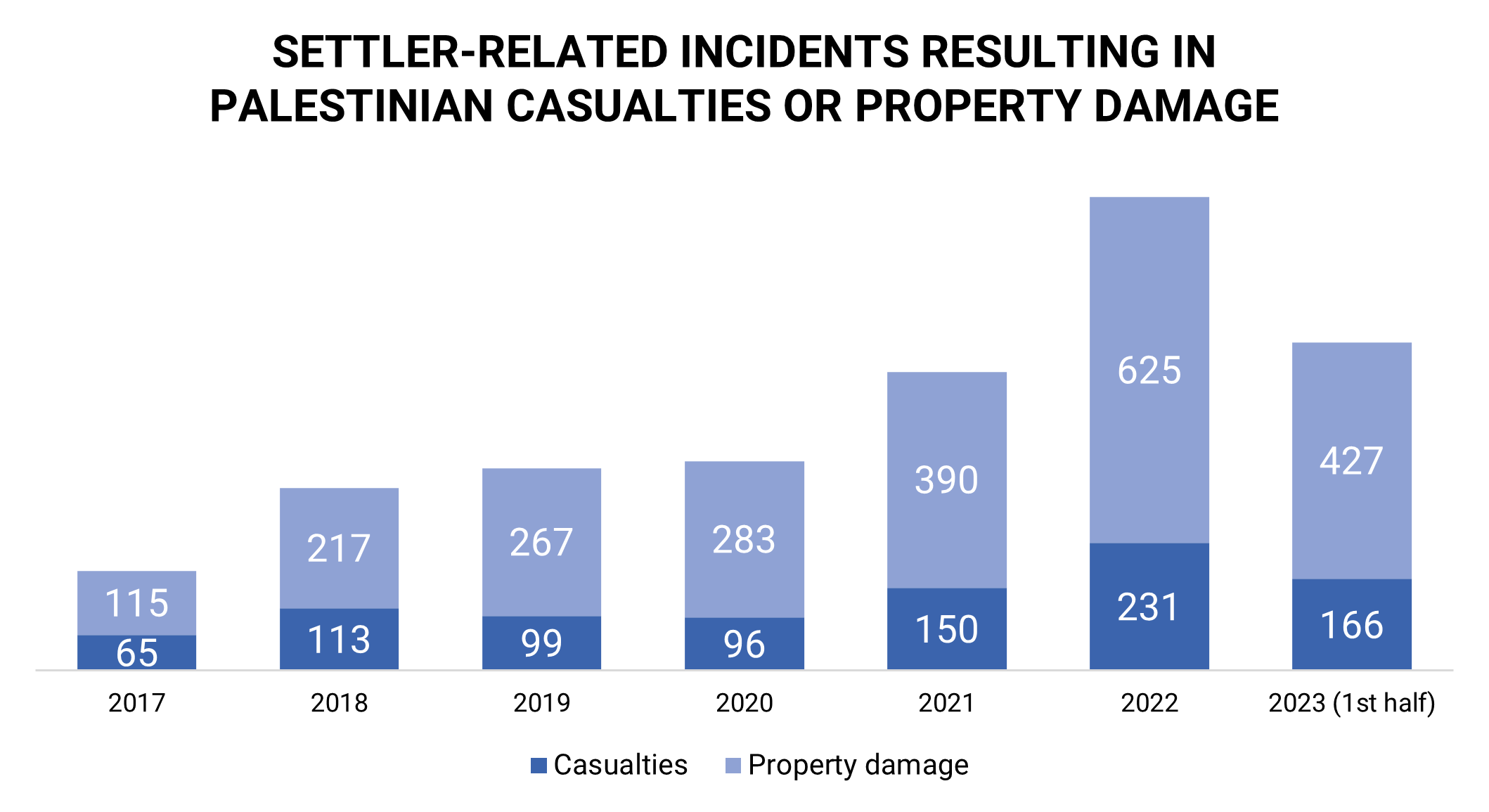
The strongest argument is that sanctions can provide individual accountability when local remedies fail. United Nations human-rights and humanitarian reports describe settlement expansion, land appropriation, settler violence, displacement, access restrictions and property damage, while also reporting inadequate accountability. These findings establish documented harm and a reason to act, even though they do not prove that sanctions will reduce it. The recorded scale and distribution of settler-related incidents provide the clearest basis for a protective rationale. 1 (see Figure 1)
International legal and policy findings also give governments a basis for distinguishing settlement-linked conduct from Israel’s wider population. The International Court of Justice’s 2024 advisory opinion concluded that Israel’s settlement policy and related practices violate international law. Security Council Resolution 2334 said settlements in territory occupied since 1967 have no legal validity and urged states to distinguish Israel from the occupied territories. UN reporting portrays settlement expansion as a broader, structural process affecting communities, rather than a series of isolated violent incidents. 2 (see Figure 2)
Focused measures such as asset freezes and travel or visa restrictions can impose consequences on identified actors without restricting the wider civilian population. UN discussions of targeted sanctions associate them with less humanitarian harm than broad economic sanctions, provided governments use clear criteria, monitoring, exemptions and other safeguards. Such measures may also raise the personal costs of violence and restrict access to international finance and travel. The United States’ West Bank sanctions program, for example, linked settler violence, forced displacement, intimidation and property destruction to threats to peace and security. 3
The case against
The main objection is that sanctions have a mixed record in changing major government policies. Comparative research finds that their results depend on the goal, the strength of the coalition imposing them, enforcement and the target’s vulnerability. Case studies show occasional limits on harmful conduct or contributions to negotiated outcomes, but rarely major success when sanctions are used alone. They may punish selected individuals without reversing settlement expansion or changing the underlying policy. 4 (see Figure 3)
Sanctions can also produce political backlash or encourage repression. Broad or poorly designed restrictions may cause humanitarian, economic and political harm, while even individualized measures can be portrayed as hostility toward Israelis or settlers generally. That could weaken cooperation and make evidence-based enforcement harder. The risks are lower with asset freezes and travel bans than with wide economic restrictions, but they are not eliminated. 5
The evidence also leaves important questions unanswered. There is substantial reporting on settlement-related harm and legal rationales, but little direct evidence showing whether sanctions in this specific setting reduce violence, halt settlement expansion or change government policy. Evasion, mistaken designations, deterrence, coordination and unresolved conflicts of interest in the evidence base all limit confidence about their precise effects.
The bottom line
The evidence favors narrowly targeted sanctions, but only as a proportionate accountability and signaling tool—not as a reliable way to end settlement activity. The support is strongest for documenting harm and justifying consequences for credibly identified actors; it is weaker on whether sanctions will produce meaningful deterrence or major policy change.
Any measures should be evidence-based, individually directed and subject to notice, review, monitoring and humanitarian exemptions. They should target violence, land seizure, financing or facilitation—not Israeli society or the wider economy. Sanctions are more credible as one part of a broader strategy that includes domestic prosecutions, diplomatic pressure, multilateral coordination and action against evasion. Overall confidence is low, because the case for accountability is stronger than the evidence that sanctions themselves will change conduct.
Figures & data

All contributions are reviewed for clarity, balance, and evidence. The strongest insights are elevated into the argument graph — with credit to you.
Help improve this analysis →