The global order is fragmenting into competing blocs
What's this about?
People disagree about whether the world is splitting into rival groups of countries. These groups may trade and work mostly with friends.
What supporters say
- Country politics now affects trade more than it did before.
- Governments add more limits to trade, money, tools, and skills because of rivalries.
- Firms invest less in countries whose leaders disagree with their own leaders.
- The United States and China limit access to high-tech tools with both business and war uses.
What critics say
- The evidence does not show fixed groups that only trade within their own side.
- Countries still trade, invest, and share links across political lines.
- Firms may move some supply chains closer to home without fully leaving other markets.
- Rules for world teamwork face stress, but they still exist and still matter.
The bottom line
The world shows clear signs of strain as countries favor friendly partners. But we cannot yet say it has split into closed, rival blocs.
The world economy is showing clear signs of geopolitical strain, as governments steer trade, investment and technology ties toward friendly partners. But the evidence does not show that the world has already split into fixed, self-contained rival blocs.
The case for
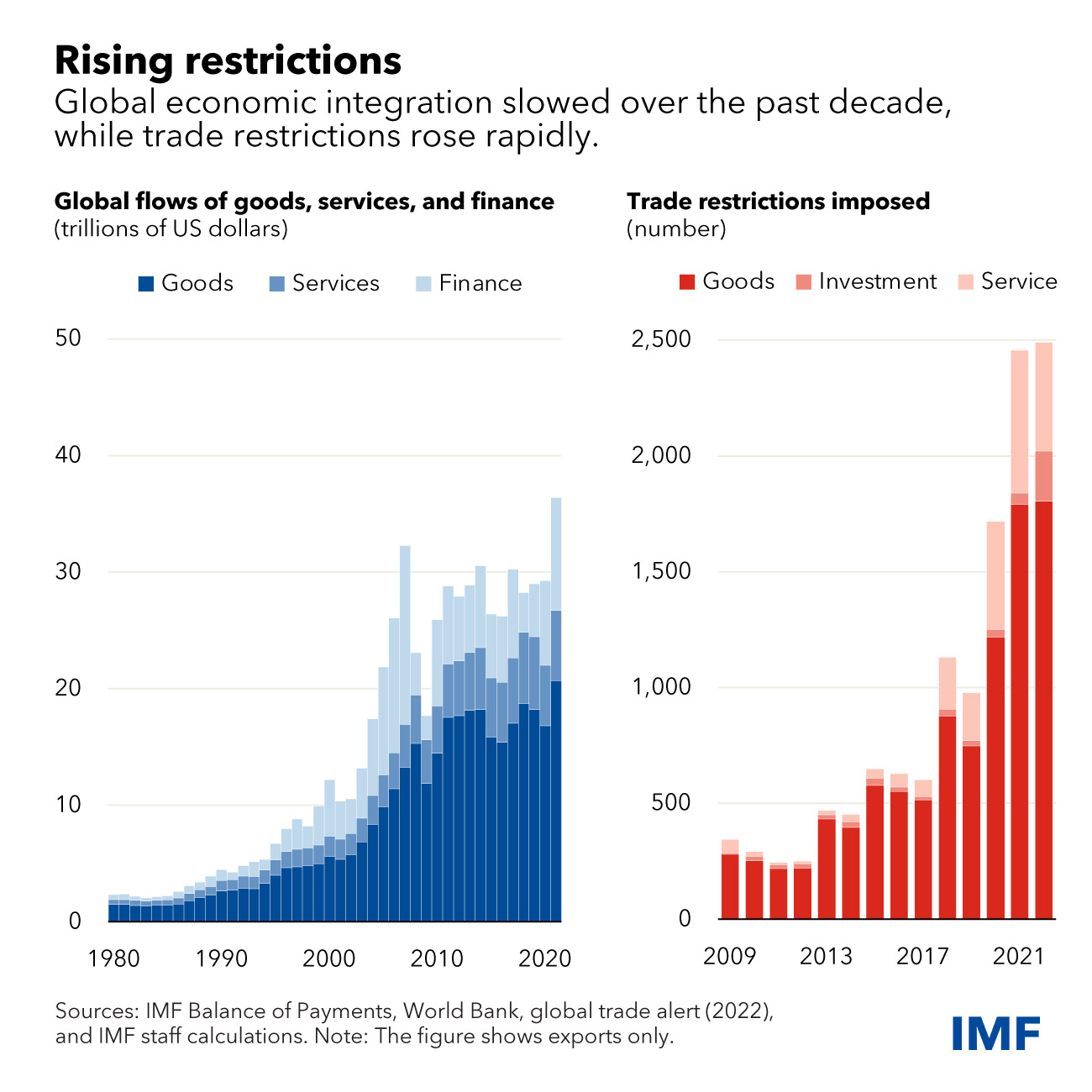
The strongest evidence for fragmentation is that political alignment is increasingly influencing economic decisions. Research finds that countries’ geopolitical distance now matters more for their trade relationships, while the IMF has documented a rise in restrictions tied to geopolitical tensions across trade, investment, technology and finance. This marks a shift away from the idea of politically neutral globalization, even if it falls short of a completed split between rival camps. Economic ties are becoming more vulnerable to strategic rivalry 1.
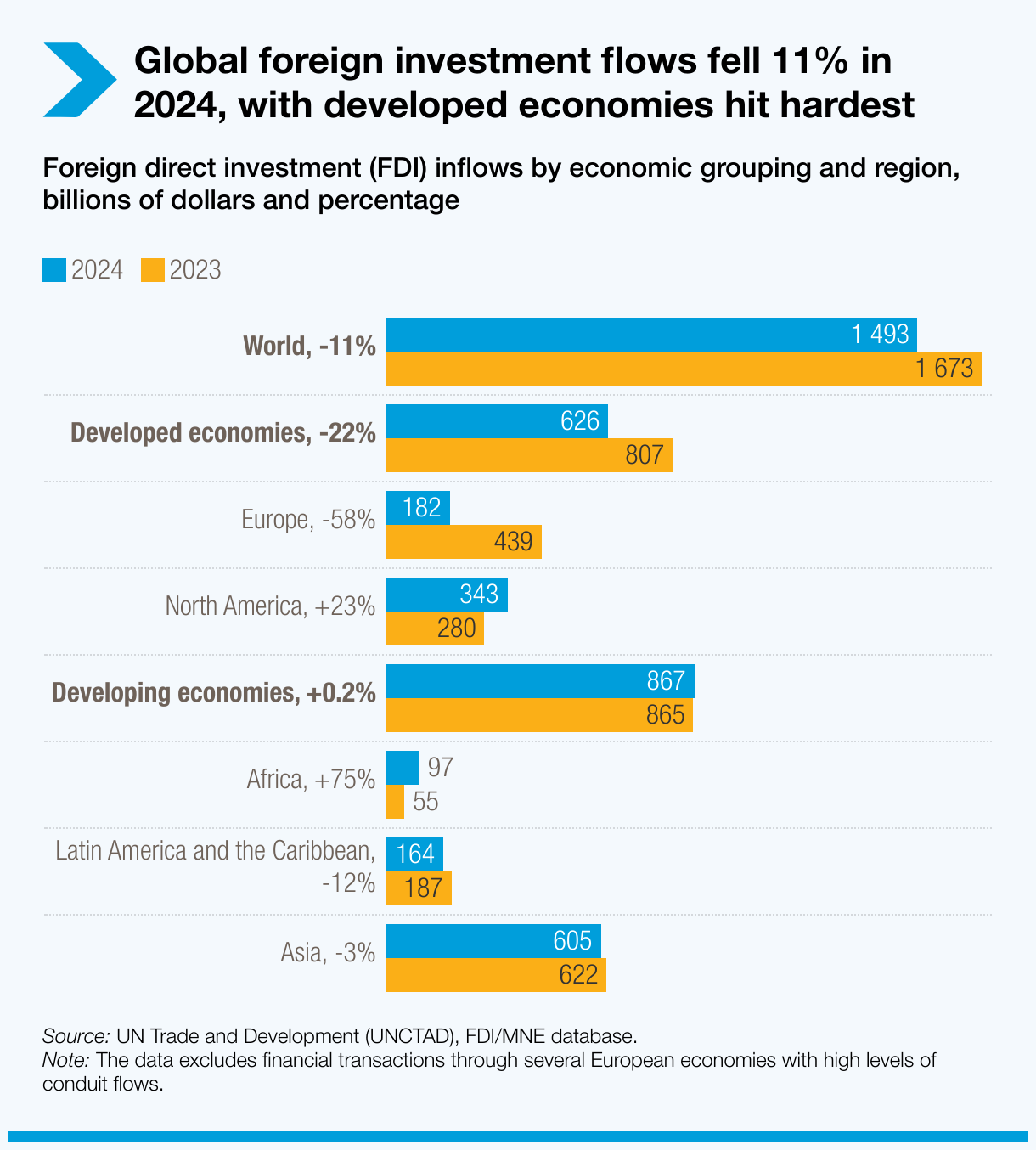
Investment patterns point in a similar direction. The IMF finds that foreign direct investment between politically distant countries has fallen relative to investment among countries that are more closely aligned. UNCTAD has also reported relocation, regional supply chains and strategic concentration as governments and companies respond to tensions, industrial policy and supply-chain risks (see Figure 2). These shifts are consistent with the emergence of economic groupings around major powers 2.
Technology is an especially important front in this trend. Export controls, particularly those involving the United States and China, have changed companies’ access to advanced technology and affected their international business relationships. Because cutting-edge technology has both commercial and military value, governments increasingly treat it as a national-security issue rather than simply another product to trade. Technology controls can deepen strategic separation beyond ordinary trade disputes 3.
The institutions meant to manage global cooperation are also under pressure. The Multilateralism Index reports weaker institutional performance and more political contestation, even as countries continue to take part in international bodies (see Figure 3). That suggests a system that is becoming less effective and more disputed, rather than one that has disappeared altogether 4.
The stakes are high. IMF models indicate that a severe split into rival economic blocs could sharply reduce trade, investment and the spread of technology. Those projections do not prove that such a division has already happened, but they show why the current trend toward alignment matters 5.
The case against
The clearest objection is that the global economy remains deeply interconnected. WTO data show that merchandise and services still move extensively across geopolitical lines, despite tariffs, sanctions and supply-chain changes. A world of truly self-sufficient rival blocs would have far less cross-border exchange. Trade remains substantially global, not confined within political camps 6.
International institutions also retain broad support. The same evidence that shows declining performance finds high levels of participation in multilateral organizations. Countries may be challenging these institutions and using them selectively, but they have not generally abandoned them for exclusive rival systems 7.
Nor does every shift in supply chains or investment mean bloc formation. Companies may move production closer to home, diversify suppliers or reduce risks for reasons that are not primarily geopolitical. UNCTAD attributes changing investment patterns to a mix of tensions, industrial policy and supply-chain concerns, while finding that investment remains globally distributed and international links persist. Regionalization and diversification are not automatically the same as durable geopolitical division 8.
There is also a problem of definition. Studies find evidence that political alignment affects economic flows, but the size of that effect depends on how researchers define geopolitical distance and which flows they measure. It can be difficult to distinguish true fragmentation from ordinary risk reduction, diversification or strategic hedging 9.
The bottom line
The evidence strongly supports the view that the global order is fragmenting in important but selective ways. Political alignment is increasingly shaping trade, investment, technology controls and the effectiveness of multilateral institutions.
But it does not support the stronger claim that the world has already broken into fixed, coherent and economically self-contained competing blocs. Trade and investment still cross political boundaries, international institutions still draw wide participation, and many countries maintain relationships with more than one major power.
The most accurate description is a developing, policy-dependent trend toward fragmentation, not an established bloc system. Whether today’s pressures lead to hardened rival camps, or remain a mix of regionalization, hedging and selective separation, will depend heavily on future policy choices.
Pros — Supporting Arguments
Figures & data

All contributions are reviewed for clarity, balance, and evidence. The strongest insights are elevated into the argument graph — with credit to you.
Help improve this analysis →