Weak economic data lift financial-market valuations when inflation is controlled
What's this about?
People disagree about whether weak economic news can raise market prices when inflation stays under control.
The answer depends on why the news looks weak and what people expect next.
What supporters say
- Weak reports can make people expect lower interest rates from the central bank.
- Lower rates can make future company profits look worth more today.
- Stocks and bonds can move before the central bank actually cuts rates.
- Poor jobs news can lift stocks if people think rate cuts will soon follow.
What critics say
- Weak news can also warn that firms may sell less in the future.
- Lower sales can lead to lower profits, which can hurt stock prices.
- Weak growth can make loans harder to get, adding stress for firms and families.
- Rate-cut hopes may not help if people fear a deep economic slump.
The bottom line
Weak economic data can lift market prices when it makes rate cuts seem more likely.
But this does not happen every time, because weak data can also signal lower profits and more risk.
Weak economic reports can sometimes lift markets, even when the economy itself is slowing. The reason is that investors may see softer data as a signal that central banks can cut interest rates—but that reaction is conditional, not automatic.
The case for
The strongest argument rests on interest rates. When investors expect lower rates in the future, the value today of companies’ future profits and bonds’ future payments can rise. Studies of unexpected Federal Reserve easing have generally found that stock prices increase after such surprises, largely because investors revise their expectations for returns and, to a lesser degree, corporate cash flows 1 (see Figure 1).
Markets do not need to wait for an actual rate cut to react. Central-bank statements and changes in expectations about future short-term rates can move stocks and bond yields immediately. If weak economic data leads investors to expect an easier policy path, bond yields may fall and asset valuations may rise before policymakers act 1 (see Figure 3).
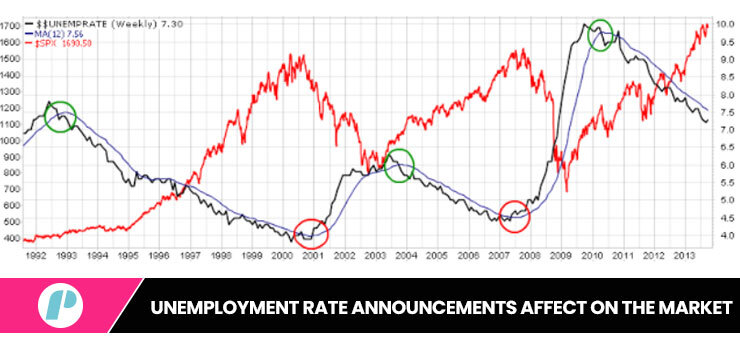
Employment reports provide one of the clearest examples of this “bad news is good news” pattern. Research has found episodes in which stocks rose after disappointing jobs data, as investors concluded that weaker hiring or higher unemployment made easier monetary policy more likely 2 (see Figure 2). Recent market commentary around weak US jobs reports has also linked such data to rising expectations of Federal Reserve rate cuts.
The evidence is especially direct for bond markets. A Bank for International Settlements study found that bond-yield reactions to economic announcements depend on how the news changes forecasts for growth, inflation and central-bank policy. Weak data can therefore push yields lower when it persuades markets that rate cuts are more likely.
The case against
The problem is that weak economic news does more than affect rate expectations. It can also point to lower future sales and profits, tighter credit conditions, and greater worries about recession. Those effects can reduce valuations or increase the extra return investors demand for taking risk—known as the risk premium—offsetting the benefit of lower expected interest rates 3.
Federal Reserve research warns that economic releases send several messages at once. A weak growth figure may suggest easier monetary policy, but it may also signal weaker corporate earnings and broader financial stress. As a result, a favorable market reaction does not necessarily mean that investors believe the underlying economy has improved.
Nor is the “bad news is good news” response stable over time. Later research found that the earlier tendency for stocks to rise on bad employment news changed across periods, suggesting that investors’ interpretation depends heavily on the inflation backdrop and the expected response from policymakers 4. When inflation is under control and a central bank is seen as ready to ease, weak data may be welcomed. When investors fear a serious downturn—or doubt that policymakers can cut rates—the same report may hurt markets.
Research on monetary-policy announcements adds another caution. Estimated stock-market effects vary depending on the period studied, the measure of policy used, market conditions and the information conveyed by the central bank. Much of the strongest evidence shows that policy surprises move markets. It is less conclusive on whether a specific weak data release reliably causes investors to expect cuts and raises valuations.
The bottom line
The evidence supports a plausible and repeatedly observed mechanism, not a general market rule. Weak economic data can lift financial-market valuations when investors mainly read it as a disinflationary signal that will bring a predictable path of rate cuts.
But that outcome requires the boost from lower expected discount rates to outweigh weaker expected earnings, higher risk premiums and fears of a damaging slowdown. Confidence is high that changing rate expectations affect asset prices, and that weak jobs news has sometimes worked through this channel. The key uncertainty is whether, in any particular economic and policy setting, markets will focus more on prospective rate cuts or on the economic damage implied by the weak data.
Pros — Supporting Arguments
Cons — Opposing Arguments
Figures & data

All contributions are reviewed for clarity, balance, and evidence. The strongest insights are elevated into the argument graph — with credit to you.
Help improve this analysis →