The U.S. should implement fiscal reforms to reduce its national debt
What's this about?
People disagree about whether the U.S. should change its money rules to lower its huge debt.
The goal means fixing money troubles without hurting jobs, growth, or people with less money.
What supporters say
- Experts expect U.S. debt to keep rising unless leaders change current money rules.
- Lower debt could give leaders more money for schools, aid, and help during hard times.
- Early plans could help handle future costs from older people, health care, and storm damage.
What critics say
- Fast cuts in public spending could slow jobs, sales, and growth.
- Some money changes could make unfair gaps between rich and poor even wider.
- Debt levels do not show one clear point where a country suddenly faces great danger.
How to read this
The number of points on each side does not show who is right; strong proof matters more than a long list.
The bottom line
The evidence clearly supports slow, careful reforms because U.S. debt will likely keep rising.
But the evidence does not support fast cuts across the board, which could hurt growth and poorer people.
The United States should pursue fiscal reforms to stabilize and eventually reduce its national debt—but the evidence does not support rapid, across-the-board austerity. The central question is how to improve the country’s finances without causing unnecessary damage to growth or widening inequality.
The case for
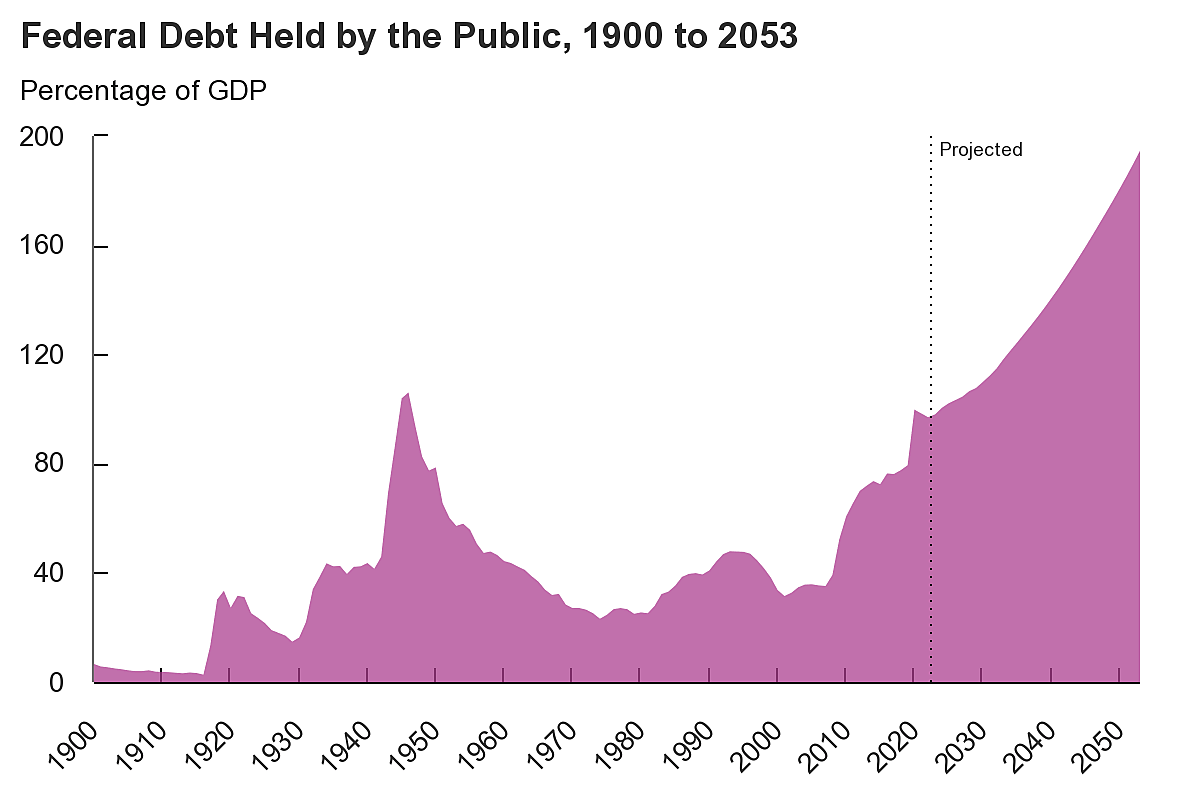
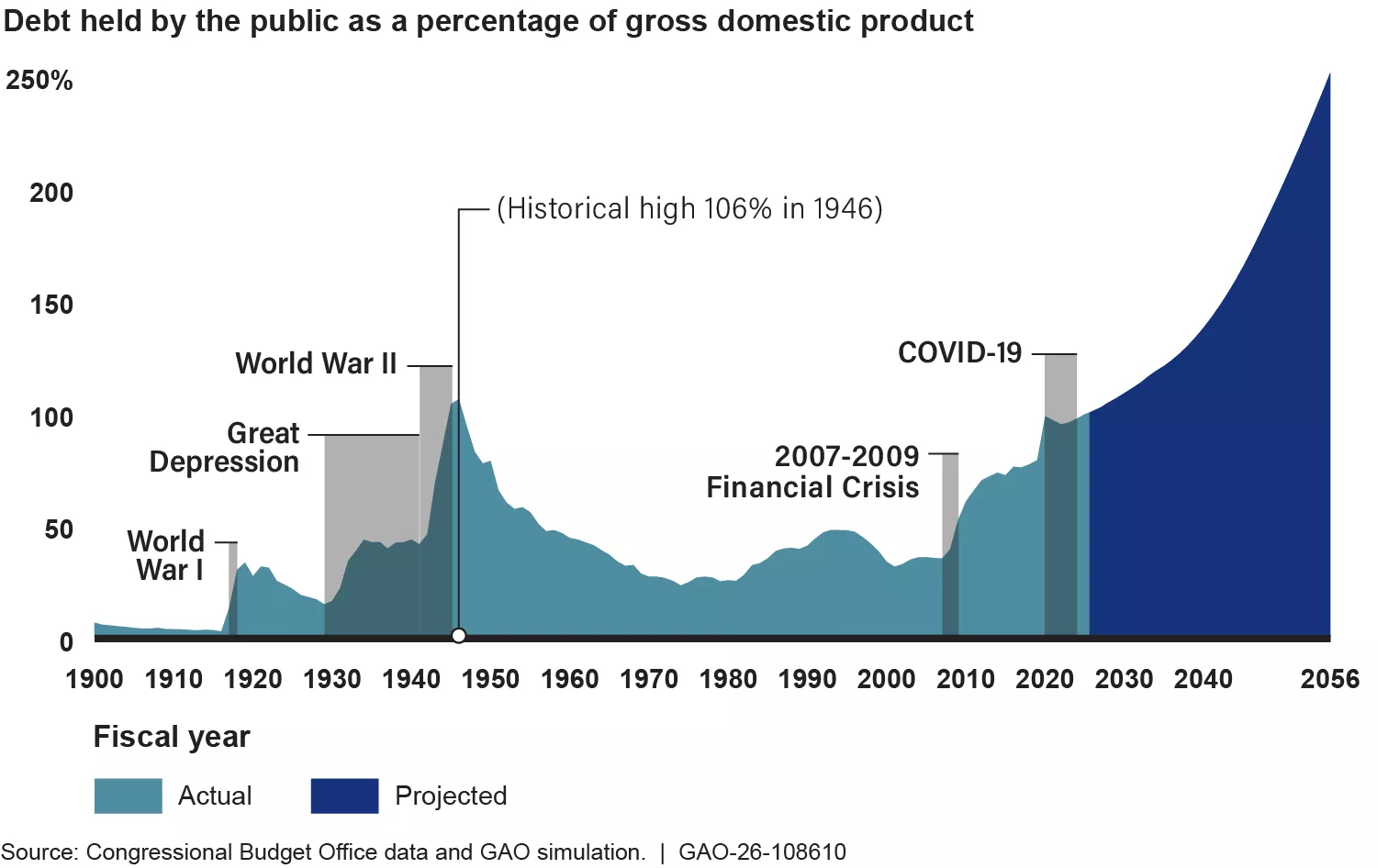
The strongest argument for reform is that federal debt is projected to keep rising under current policies. Persistent budget deficits, higher interest costs, Social Security and major health programs are driving long-term pressure. The Congressional Budget Office projects that debt held by the public will rise relative to the economy, while current policies fail to stabilize the debt ratio (see Figure 2). The Social Security and Medicare trustees have also warned about financing problems in those programs. 1
Reducing debt over time could preserve the government’s future fiscal room. As interest payments consume more of the budget, fewer resources remain for public services, investment or emergency action. The CBO projects rising debt-service costs, and the OECD says high debt can limit a government’s ability to respond to recessions, disasters or other crises. But the OECD also stresses that the effect depends on interest rates, economic growth, public institutions and how governments use borrowed money. 2
Early planning may also help address future pressures. An aging population is expected to increase spending on retirement and health programs, while climate-related damage could add to government costs. That gives lawmakers a reason to act before fiscal adjustments become more abrupt. Still, the evidence is stronger on the existence of these pressures than on the exact reforms needed to manage them. 3
The case against
The main objection is not that fiscal reform is never justified, but that fast or poorly designed cuts can weaken the economy. Research and economic models generally find that fiscal consolidation reduces demand in the short term. The effects can be larger during recessions, especially when central banks have little ability to offset the impact with lower interest rates. 4
Nor does the debt-to-GDP ratio provide a simple alarm bell. A widely cited study linked very high debt levels to weaker growth, but later criticism found coding and methodological errors and produced notably different results. That means no single debt threshold can automatically prove that immediate austerity is the right response. The risks depend on borrowing costs, growth, institutions and what the government is financing. 5
Fiscal reforms can also place an uneven burden on households. Cutting transfers or public services may hurt lower-income families most, even if the measures improve the budget balance. International Monetary Fund analysis finds that consolidation can increase inequality in the short term, although the effects vary according to the policies used. Reforms without protections for vulnerable people could therefore increase poverty or reduce access to essential services. 6
The bottom line
The evidence favours fiscal reform, but only conditionally. There is strong evidence that U.S. debt is on an unsustainable upward path under current policies, and some evidence that stabilizing debt would preserve economic and political flexibility. The evidence against reform is weaker overall, but it identifies serious risks when adjustment is rushed, indiscriminate or poorly targeted.
The best-supported position is gradual debt stabilization through a credible medium-term plan, not immediate across-the-board austerity. Lawmakers could combine targeted revenue increases or entitlement changes with protection for vulnerable households and continued investment in areas that support growth. The evidence does not identify one ideal package or pace, so confidence is high in the diagnosis of rising fiscal pressure but only moderate in the precise policy prescription. The unresolved issue is whether lawmakers can design reforms that reduce future debt while limiting harm to growth and inequality.
Figures & data
All contributions are reviewed for clarity, balance, and evidence. The strongest insights are elevated into the argument graph — with credit to you.
Help improve this analysis →