The Trump administration’s immigration crackdown has increasingly targeted legal immigration pathways
What's this about?
People disagree about whether Trump’s team has aimed its crackdown at legal ways to enter or stay in America.
The main question is whether this goes beyond people who cross the border without legal papers.
What supporters say
- Trump’s plan also touched rules that protect some people seeking citizenship, the legal right to be a citizen.
- Border rules made it harder for some people to seek asylum, a safe place from harm.
- The team ended or weakened short-term entry plans for some people, called parole.
- The team stopped refugee entry for a time, blocking a legal way for refugees to come.
What critics say
- Courts often blocked the new limits, or judges asked the courts to review them.
- Short-term aid plans do not all count as full legal paths to live in America.
- Most actions still aimed at people who came without legal papers.
How to read this
The number of points on each side does not show who is right; look at how strong the proof is.
The bottom line
The proof most clearly shows attacks on refugee and other aid-based legal paths.
But the proof does not show an attack on every legal way to enter or live in America.
The Trump administration’s immigration crackdown has reached beyond unauthorized migration in some important ways. The evidence is strongest for humanitarian routes and protections, but it does not show an across-the-board attack on every form of legal immigration.
The case for
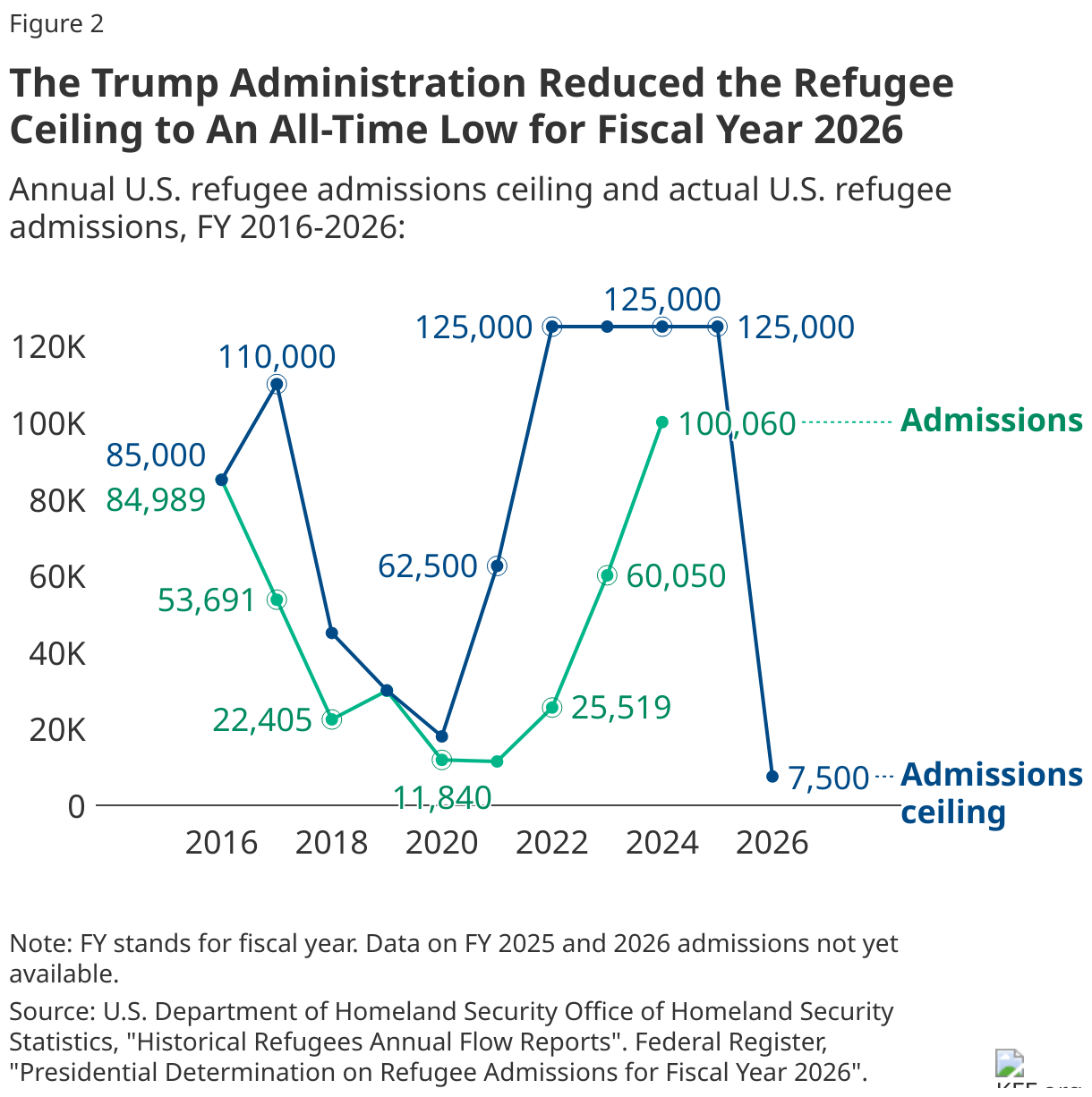
The clearest evidence comes from direct action against lawful humanitarian programs. In January 2025, the administration suspended the U.S. Refugee Admissions Program and ordered a reassessment. That interrupted a formal, legally authorized route for refugees to enter the country, and implementation documents recorded disruption to refugee-processing operations. 1 (see Figure 1)
The administration also moved to end or narrow humanitarian parole programs, including the CHNV process. That program allowed eligible people to enter temporarily and receive work authorization under legal discretionary authority. Ending or weakening it made a lawful route less available and less secure, even though parole is temporary and is not the same as a permanent visa. 2
Border-enforcement policies also made it harder for some people to seek asylum, a legal protection process. Increased detention, rapid removal and limits on access to asylum-related procedures brought lawful protection seekers within the reach of the crackdown. The evidence is strongest at the border, rather than showing that every kind of asylum case inside the United States was restricted in the same way. 3
Other measures added burdens without abolishing legal categories. Expanded reviews of applicants’ online activity, along with broader security and eligibility checks, could delay or complicate visa processing. That supports a broader definition of “targeting,” in which administrative friction and uncertainty count even when visa categories remain open. 4
The administration’s agenda also touched a citizenship-related protection through its attempted restriction of birthright citizenship. Courts blocked the initiative, so it did not produce a lasting change. Still, its subject matter suggests that the administration’s stated and attempted policies were not limited to removing people classified as unlawfully present. 5
Taken together, the actions span refugee admissions, humanitarian parole, asylum access, visa processing and citizenship-related protections. That pattern supports the claim that the crackdown increasingly affected several lawful pathways, not just unauthorized migration.
The case against
The strongest enforcement measures were still aimed chiefly at border control, detention, removal and deterrence of people considered unlawfully present. The evidence does not show a broad or uniform reduction in ordinary family-based or employment-based permanent immigration. 6
There is also an important question of definition. Refugee resettlement, asylum and humanitarian parole are legally authorized, but they are not interchangeable with permanent immigration categories. Treating restrictions on temporary or discretionary humanitarian routes as proof that all legal immigration was targeted would go too far. 7
Announced policies do not always become lasting policy. Courts blocked the birthright-citizenship order, while parole measures faced litigation. Short-term disruption and government intent therefore cannot automatically be counted as permanent reductions in legal status or admissions. 8
The available record also does not provide a complete category-by-category comparison of visa approvals, denials, processing times, refugee admissions, parole entries and asylum outcomes before and during the administration. Policy documents show authority and intent, while institutional and advocacy reports provide implementation details but may emphasize the effects on immigrants. Those reports can still contain valuable facts, but broader conclusions would be stronger with independent, long-term government data.
The bottom line
The evidence favours the claim, but not without important limits. Confidence is high that the administration increasingly targeted several lawful humanitarian pathways, especially refugee admissions and parole. There is also some evidence that asylum access and visa processing faced new burdens.
But the evidence is weaker for the broader claim that the administration imposed a uniform crackdown on all legal immigration. It does not establish a comparable contraction across ordinary family- and employment-based immigration. The best-supported conclusion is therefore that the administration targeted lawful pathways in a broad sense—particularly humanitarian ones—while the size and durability of the effect on legal immigration as a whole remain uncertain.
Figures & data
All contributions are reviewed for clarity, balance, and evidence. The strongest insights are elevated into the argument graph — with credit to you.
Help improve this analysis →