The EU AI Act is unfairly burdening US tech companies with compliance costs
What's this about?
People disagree about whether the EU AI Act makes US tech firms pay unfairly high costs. The law sets rules for AI sold or used in Europe.
What supporters say
- US firms must follow the law when their AI reaches Europe, even if they work mostly in America.
- Companies may need to spend money on risk checks, clear user facts, records, and expert staff.
- Big makers of AI that creates text or images face extra rules about copyright and model details.
- Large firms also face big possible fines, so they may spend more early to avoid breaking rules.
What critics say
- The law does not single out US firms; Europe-based firms must follow the same rules for similar AI.
- Real costs do not prove unfair treatment when every company needs to meet the same safety rules.
- Small firms may struggle most because they lack large law, safety, and tech teams.
- Business groups warn about delays and trade fights, but these claims show fears, not firm proof.
The bottom line
The EU AI Act creates real costs for US tech firms that want to sell AI in Europe. But the facts do not show that Europe unfairly targets US firms over similar Europe-based rivals.
The EU AI Act imposes real costs on American technology companies that sell AI products in Europe. But the evidence does not show that the law unfairly targets US firms, or that they face worse treatment than comparable European competitors.
The case for
The law reaches beyond the EU’s borders. US companies can face its requirements when they place AI systems on the EU market, use them in Europe, or produce outputs used there—even if their headquarters and much of their infrastructure are outside the bloc. That can mean spending on technical documentation, risk management, transparency, monitoring, and new legal and engineering oversight. For firms seeking access to Europe’s market, these are genuine compliance costs. 1
The burden may be most visible for large US developers of generative AI and so-called general-purpose models. These companies are especially likely to fall under rules requiring technical information for customers, copyright policies, and documentation. Models deemed to pose systemic risks can also face extra testing and risk-reduction duties, while the EU’s AI Office acts as an important regulator for such providers. 2
Potential fines add to the pressure. The Act allows penalties linked to worldwide annual turnover, raising the possible cost of breaking the rules for large multinational businesses. Maximum fines are not the same as actual costs, but the prospect of them can encourage companies to invest early in reviews, controls, audits and record-keeping. 3
Smaller companies may face a different problem: fixed compliance demands can weigh more heavily on firms without large legal, safety and technical teams. Conformity assessments, governance systems, specialist staff and documentation may delay launches or make it harder for new entrants to compete. Business groups have also warned of uncertainty and possible trade friction. But those submissions mainly show what affected companies fear; they are advocacy evidence, not independent measurements of actual costs. 4 5
The case against
The strongest response is that the AI Act is formally nationality-neutral. Its rules are based on what a company does, the AI system it offers, and the level of risk involved—not whether the company is American, European or from elsewhere. EU firms in comparable roles face the same substantive duties and the same penalty structure. 6
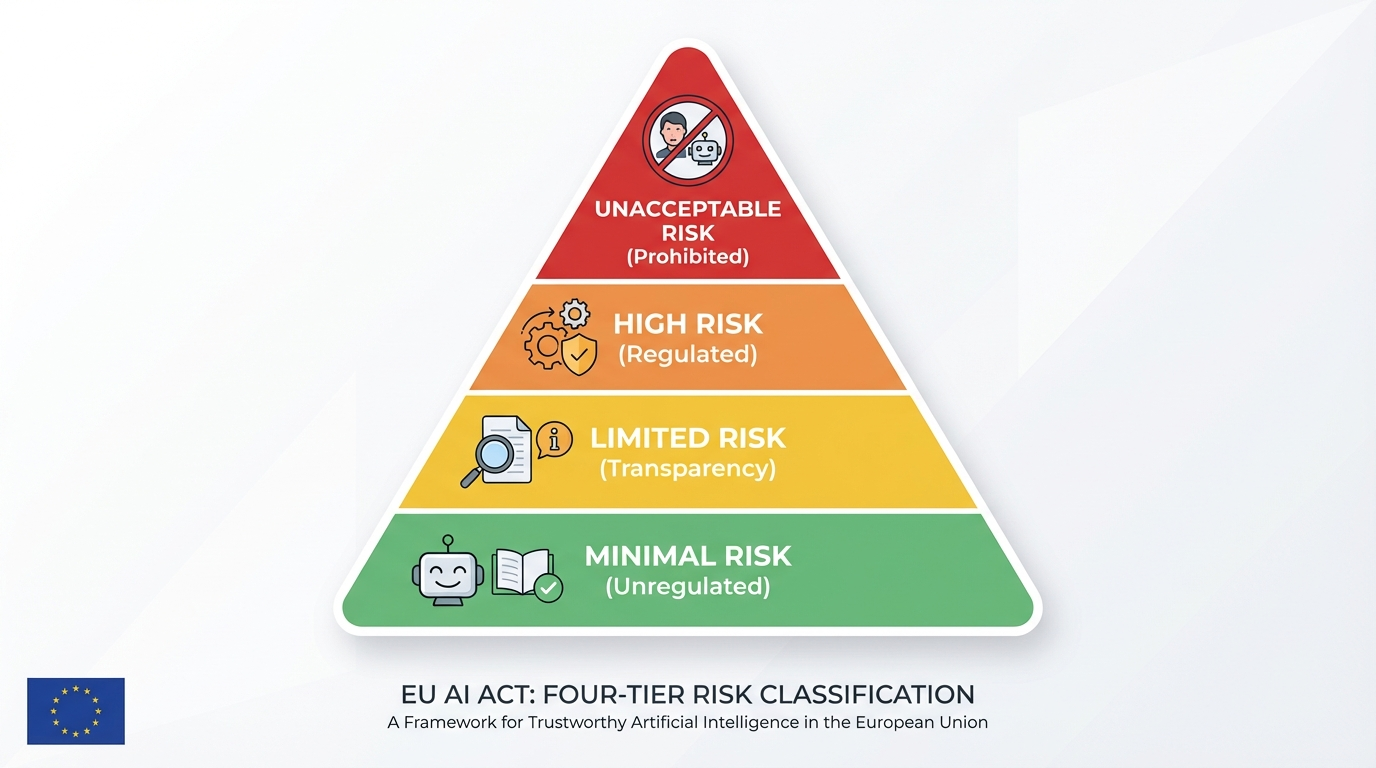
The strictest obligations are not imposed on every AI product. The Act distinguishes between prohibited systems, high-risk uses, transparency-related uses and less regulated applications. The heaviest requirements focus on high-risk systems and certain general-purpose models, rather than applying equally across the industry (see Figure 1). That means the real-world burden depends largely on a company’s product line and place in the AI supply chain, not simply on where it is headquartered.
Large technology companies may also be better placed to absorb compliance work than smaller rivals. Many already have legal, cybersecurity, safety and governance teams that can spread fixed costs across global operations. That does not make compliance cheap, but it weakens the argument that large US companies are uniquely disadvantaged. 7
There may also be benefits from one EU-wide rulebook. A harmonized system can reduce the need to navigate differing national regulations across the single market, improving predictability for companies operating in several European countries (see Figure 2). The Act also includes measures meant to soften its effects on smaller businesses, including attention to the needs of small and medium-sized providers, regulatory sandboxes, computing access, funding and other startup support. 8 9
The bottom line
The evidence strongly supports the view that the EU AI Act creates real, and at times substantial, compliance obligations for US technology companies serving Europe. Those effects may be concentrated among American firms because many leading frontier AI developers are US-based.
But that is not the same as proving unfair treatment. The law applies by role, activity and risk level, and the available evidence does not show that US firms face different legal rules from similarly situated EU firms. Crucially, there is no independent, post-implementation comparison of actual compliance spending, market effects or enforcement outcomes for US companies versus European competitors.
So the claim is only partly supported: US firms may bear heavy costs, but there is insufficient evidence that the costs are discriminatory or demonstrably unfair.
Pros — Supporting Arguments
Figures & data

All contributions are reviewed for clarity, balance, and evidence. The strongest insights are elevated into the argument graph — with credit to you.
Help improve this analysis →