Privacy-limited CBDCs have lower retail payment costs
What's this about?
People disagree about whether privacy-limited CBDCs have lower retail payment costs. A CBDC is digital money that a central bank creates.
What supporters say
- A CBDC could push card firms to cut fees when shops gain another way to take payments.
- Direct payments in central-bank money could skip some costly steps in today’s payment chain.
- The digital euro plan would give people free basic use and cap fees for shops.
- Some designs give small or offline payments more privacy, while still checking for dirty money.
What critics say
- We have no direct proof that CBDCs cut the average total cost of all shop payments.
- Savings only happen if a CBDC replaces costly steps, rather than adding new steps.
- A low fee for users does not prove that the whole payment system costs less.
- CBDC plans need many people to use them and work well with other payment tools.
The bottom line
Privacy-limited CBDCs could cut some fees, mainly for shops and people making payments. But we do not yet know if they make all retail payments cheaper than current digital choices.
Privacy-limited central bank digital currencies, or CBDCs, could reduce some payment fees, especially for merchants and consumers. But the evidence does not yet show that they lower the average total cost of retail payments compared with existing digital options.
The case for
A CBDC gives the public a payment option backed by the central bank. That could put pressure on private payment firms to cut their prices, particularly in markets where card networks or other providers charge substantial merchant fees. IMF work suggests such public competition can improve outcomes, though the effect depends heavily on adoption, interoperability and how the system is run 1.
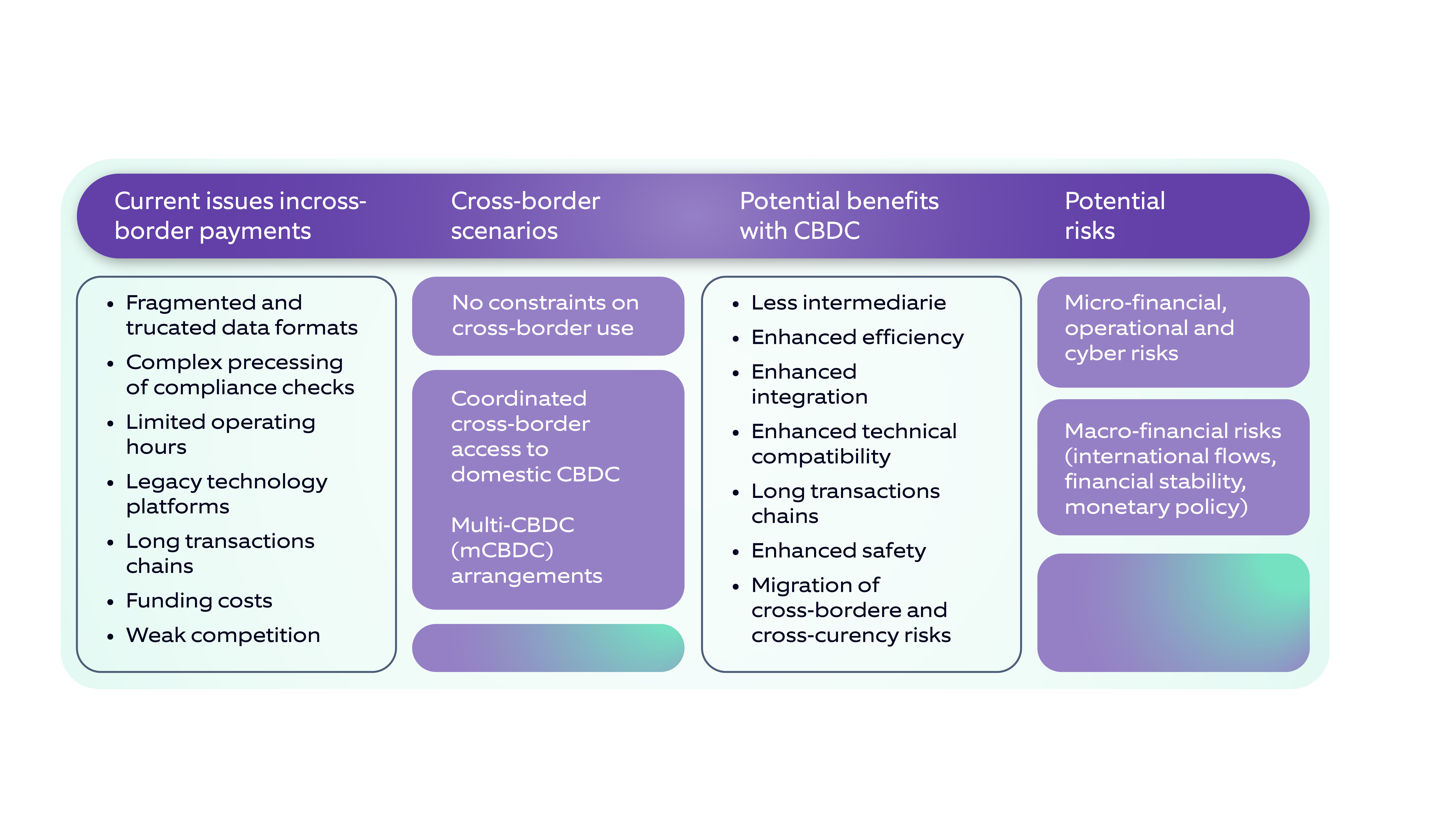
The potential savings are clearest when a CBDC replaces an expensive part of today’s payment system. Because payments could settle directly in central-bank money, the system may avoid some private-network arrangements and reduce payment friction 2 (see Figure 3). But those gains are not automatic: they are strongest when the CBDC replaces existing costly functions rather than simply adding another layer to the same delivery chain.
The proposed digital euro shows how governments could make savings visible to users. Its basic services for individuals would be free, while charges to merchants and payment providers would be capped. That could lower the fees paid on transactions covered by the scheme, even if it does not prove that the whole system costs less to operate.
Privacy protections do not necessarily mean every transaction would be hidden from authorities. Designs being considered for the digital euro and used in China’s e-CNY include more private treatment for certain low-value or offline payments, alongside legal checks in other cases. Tiered wallets and authorised operators are intended to balance privacy with anti-money-laundering rules, rather than impose universal surveillance 3.
The case against
The biggest problem for the claim is straightforward: there is no direct real-world evidence showing that privacy-limited CBDCs have reduced average retail-payment costs compared with cards, bank transfers or other digital methods 4. Pilot programmes in the Bahamas and Thailand offer evidence on use and operation, but not a mature, like-for-like comparison of costs across payment methods.
Much of the favorable evidence is instead based on models, design proposals or early-stage pilots. Those sources identify possible benefits, but they also say outcomes depend on whether people adopt the CBDC at scale, whether it works smoothly with other systems, and whether the market has enough competition. A pilot is not the same as a full national cost test.
Privacy safeguards and financial-crime controls may also add substantial costs. A CBDC needs systems for identity checks, data governance, security, resilience, fraud prevention, monitoring and, in some cases, offline payments. These requirements can create ongoing compliance and operating expenses rather than eliminate them 5.
Nor would private intermediaries necessarily vanish. The proposed digital pound would retain private providers for customer-facing services, while China’s e-CNY uses authorised operators and tiered-wallet arrangements. The digital euro, too, would rely on distribution systems and merchant compensation. In other words, a public settlement rail may remove some middlemen while keeping others in place 6.
Existing payment methods are also changing. Account-to-account “pay-by-bank” payments, for example, can avoid some card-network and interchange charges and may offer merchants a lower-cost alternative without a CBDC. Several payment methods are likely to coexist, meaning a CBDC would compete against systems that may themselves become cheaper 7.
The answer also depends on what “cost” means. A government can make a basic CBDC free for consumers or cap merchant fees, but that only establishes the price users see. It does not prove lower economy-wide costs once infrastructure, security, compliance, subsidies and provider compensation are included. European studies show that cost rankings vary by country, payment type, transaction size and accounting method (see Figure 2).
The bottom line
The evidence is mixed, but does not establish the claim. Privacy-limited CBDCs could cut visible fees in particular designs and markets, especially if they increase competition or replace costly payment functions. Yet there is no supplied evidence from mature, large-scale deployments showing that they lower average retail-payment costs versus existing digital methods.
The main uncertainty is not a lack of plausible arguments. It is the lack of a common, real-world comparison that counts all relevant costs—including infrastructure, compliance, fraud, resilience and intermediary services—across CBDCs and their evolving alternatives. High confidence: any cost advantage remains conditional on design, adoption, market structure, jurisdiction and the measure of cost being used.
Pros — Supporting Arguments
Cons — Opposing Arguments
Figures & data

All contributions are reviewed for clarity, balance, and evidence. The strongest insights are elevated into the argument graph — with credit to you.
Help improve this analysis →