Central bank digital currencies (CBDCs) will enhance financial inclusion globally
What's this about?
People disagree about whether CBDCs, or digital money run by a nation’s central bank, will help more people use money services. They could help in some places, but we cannot say they will help everywhere.
What supporters say
- CBDCs could give people a low-cost way to send and get money when other payment apps cost too much.
- A public digital wallet could help people use payments if it connects well with other money systems.
- States could use CBDCs to send aid money or support payments faster to people who already use digital money.
- CBDCs might work with weak internet or no internet, which could help people in far-off areas.
What critics say
- Many nations already helped more people use money services without CBDCs, through banks, phone money, and aid plans.
- A CBDC needs safe phones or cards, shops that accept it, fraud checks, and helpful support staff.
- A CBDC may not send aid better than bank accounts, phone-money groups, or current state payment plans.
- A new digital money tool alone cannot fix gaps in internet, phones, trust, or money skills.
The bottom line
CBDCs could make payments easier for some people, if nations design them well. But the facts do not show that CBDCs will improve financial inclusion around the world.
Central bank digital currencies, or CBDCs, are often presented as a way to bring more people into the formal financial system. But while they could help in some places, the evidence does not show that they will improve financial inclusion worldwide.
The case for
CBDCs could make basic digital payments cheaper and easier to access, especially where private services are expensive, unavailable or poorly connected. A public digital wallet that is low-cost, widely available and able to work with other payment systems could give more people a practical way to send and receive money. International institutions and academic studies identify lower fees and broader payment access as real possibilities, though not guaranteed outcomes. 1
They could also improve the delivery of state support. A CBDC might provide a direct channel for welfare payments, emergency aid and other public transfers, potentially helping governments send money faster and reach people already able to use digital financial services. 3 But the evidence does not show that CBDCs do this better than existing bank accounts, mobile-money networks or government payment systems.
Another possible benefit is offline or low-bandwidth use. If designed to function during internet outages or in places with weak connectivity, CBDCs could extend payment options to remote communities that conventional online services do not reliably reach. 2 Yet technical capability alone is not enough. Such systems still need secure devices, merchant acceptance, fraud protection, customer support and the capacity to operate at scale.
The case against
The strongest objection is that many countries have already made major inclusion gains without CBDCs. Bank accounts, mobile money, digital payments and government-transfer programs have expanded access in many settings (see Figure 2). That weakens the idea that a CBDC is necessary, rather than simply one option among many. 4
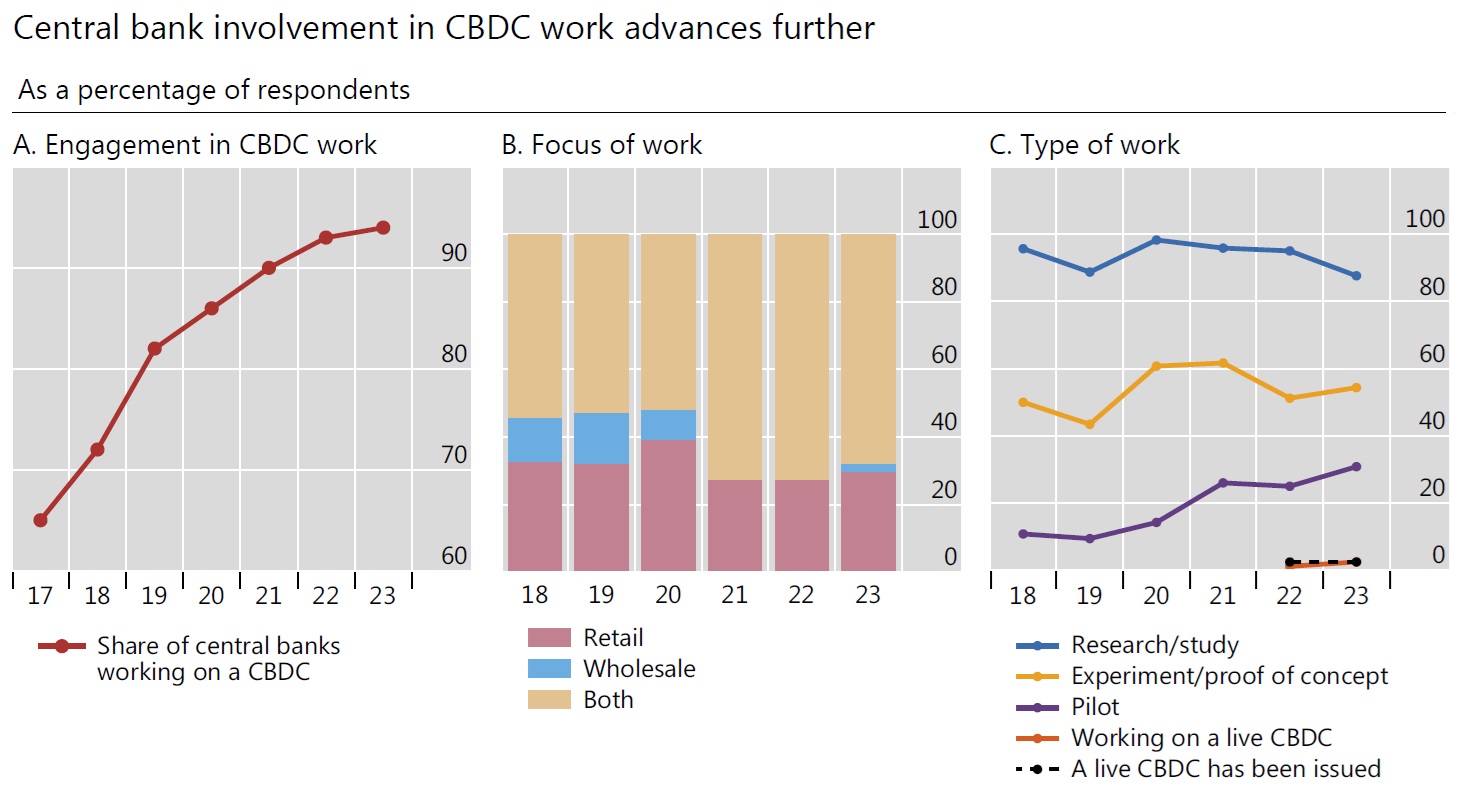
Moreover, launching a CBDC does not mean people will use it. Nigeria’s eNaira, for example, faced low awareness, limited trust, gaps in digital literacy, poor internet and smartphone access, limited merchant acceptance and competition from familiar alternatives. CBDC experiments are now widespread, but mature retail systems with high, sustained use remain far less common (see Figure 1). 5
Digital systems can also reproduce the barriers they are meant to overcome. People without reliable connectivity, suitable phones, formal identification, literacy or easy-to-use interfaces may still be left out. Offline functions can reduce the connectivity problem, but they bring their own challenges involving security, fraud, device access and the need to reconcile transactions later. 6
Trust is another major issue. CBDCs could produce detailed records of people’s transactions, and users who fear surveillance or misuse of their data may avoid them. Strong privacy rules, cybersecurity and clear limits on data use are therefore central to whether a system gains public confidence. 7 There are also risks to the wider financial system if people move deposits from banks into CBDCs, though design choices such as holding limits or intermediary-based distribution can reduce those risks.
The bottom line
The evidence supports a qualified conclusion: CBDCs may be useful tools for financial inclusion, but only under the right conditions. Their effects will depend far more on design and local systems than on the CBDC label itself—especially fees, interoperability, offline access, privacy, identity requirements, consumer protection, agent networks and digital literacy.
CBDCs should therefore be seen as a complement to broader policies, not a replacement for affordable internet, reliable identification, trusted payment networks and financial education. Their value should be judged against less disruptive alternatives and by whether underserved groups actually adopt and continue using them.
There is still no long-term, cross-country evidence showing that deployed CBDCs have increased inclusion among excluded populations more effectively than credible alternatives. On today’s record, the categorical claim that CBDCs will enhance financial inclusion globally is not established. The evidence more strongly indicates that they can produce positive, negligible or even exclusionary results depending on implementation.
Figures & data


All contributions are reviewed for clarity, balance, and evidence. The strongest insights are elevated into the argument graph — with credit to you.
Help improve this analysis →