AI-assisted design of novel viruses poses less public-health risk than widely feared
What's this about?
People disagree about whether AI help with new virus designs creates less health danger than many people fear. AI can help write virus gene plans, but making a harmful virus remains very hard.
What supporters say
- A gene plan alone cannot make a virus spread, cause illness, or beat our body's defenses.
- Labs need the right cells, tools, tests, and many repeat tries to grow a working virus.
- So far, AI-made virus plans have only made viruses that infect bacteria, not people.
- DNA companies and labs can check orders, train staff, track samples, and plan for mishaps.
What critics say
- AI can create new virus gene plans that work in living things, which shows real skill.
- A person with strong lab skills and tools could face fewer barriers than before.
- Safety checks do not stop every bad order or every unsafe lab action.
- We do not yet know how much better AI will become at helping with human viruses.
The bottom line
The danger is real, but it has limits and depends on many things. AI alone cannot easily create a virus that starts a major outbreak.
AI tools can now help create novel virus genomes, but that does not mean they can readily produce a pandemic-causing pathogen. The evidence suggests the public-health risk is real but more conditional and constrained than the most sweeping warnings imply.
The case for
The strongest reason for caution without panic is that generating a genetic sequence is only the first step in a long and difficult process. Turning a computer-designed genome into a virus that can survive, spread efficiently, cause disease and evade immune defenses requires much more: suitable cells, laboratory methods to “rescue” and grow the virus, testing, delivery, and repeated rounds of refinement. These practical barriers make it misleading to suggest that an AI-generated sequence could directly produce a pandemic threat 1 (see Figure 1).
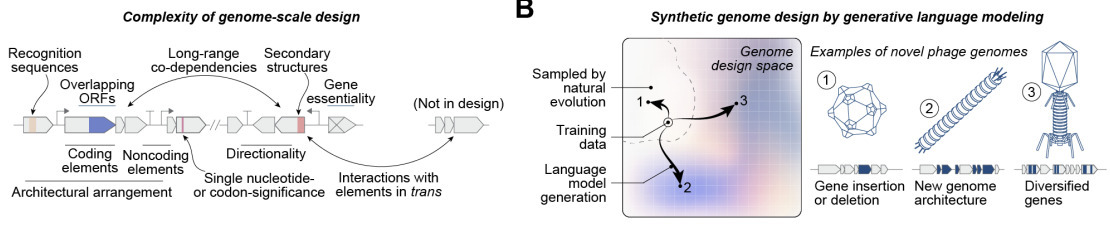
The clearest experimental proof so far is also limited in what it shows. Researchers have used genome-language models to generate new bacteriophage genomes, then synthesized some of those designs and showed that they worked. But bacteriophages infect bacteria, not people. The result demonstrates that AI can make biologically meaningful viral designs, yet it does not show that AI can create a human virus with the combination of traits needed for a major outbreak 2 (see Figure 2).
There are also opportunities to intervene before a design becomes a physical organism. U.S. guidance encourages DNA-synthesis companies to screen orders and verify customers, while World Health Organization guidance calls for layered lab protections, including containment, staff safeguards, inventories and plans for incidents. These measures do not remove the danger, but they make the route from a digital design to real-world use less open and less automatic 3 (see Figure 3).
Taken together, this points to a more targeted view of the threat. Risk depends on the virus in question, how reliable and wide-ranging the AI assistance is, whether users can access capable wet labs, and how strong local controls are. In countries and institutions with robust oversight, the claim that near-term risk is lower than widely feared is more plausible.
The case against
The reassuring case has an important limit: AI-assisted viral design is no longer only a hypothetical possibility. The successful bacteriophage experiments show that genome models can generate functional virus designs when researchers combine them with DNA synthesis and laboratory testing. Because the viruses involved do not infect humans, the findings cannot be translated directly into public-health risk—but they do show that the underlying capability is real 4.
AI may also matter well before it can independently design a dangerous human pathogen. A tool that helps researchers solve several parts of the development process could reduce the expertise needed and speed up trial-and-error work. Reviews and institutional assessments warn that AI could accelerate design cycles and make specialized biological knowledge more accessible, even though its outputs remain unreliable and physical lab infrastructure is still essential 5.
Existing screening systems are another weak point. They are often based on comparing requested sequences with known dangerous organisms. A genuinely novel or highly altered sequence may not closely resemble anything already on a watch list, even if it has harmful functions. Researchers have proposed screening systems that look more closely at biological function, but these approaches still face limited data, false alarms, missed threats and difficulty testing their performance against unknown biology 6.
Protections are also uneven globally. Screening practices vary among providers and countries, and not all suppliers are covered. That means safeguards described in official frameworks cannot be assumed to work consistently everywhere, especially as designs become more divergent from known pathogens.
The bottom line
The evidence supports a qualified conclusion: current AI-assisted virus design poses less immediate risk than claims that portray sequence generation as a direct path to a pandemic. Major biological and operational hurdles remain between a generated genome and a viable, transmissible and harmful human virus.
But the risk is not trivial or merely speculative. AI has already helped produce functional viruses in the laboratory, albeit bacteriophages rather than human pathogens, and it could lower barriers as its capabilities and access to wet-lab resources improve.
There is no direct evidence showing how often AI-designed viruses are attempted, successfully built or used to cause public-health harm. That absence makes it impossible to put a reliable number on the near-term threat. The central uncertainty is whether safeguards can keep pace with more capable AI systems and novel designs that may evade conventional screening.
Figures & data

All contributions are reviewed for clarity, balance, and evidence. The strongest insights are elevated into the argument graph — with credit to you.
Help improve this analysis →