School choice programs impact the quality of public schools
What's this about?
People disagree about whether school choice plans, such as charter schools and vouchers, change public school quality a lot.
These plans give families more school options, but results differ from place to place.
What supporters say
- More options can create rivalry (schools trying to win families), which may push public schools to improve.
- Studies in Michigan linked more rivalry with higher student scores and lower school costs.
- Some nearby public schools improved when charter schools grew in their area.
- Some charter schools helped students learn much more, so good school plans may spread.
What critics say
- These gains do not happen everywhere, and some schools show little change.
- Results can differ by city, school, student group, and the kind of test people choose.
- A charter label alone does not mean a school gives a good education.
- Choice can shift student numbers and money, even when we do not know if scores improve.
The bottom line
School choice can change public schools in real ways. But the evidence does not show that it always makes public schools better or worse.
School-choice programs—including charter schools and voucher plans—can meaningfully change the public-school landscape. But the research does not show that choice reliably makes public schools better or worse overall: results vary sharply by program, place and the measure used.
The case for
The strongest argument for school choice is that it can create competitive pressure on traditional public schools. When families have alternatives, public schools may respond by improving performance, adjusting their programs or using resources more efficiently. Reviews of U.S. research have found that competition can raise student achievement, while studies in Michigan linked greater competition to better school performance and lower costs. Research in North Carolina also found that the availability of charter schools could affect public-school quality 1.
There is also evidence that charter-school growth can produce benefits beyond the students who switch schools. In some local markets, charter competition has been associated with gains at nearby traditional public schools. But these results are not universal. A long-run Michigan study found that effects differed across schools, and broader market-level research similarly suggests that gains occur in selected places rather than across the country as a whole 2.
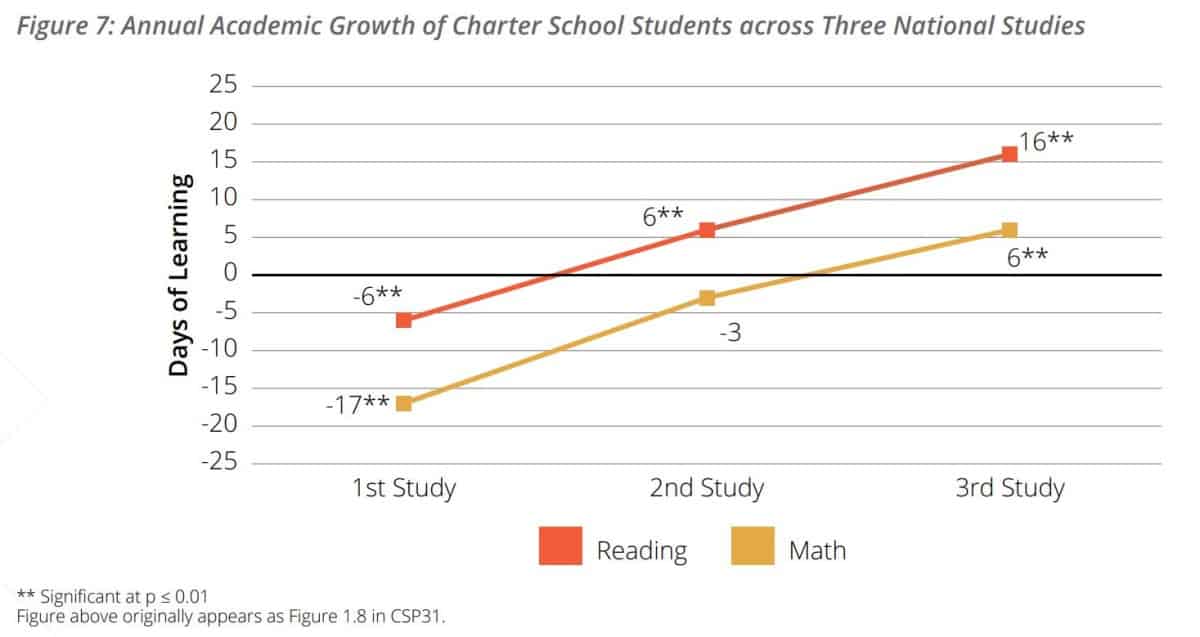
At the individual-school level, lottery-based studies offer a narrower reason for optimism. Some charter schools have produced substantial academic gains, according to a federal charter evaluation. A meta-analysis, however, found that results varied by location, student group and the characteristics of the school. That means choice may help identify and expand effective school models, but charter status alone is not proof of quality (see Figure 2) 3.
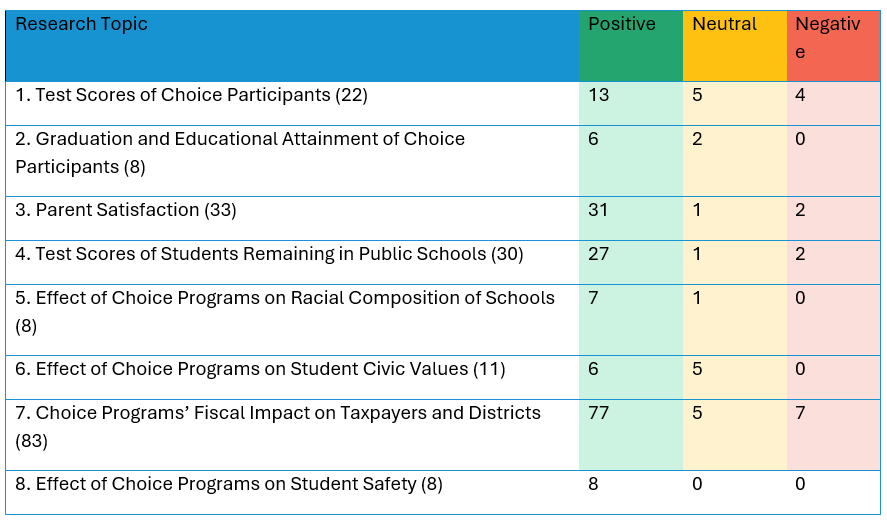
Choice can also reshape public education even when test-score results remain uncertain. It can change enrollment patterns, school organization and finances, affecting how traditional public schools operate. In that sense, its impact can extend well beyond the students who use the programs (see Figure 3).
The case against
The clearest challenge comes from voucher programs, where evidence on student achievement has often been weak or negative. Randomized studies have generally found limited or mixed effects. In Louisiana, students who won vouchers through a lottery saw substantial initial drops in math and reading scores, and another voucher expansion was linked to short-run score declines for some students 4.
Competition does not necessarily help traditional public schools, either. In Louisiana, voucher competition was associated with adverse short-run performance responses at some public schools. That does not prove all competition is harmful, but it directly undercuts the idea that giving families more choices automatically improves public-school achievement 5.
There is another problem with judging quality through test scores alone: student sorting can make schools look better or worse without changing their teaching. A Wisconsin study found that student movement and shifts in the makeup of a school’s enrollment could influence measured performance. Reviews of charter growth warn that enrollment losses should not automatically be treated as evidence that instruction has improved or deteriorated 6.
Choice may also bring equity costs. Peer-reviewed research has found that school-choice systems can increase racial segregation even when families do not express openly segregative preferences. Other reviews conclude that choice policies can deepen socioeconomic divides, depending on the policy design and local conditions 7. Those concerns matter even if average test scores rise.
The bottom line
The evidence supports a conditional conclusion: school-choice programs can significantly affect public schools, but the direction and size of those effects depend on the type of program, local market conditions and the outcome being measured.
There is high confidence that the effects are real and varied. The research includes randomized trials, reviews, meta-analyses, federal evaluations and studies of local school markets. Yet the overall evidence does not support a broad claim that school choice consistently improves—or consistently damages—public-school quality.
Test scores are important, but they are not the whole story. Graduation, attendance, student well-being, curriculum, safety, equity and financial stability also shape school quality, and the available evidence is less decisive on many of those questions. Policymakers should therefore judge choice programs by their specific design, setting and goals—not treat “school choice” as a single policy with a predictable result.
Figures & data

All contributions are reviewed for clarity, balance, and evidence. The strongest insights are elevated into the argument graph — with credit to you.
Help improve this analysis →