University rankings distort the priorities and behavior of higher-education institutions
What's this about?
People disagree about whether university rankings change schools in bad ways.
The key point is whether rankings show real worth or only a small part of it.
What supporters say
- Universities change their plans, staff jobs, data work, and research to gain rank points.
- Ranking races may lead schools to twist their numbers, papers, or links to look better.
- Rankings may push many schools to copy the same rich, global, research-heavy model.
- Rankings often prize research, fame, jobs, and world links more than good teaching, fair treatment, local help, or public service.
What critics say
- Rankings give students, leaders, and the public useful facts for judging schools.
- Some changes made to rise in the rankings may also help schools improve.
How to read this
The number of points on each side does not show who is right; the strength of the proof matters most.
The bottom line
The proof shows that rankings do change how universities work and what they value.
They can harm schools when people treat one score as the whole truth, but some changes may help.
University rankings do more than inform students and policymakers, according to the evidence. They also shape what universities pursue and how they organize themselves—though whether that influence becomes harmful distortion depends on how rankings are designed and used.
The case for
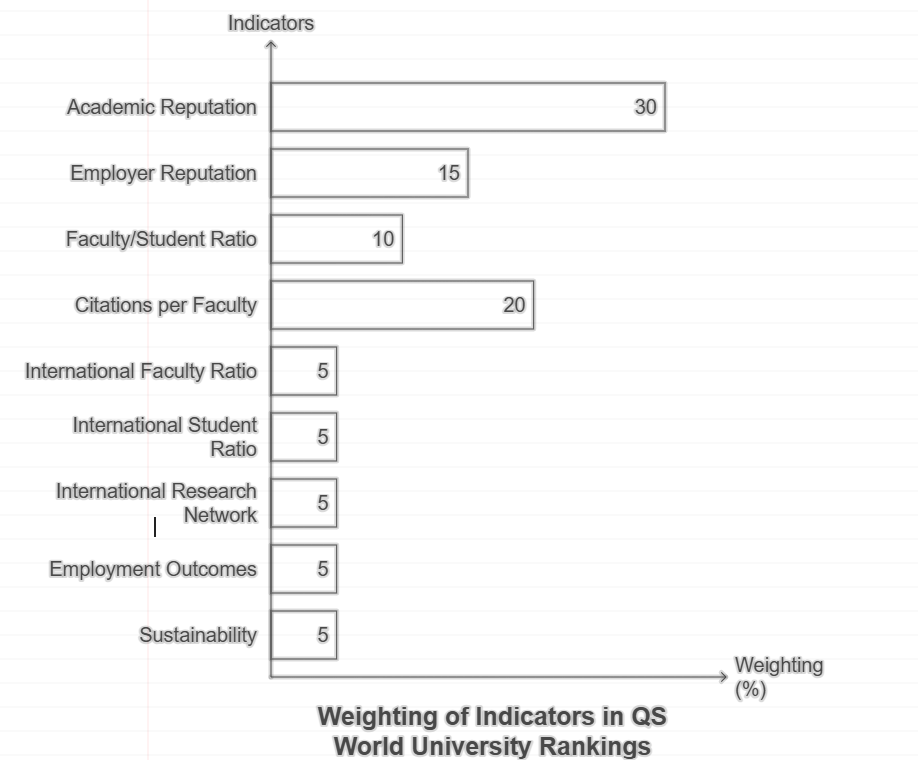
Rankings reward a narrow picture of success. Their measures often emphasize research output, citations, reputation, international visibility, graduate employment and links with industry. Teaching quality, fairness, local involvement and public service are represented less fully. The rankings’ own methods show how this particular definition of performance is built into the systems (see Figure 1). 1
That can redirect scarce time and money toward activities that are easy to count, compare and reward. The risk is greatest when university leaders or governments treat a ranking score as a complete measure of quality rather than one limited source of information.
There is strong evidence that universities respond strategically to these incentives. Studies and case reports describe changes in administration, data management, recruitment, international partnerships, branding, research priorities and institutional planning. Universities may pursue more international students and staff, adjust research efforts or reorganize their operations to improve their standing. 2
Some responses go beyond legitimate planning. Competition can encourage metric gaming, including efforts designed mainly to improve the numbers reported to ranking systems. A recent bibliometric analysis found possible irregularities linked to publication and citation practices focused on ranking results, although that study is a preprint and needs independent replication. 3
Rankings may also push institutions toward the same model. Standardized comparisons and pressure to become “world-class” can encourage universities to imitate research-intensive, internationally visible institutions, even when their own missions or local conditions differ. This can reduce institutional diversity and place less emphasis on teaching, equity or local service. 4
The case against
Rankings are not necessarily harmful. They can make universities’ characteristics more visible, help students and funders compare institutions across borders, and encourage better data systems and clearer planning. For people choosing a university or evaluating one in another country, rankings may provide information that is otherwise difficult to obtain. 5
Some ranking-driven changes may also represent genuine improvement rather than waste or manipulation. International recruitment, faculty mobility, research collaboration, expanded partnerships and greater global visibility can benefit students and institutions when they fit the university’s mission. Better performance tracking may also help leaders identify problems and set goals. 6
The main challenge to the claim is therefore its broadest version. The evidence shows more clearly that rankings change behavior than that those changes are always damaging. Rankings operate alongside funding pressures, internationalization policies, competition and existing reputational systems, making it difficult to measure their independent effect on resources, educational quality or public service.
The evidence also varies by institution. Ranking pressures appear strongest among universities competing for global status and visibility. National or mission-specific evaluation systems may create different, and sometimes weaker, incentives. Much of the research is qualitative or based on individual cases, so the scale of the effects—and how often they produce net harm—remains uncertain.
The bottom line
The evidence favors the claim, but in a qualified way. It is strong that rankings influence university behavior and that their design can privilege a narrow model of institutional success. It is less certain how large the effects are, how widely they occur, and whether the overall result is harmful in every setting.
Rankings can lead universities to neglect less measurable goals, imitate high-status institutions or focus on improving indicators rather than underlying performance. But they can also support useful benchmarking, collaboration, transparency and planning. The evidence does not show that rankings are the sole cause of these changes, or that every response is harmful.
The key uncertainty is not whether rankings matter. It is when their influence becomes distortion rather than useful coordination or improvement. That is most likely when a ranking is treated as the single definition of quality, rather than used alongside measures that reflect an institution’s mission and local context.
Figures & data

All contributions are reviewed for clarity, balance, and evidence. The strongest insights are elevated into the argument graph — with credit to you.
Help improve this analysis →