Meritocracy is a myth that justifies inequality
What's this about?
People disagree about whether meritocracy (success from skill and hard work) explains why some people do better than others.
This claim says meritocracy hides inequality (big gaps in money and chances).
What supporters say
- Kids do not start life with the same schools, homes, health care, or safe areas.
- A child’s family, town, and family friends can strongly shape future jobs and pay.
- Big gaps in wealth can make it harder for hard work to lead to a better life.
- Discrimination (unfair treatment because of race or sex) can hurt job chances and pay.
What critics say
- Skill, effort, and good choices still help people succeed in many jobs and schools.
- Some people do move up through hard work, even when life starts out hard.
- Not every gap in pay or success comes from unfair treatment or family wealth.
- Jobs and schools may try to judge people fairly, though small unfair acts can add up.
The bottom line
Hard work and skill matter, but they do not fully explain today’s big gaps in money and chances.
Family background, where someone grows up, and unfair treatment often shape who gets ahead.
Meritocracy—the idea that people rise or fall mainly through talent and hard work—is often used to explain unequal outcomes. But the evidence suggests it is a poor full explanation for today’s social and economic gaps, even if skill and effort still matter in many settings.
The case for
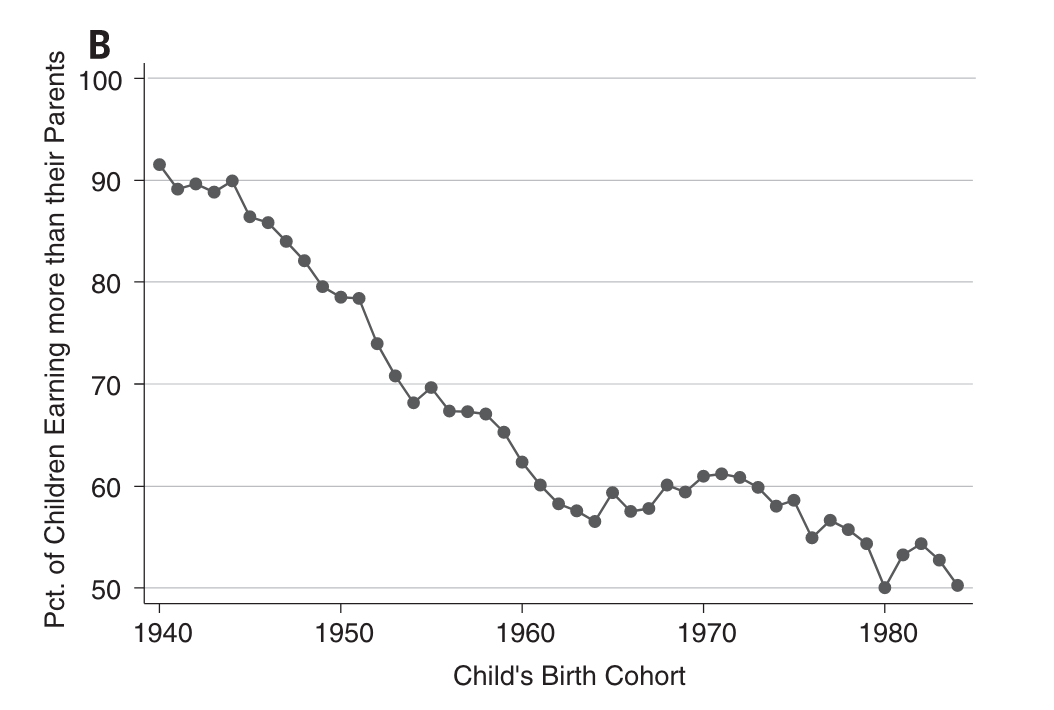
The strongest challenge to meritocracy is that family background and birthplace heavily influence life chances. Research from the United States finds large differences in upward mobility between places, with children’s prospects linked to their family circumstances, school quality, segregation, local inequality and social networks. World Bank and OECD research similarly finds that education, earnings and social position often persist across generations. 1
That does not mean effort is irrelevant. But it means people do not begin on equal footing. Access to good schools, healthcare, stable housing, secure jobs, influential networks and safe neighborhoods can shape who is prepared to compete long before an interview, exam or promotion decision is made. In more unequal societies, the evidence also points to lower mobility between generations, suggesting that inequality itself can make it harder for effort to turn into opportunity (see Figure 1). 4
The OECD has found that low mobility and high inequality can reinforce each other. In some countries, moving from a low income to an average income may take several generations. That pattern clashes with a simple story in which relative success is mainly the result of individual drive or ability (see Figure 2). 1
Discrimination is another obstacle to a purely merit-based account. Studies using otherwise comparable job applicants have found different treatment by race or gender. Research on organizations also suggests that small biases in hiring and promotion can build up over time, producing large differences between groups. 3 When judgments about competence are subjective, institutions may call their decisions meritocratic while still rewarding some groups more than others.
There is also evidence that the language of merit can make inequality feel deserved. In one experiment, prompting people to think in meritocratic terms increased their willingness to justify unequal outcomes. Survey findings likewise link stronger belief in school meritocracy with greater acceptance of social and income inequality. 2 These results support the argument that meritocratic ideas can encourage people to see unequal rewards as the fair result of individual choices, rather than of unequal starting points.
The case against
The case is not that merit-based selection is entirely invented. Competence, performance and persistence can make a real material difference, particularly within institutions. Reviews of public administration have found that hiring and promotion based on relevant qualifications can improve performance compared with patronage or arbitrary appointments. Organizational studies also connect recruitment and selection practices with better results. 5
This matters because the alternative to merit-based decisions is not necessarily fairness. A public agency or employer may reasonably prefer people with relevant skills over those chosen because of political connections, family ties or chance. Evidence that inherited advantage and discrimination shape outcomes does not prove that talent, hard work or performance never affect who succeeds. 6
Still, this evidence has limits. Much of the research on organizational performance is correlational, and findings from particular workplaces or public agencies cannot automatically be extended to explain the entire distribution of wealth and status across society. A hiring system can reward competence more effectively than patronage while operating in a society where access to education, networks and early opportunities remains deeply unequal.
Meritocratic belief is also not necessarily just an excuse for inequality. People’s own experiences of moving up or down can shape whether they believe society rewards effort. The available experiments and surveys show a plausible link between meritocratic ideas and acceptance of inequality, but they do not establish how strong or lasting that effect is in every country or institution.
The bottom line
The evidence strongly supports the view that meritocracy is inadequate as either a description or a justification of existing inequality. Family advantage, geography, unequal access to opportunity and biased evaluations all shape who gets ahead, making it implausible that social rank simply reflects deserved individual merit. 1 3
But the narrower ideal retains value: institutions can sensibly use relevant competence rather than favoritism or arbitrary choices. Merit-based selection is not a myth; society-wide meritocracy is. The main uncertainty is not whether structural advantage matters, but exactly how much meritocratic beliefs themselves help sustain acceptance of unequal outcomes.
Pros — Supporting Arguments
Cons — Opposing Arguments
Figures & data

All contributions are reviewed for clarity, balance, and evidence. The strongest insights are elevated into the argument graph — with credit to you.
Help improve this analysis →