Reparations for slavery are justified and feasible
What's this about?
People disagree about whether the United States should give reparations (ways to repair harm) for slavery. Supporters see lasting harm, but key plan details remain unsure.
What supporters say
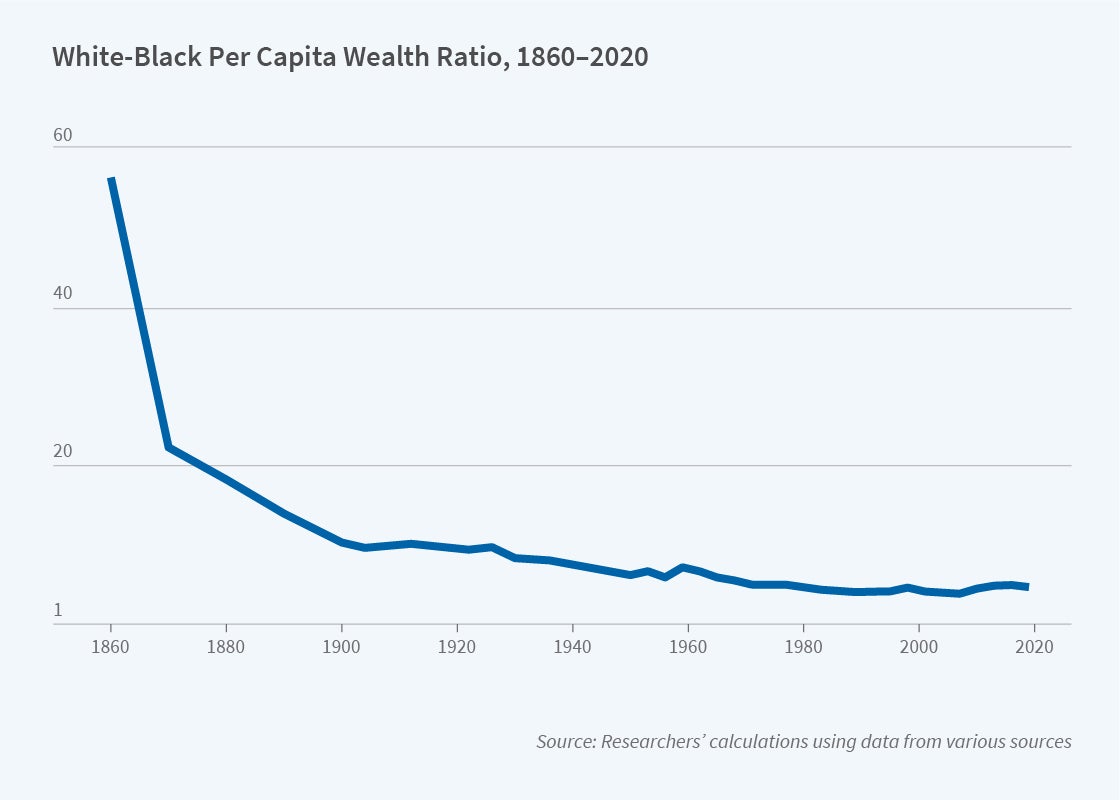
- Slavery and later unfair rules helped create a large gap in wealth between Black and white families.
- Black families still own far less wealth than white families, even long after slavery ended.
- Repairs could include homes, health care, schools, public apologies, and rule changes, not only cash.
- Evanston, a city near Chicago, has tried a home aid plan for some Black people.
What critics say
- Critics ask who should get help, since slavery happened many years ago.
- Critics ask how a plan across the whole nation would work and how much it would cost.
- Critics worry that leaders may not agree on fair rules for payment or aid.
- We do not yet know if a large national plan could work as well as small local plans.
The bottom line
Strong facts link slavery and later unfair treatment to today’s wealth gap. Repairs have support as a way to address that harm, but the nation still needs clear answers on cost, rules, and who gets help.
Reparations for slavery are strongly supported as a response to lasting harm, but the evidence is much less clear on how a nationwide program should work, who should qualify, or how it would be paid for.
The case for
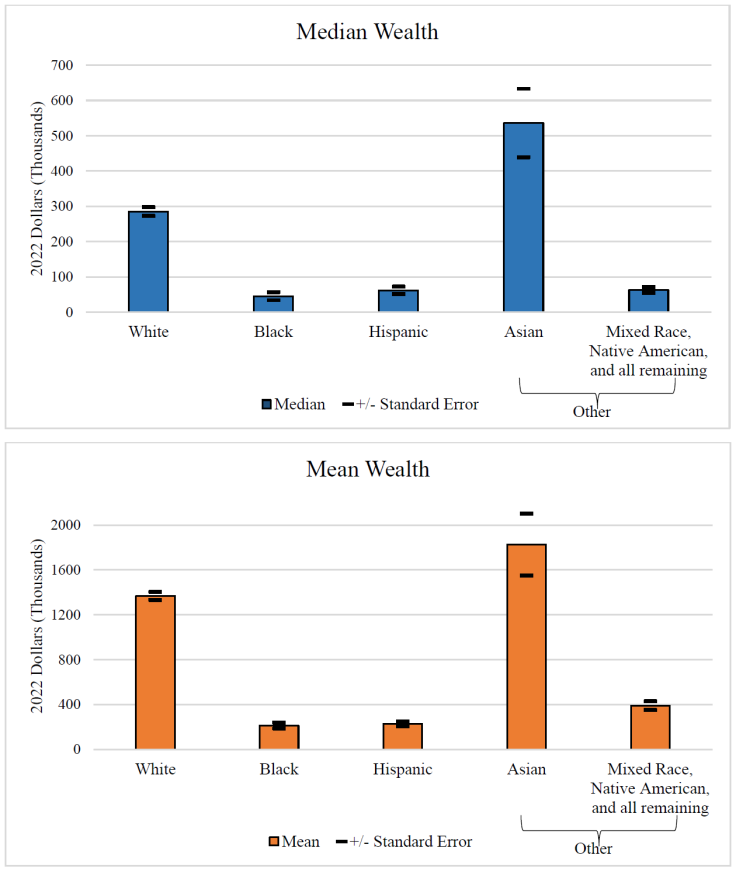
The central argument for reparations is that slavery and the discrimination that followed it did not end their economic effects when the laws changed. Historical research links slavery, Jim Crow laws, discriminatory housing policy and unequal access to assets with a persistent Black-white wealth gap extending from emancipation to the present. Federal Reserve data from 2022 likewise show that Black households have far lower median and average wealth than white households (see Figure 2). 1
Supporters argue that reparations need not mean one national cash payment. International standards and proposals from California and Caribbean governments describe a wider range of remedies: compensation, housing assistance, health and education programs, institutional reforms, apologies and measures intended to prevent future discrimination. That approach could address different forms of harm rather than putting a single dollar figure on every historical injustice. 2
There is also evidence that public bodies can administer at least limited reparative programs. Evanston, Illinois, has run a locally funded housing-focused initiative for eligible Black residents. California’s reparations task force has compiled an official account of past harms and recommended responses. At the federal level, H.R. 40 would create a commission to study slavery and later discrimination before proposing remedies, offering a route to settle key questions through legislation rather than courts. 3
Large wealth-building programs are not automatically beyond the reach of government, either. One peer-reviewed simulation found that a universal inheritance policy could narrow racial wealth inequality. That policy was not slavery reparations, but it suggests that substantial asset transfers can be designed and assessed as public-policy tools. 4
The case against
The hardest problem is turning a broad moral and historical case into a precise legal claim or national program. Evidence that slavery and discrimination caused enduring harm does not, by itself, identify one correct payment amount, eligibility rule or remedy. Legal scholars point to serious obstacles in court cases, including proving direct causation, establishing standing, statutes of limitation and sovereign immunity. Those barriers matter most for lawsuits, though Congress or state legislatures could create new statutory programs. 5
The price of a national program also remains unsettled. There is no agreed estimate of what would be owed, which harms would be covered, who would receive benefits, whether aid would be cash or services, or where the money would come from. Existing studies of wealth inequality do not produce one definitive reparations figure, and detailed proposals have not established a settled national financing plan. A program could require significant taxes, borrowing or cuts to other spending. 6
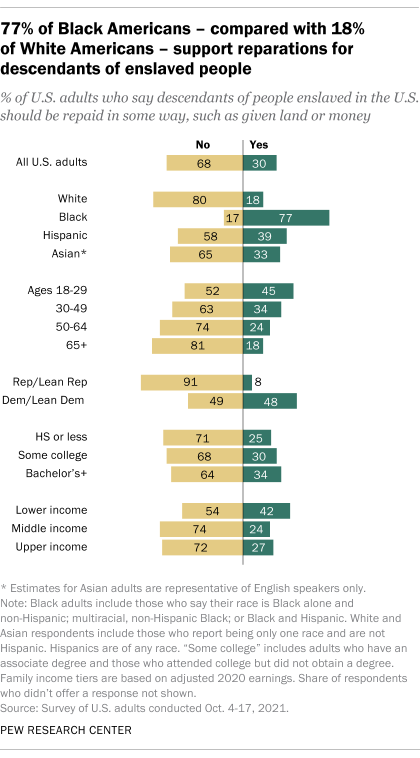
Political support presents another obstacle. Pew survey evidence shows substantial backing among Black Americans, but much weaker support across the broader public and sharp divisions by race and party (see Figure 3). That could make national legislation, long-term funding and political durability difficult. 7
Small or historically different programs do not resolve those concerns. Evanston’s local housing initiative is not comparable to a nationwide cash program. Holocaust restitution occurred under distinct legal, demographic and historical circumstances. Such examples show that reparative policies are possible, but not that a U.S. slavery-reparations program could be expanded smoothly to national scale. 8
The bottom line
The evidence provides a strong moral and historical case for some form of reparative action. It shows that public institutions helped create durable, group-linked harms that remain visible in wealth inequality and other outcomes. The case is strongest for remedies that recognize those continuing effects, responsibility and unequal accumulation of wealth.
But the evidence does not validate a single nationwide cash payout, or settle the crucial details of a national plan. It does not yet determine who should receive aid, what form it should take, how much it should cost, how it should be financed, or whether it would achieve its intended results at scale.
A staged, mixed approach has the strongest practical support: study commissions, targeted programs, housing or community investment, and gradual testing of eligibility and funding rules. Confidence is high that reparative policy is justified; it is lower that any particular nationwide package is affordable, legally enforceable, politically durable or proven to work.
Figures & data
All contributions are reviewed for clarity, balance, and evidence. The strongest insights are elevated into the argument graph — with credit to you.
Help improve this analysis →