Global supply chains are being restructured around geopolitical risk rather than cost efficiency
What's this about?
People disagree about whether world-power (geopolitical) risk now matters more than low prices in supply chains. Supply chains move parts and goods from makers to shops.
What supporters say
- Firms now worry more about trade fights, war risks, and key sea routes that may close.
- Many firms use more than one seller or factory, instead of trusting one cheap source.
- Extra choices give firms backup plans when storms, fights, or new rules stop trade.
- This change looks strongest for vital goods, such as computer chips and other key tech.
What critics say
- Backup factories and extra sellers often cost more than using one large, cheap source.
- Firms still seek low prices because making and moving goods costs a lot.
- The biggest changes happen in key areas, not across all goods made around the world.
- We do not see proof that risk has replaced cost as the main force overall.
The bottom line
Risk from world events now shapes some factory, seller, and travel choices. But low cost still guides most world production, so the claim goes too far.
Global supply chains are not simply being rebuilt around politics at the expense of price. But geopolitical risk has become a far more important factor—especially in industries governments view as strategic.
The case for
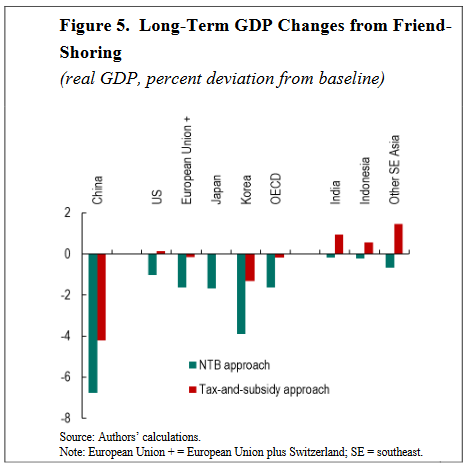
Political tensions, export controls and fears of overdependence on a single country are now real constraints on business decisions, not just background risks. The IMF has documented a rise in trade and investment restrictions, technology controls and government efforts to reduce dependence on foreign suppliers. World Bank investment research also points to projects moving toward politically aligned countries (see Figure 1). 1
The shift is clearest in strategically important industries, notably semiconductors and critical minerals. Mining, mineral processing and chip production are concentrated in relatively few places, leaving countries vulnerable when a supplier restricts exports or becomes politically unreliable. That concentration has encouraged governments and companies to build capacity at home, within their regions or among allies—even when doing so costs more than relying on the cheapest established supplier. 2
Companies are also investing more in resilience. The Bank for International Settlements has reported that firms adjusted inventories and suppliers after major disruptions. Executive and logistics surveys describe greater use of dual sourcing, regional supply networks and better visibility into where parts and materials come from. These moves show that companies are taking geopolitical uncertainty seriously, though they show adaptation more clearly than a completed worldwide shift in production. 3
Recent shipping disruptions underline the pressure. Problems in the Red Sea and Panama Canal have meant longer routes, slower transit and higher freight costs, according to UN Trade and Development. Such shocks can quickly change logistics decisions and make businesses reconsider how dependent they are on particular routes or suppliers.
The case against
The evidence does not show that companies have broadly abandoned global production or that cost has stopped shaping where factories are located. OECD and IMF assessments find that trade and global value chains remain extensive. Production networks are changing, but there is little evidence of a general retreat from cross-border specialization or a worldwide move to make everything domestically. 4
A change in trade figures can also be misleading. Imports may shift away from China, for example, without production truly moving out of Chinese supply networks. Stanford research finds that lower direct US imports from China can coexist with continuing dependence through third countries. Other research suggests that rising exports from countries such as Vietnam sometimes reflect transshipment or continued use of Chinese inputs, rather than full relocation of manufacturing. 5
Cost and commercial realities still matter for many goods. The OECD warns that indiscriminate efforts to bring production home can reduce efficiency without necessarily improving resilience. Investment and production patterns vary sharply by sector and region, making it difficult to argue that geopolitical risk now follows a single, universal rule.
There are also limits to the available evidence. Investment announcements may not become operating factories, while surveys often capture executives’ intentions rather than completed changes. Several indicators come from industry-sponsored surveys, which are useful for showing managerial priorities but cannot prove that global supply chains have already been fundamentally remade.
The bottom line
The strongest conclusion is that geopolitical risk is increasingly reshaping selected supply chains and investment decisions, especially where governments see concentrated foreign supply as a national-security vulnerability. Semiconductors and critical minerals offer the clearest examples of companies and states accepting extra cost and redundancy for greater security.
But the wider global economy is better described as pursuing risk-adjusted diversification, not replacing cost-based globalization altogether. Firms are adding suppliers, building regional options and seeking politically safer partners while keeping international networks that still offer scale, skills and lower costs. 6
Confidence in that qualified conclusion is high. Strong institutional and peer-reviewed evidence supports both sides of the picture: a genuine strategic-sector shift, alongside the persistence of deep global integration. The main unanswered question is whether today’s trade and investment changes represent lasting relocation—or merely rerouted commerce, announced plans and adaptations that leave underlying dependencies intact.
Figures & data

All contributions are reviewed for clarity, balance, and evidence. The strongest insights are elevated into the argument graph — with credit to you.
Help improve this analysis →