U.S. tariffs primarily divert Chinese exports through third countries
What's this about?
People disagree about whether U.S. tariffs mostly caused Chinese goods to reach America through other countries. Tariffs made goods from China cost more.
What supporters say
- U.S. buyers bought less from China and more from Vietnam, Mexico, and other places.
- Some goods tied to Chinese supply chains began to ship from other countries after the trade fight started.
- Studies found both simple rerouting and real moves of jobs and factories.
- A product from Vietnam may still use Chinese parts, money, firms, or supply links.
What critics say
- The data do not show that most of China’s lost sales simply went through other countries unchanged.
- Many firms moved some real work, such as making or putting together goods, out of China.
- A shipping label does not tell us where every part came from or who earned the money.
- China kept a role in some supply chains, but that does not prove most trade got rerouted.
The bottom line
Tariffs clearly pushed U.S. buyers to use countries other than China more often. But the facts do not show that third countries mostly just passed Chinese exports on to the United States.
U.S. tariffs on Chinese goods pushed American buyers to look elsewhere, including Vietnam and Mexico. But the evidence does not show that most of China’s lost trade simply passed through third countries unchanged.
The case for
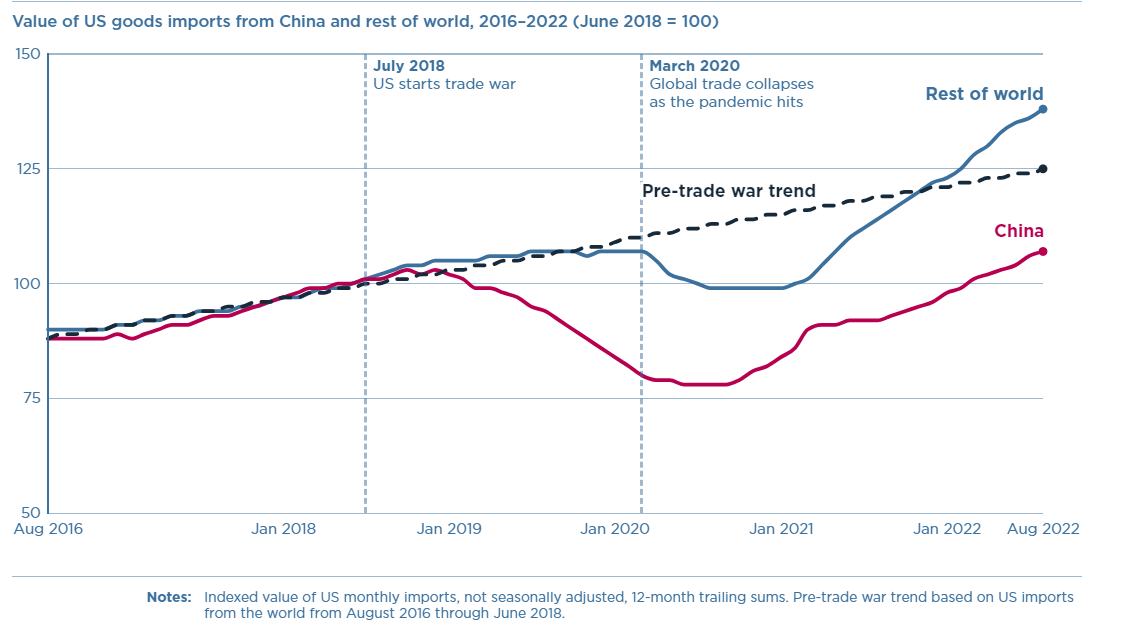
The strongest argument for the claim is that tariffs clearly redirected U.S. sourcing away from China. As duties rose on Chinese products, U.S. imports from China fell while imports from alternative suppliers increased. Vietnam, Mexico and other countries gained market share in goods exposed to the tariffs, while China’s direct share of U.S. imports declined (see Figure 1). 1
In at least some sectors, the shift appears to have involved Chinese goods or Chinese-linked supply chains moving through intermediary countries. Firm- and product-level research found sharp increases in exports to the United States from third countries in products closely tied to Chinese supply chains after the trade war began. That research distinguishes between goods being rerouted and production genuinely moving, and finds evidence of both (see Figure 2). 2
There is also a basic limitation in reading customs data too literally. The country that ships a finished product to the United States is not always the country that supplied its parts, investment or much of its value. A decline in goods officially recorded as Chinese imports therefore does not necessarily mean an equal decline in Chinese value added or Chinese firms’ role in the supply chain. 3
That distinction matters because a product assembled in Vietnam or Mexico may still contain Chinese components, be made by a Chinese-owned company, or rely on Chinese upstream suppliers. On that broader definition of access to the U.S. market, China may have retained a role in some trade flows even as its direct exports dropped.
The case against
The main problem with the claim is that tariffs did not merely change the label on imports. Government analyses and academic studies find that the measures substantially reduced direct imports from China in the goods affected. U.S. International Trade Commission evidence also indicates that Section 301 tariffs cut imports of targeted products and increased U.S. production in many industries (see Figure 3). 4
This is difficult to square with the idea that third-country diversion was the sole, or necessarily the dominant, response. Some production did move to other countries, and some buyers replaced Chinese suppliers with non-Chinese alternatives. In other cases, U.S. producers expanded output. The rise in imports from Vietnam, Mexico or elsewhere cannot automatically be treated as Chinese goods passing through unchanged. 5
The tariffs also imposed real economic costs. Studies have found that much of the tariff burden was passed on in U.S. import prices, while import quantities fell and broader efficiency and welfare losses followed. Those effects show that access to the American market became more expensive and more limited, even where Chinese firms or inputs remained part of indirect supply chains. 6
The evidence varies sharply by product and country. Some trade appears to have been rerouted; some seems to reflect new factories and new production capacity abroad; and some reflects supplier substitution, increased U.S. output or reduced demand. Available data do not provide one comparable estimate showing how much displaced Chinese trade went into each category.
The bottom line
The evidence strongly supports a narrower conclusion: U.S. tariffs reduced direct imports from China while also producing substantial diversion to third countries and some rerouting of Chinese-linked trade.
But it does not establish that diversion through third countries was the primary effect across all goods, countries and periods. Direct customs data are good at measuring imports from China, but they cannot fully identify Chinese value embedded in products shipped from elsewhere, nor can they prove transshipment in every case.
There is high confidence that both direct reduction and third-country diversion occurred. The unresolved question is their relative size: the available record cannot reliably divide the overall adjustment among rerouting, Chinese inputs in third-country production, genuine relocation, non-Chinese supplier replacement, increased U.S. production and lower demand.
Figures & data


All contributions are reviewed for clarity, balance, and evidence. The strongest insights are elevated into the argument graph — with credit to you.
Help improve this analysis →