Cancel culture is a threat to free expression
What's this about?
People disagree about whether cancel culture stops people from speaking freely. It can mean strong public backlash against someone’s words or actions.
What supporters say
- Fear of anger, job loss, or shame can make people hide their views.
- In one survey, 62% of people in the US felt unable to share a public opinion.
- Online attacks can spread fast before people check key facts or judge what seems fair.
- Reporters and other public speakers may leave online spaces after threats or harsh abuse.
What critics say
- “Cancel culture” does not describe one clear thing that happens the same way each time.
- The evidence does not show one planned, wide attack on free speech.
- Private groups, jobs, websites, and crowds cannot ban speech like a government can.
- The harm depends on the person, the setting, and how serious the backlash becomes.
The bottom line
Cancel culture can make some people stay quiet, mainly on hard public issues. But we do not have proof that it creates one steady, wide threat to free expression.
“Cancel culture” can make people less willing to speak openly, especially on controversial subjects. But the evidence does not show that it is a single, uniform or systematic threat to free expression; its effects depend heavily on the situation.
The case for
The strongest argument is that fear of public backlash can lead people to keep opinions to themselves. A national survey found that 62% of Americans felt the political climate stopped them from sharing a political opinion. Research also finds that people may stay silent when they expect strong disagreement or social and professional consequences. 1
Online criticism can become especially powerful because platforms rapidly amplify accusations, disputes and campaigns against a person. A post can reach huge audiences before key facts are established or anyone considers whether the response is fair or proportionate. Legal and academic studies point to risks including mistakes, weak due process, lasting reputational damage and punishments that may far exceed the original conduct. 2
These pressures do not fall equally on everyone. Journalists and other public-facing speakers, particularly women facing misogynistic abuse, may reduce their participation or withdraw from online spaces when confronted with targeted hostility. Harassment and threats are not the same thing as cancellation, but the evidence suggests that hostile online environments can still narrow who feels able to take part in public debate. 3
This matters most under a broad understanding of free expression—one concerned not only with whether the government bans speech, but with whether people have a practical chance to speak and be heard. Private actors such as employers, publishers, platforms and online audiences cannot usually impose state censorship. Yet their actions can carry serious social and economic costs, and platform design can magnify those costs.
The case against
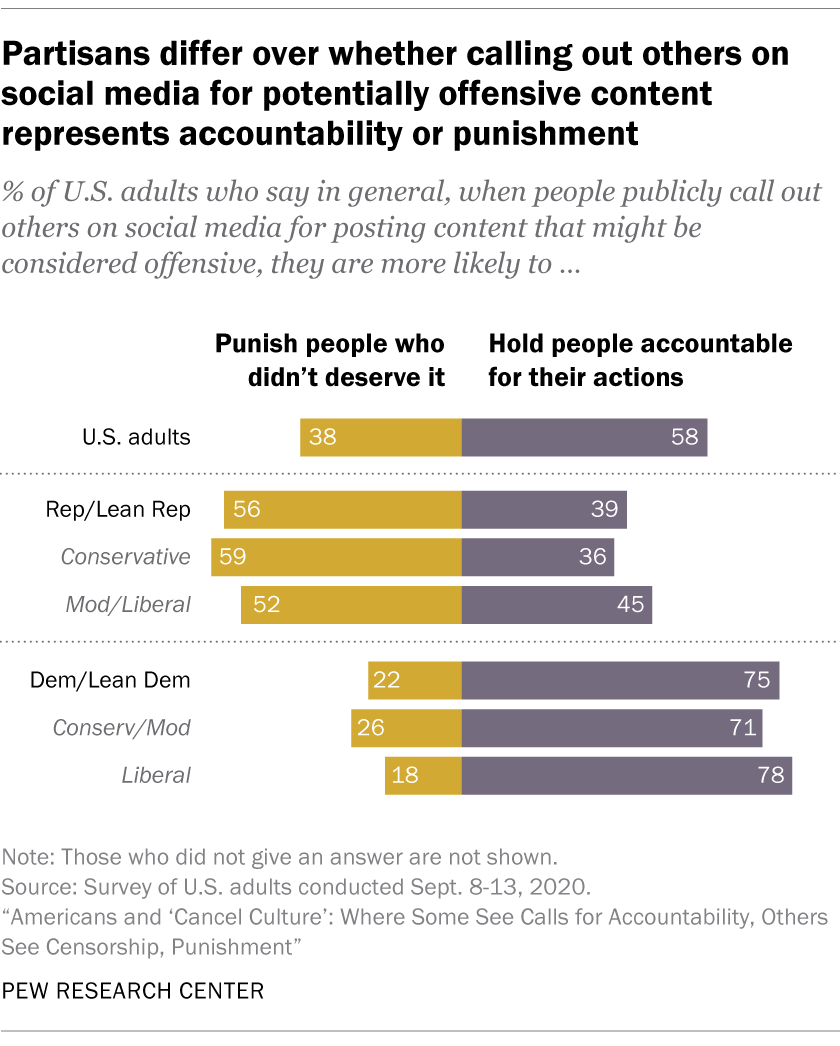
The central problem is that “cancel culture” is not a clearly defined phenomenon. The label can refer to public criticism, consumer boycotts, workplace discipline, social-media harassment, account removal or censorship. Americans themselves are divided over whether it means accountability or unfair punishment, often along partisan and demographic lines, while researchers use inconsistent terms and measures (see Figure 1). 4
That makes broad claims difficult to prove. Surveys can show that people feel worried about political, social or professional consequences, but they cannot establish what causes that fear, how widespread any self-censorship is, or whether it results specifically from cancellation rather than polarization, ordinary disagreement, workplace norms, harassment or platform policies. People’s views can also be shaped by whether an episode is framed as accountability or censorship, and by their group identity.
Not all deplatforming reduces expression in a meaningful sense. Removing accounts that spread harmful misinformation may improve the wider public conversation by reducing false claims’ reach. A peer-reviewed Nature study found that Twitter’s deplatforming after January 6 reduced misinformation exposure on the platform, challenging the assumption that every account removal is a net loss for free expression. 5 There is still uncertainty: harmful communities may move elsewhere, and evidence remains limited on long-term outcomes.
Public criticism can also give a voice to people failed by formal institutions. Survivors may turn to public disclosure when reporting systems are inaccessible or distrusted, seeking recognition or pressure for action. This can expand accountability and participation, though it also carries real risks of error and unfairness. 6
The bottom line
The evidence supports a qualified conclusion: cancellation-related practices can threaten practical free expression when networked punishment, professional risks and online hostility cause people to withdraw or self-censor. Those effects are likely to be conditional and uneven, rather than shared equally across society.
But the evidence does not establish that “cancel culture,” broadly defined, is a uniform or systematic threat to free expression. The term groups together very different actions, some of which can suppress participation and others of which can promote accountability, protect people from harm or reduce misinformation.
Whether a particular case threatens free expression depends on its accuracy, proportionality, fairness, permanence, the power of those involved and its demonstrated effects. The largest uncertainty remains basic: current research cannot reliably separate the effects of cancellation from those of other forces shaping public speech.
Figures & data
All contributions are reviewed for clarity, balance, and evidence. The strongest insights are elevated into the argument graph — with credit to you.
Help improve this analysis →