Antibiotic resistance is accelerating faster than new antibiotic development
What's this about?
People disagree about whether drug-proof germs now grow faster than people can make new germ-fighting drugs. The evidence says the need for new drugs is much greater than the supply.
What supporters say
- The list of new germ-fighting drugs stays too small for the worst drug-proof infections.
- Many possible new drugs sit early in testing and may never reach sick people.
- The biggest gap involves Gram-negative bacteria (a hard-to-treat group of tiny germs).
- Drug-proof bacteria directly caused about 1.27 million deaths worldwide in 2019.
What critics say
- New drugs and research plans do exist, so drug making has not stopped.
- Death totals show a huge problem, but they do not prove resistance speeds up every year.
- Germ resistance does not rise at one same speed in every nation or illness.
- More drug use helps drug-proof germs spread, but use alone cannot prove faster resistance.
The bottom line
The claim has strong support: drug-proof germs create a growing threat, while new drug supplies lag behind. Still, we cannot say resistance speeds up at one single rate everywhere.
Antibiotic resistance is posing a growing challenge to medicine, while the supply of new drugs is failing to keep pace with the infections that need them most. The claim is substantially supported—but “accelerating” should not be read as a single, universal trend measured at the same rate in every country or disease.
The case for
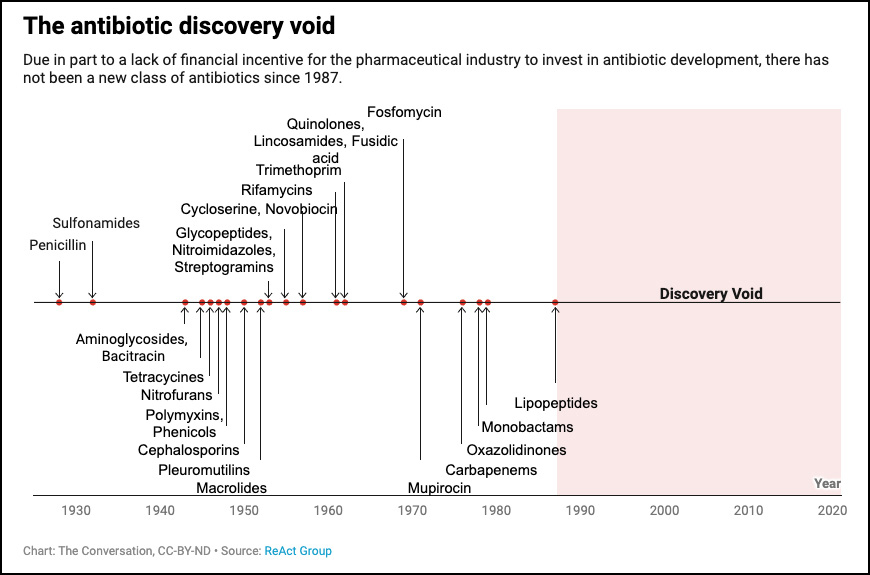
The strongest evidence is that the antibiotic pipeline is too small and too limited in scope for the most dangerous drug-resistant infections. There are new drugs and research projects, but headline totals can mislead: many candidates are still at an early stage, may fail in testing, or offer only small improvements over medicines already available. The shortage is particularly acute for highly resistant Gram-negative bacteria, among the pathogens with the greatest unmet need. Through 2023, the pipeline had not grown enough to provide a reliable stream of genuinely new treatments for these priority threats (see Figure 1). 14
The human toll is already severe. Global estimates found that bacterial antimicrobial resistance directly caused about 1.27 million deaths in 2019 and was associated with roughly 4.95 million deaths that year. Later analyses also point to substantial long-term and future burdens unless stronger action is taken. These figures do not directly measure whether resistance is speeding up year by year, but they show that the need for effective treatments is already immense. 2
Antibiotic use continues to fuel the problem. When bacteria are exposed to antibiotics, resistant strains are more likely to survive and spread. Global antibiotic consumption rose substantially between 2000 and 2015 and continued to shift from 2016 to 2023. Consumption alone is not proof that resistance is accelerating, but it remains a major source of the selection pressure that favors resistant bacteria. 3
Economic forces help explain why scientific need has not produced a stronger drug pipeline. Antibiotics are usually taken for short courses, and responsible stewardship means doctors are encouraged to reserve new medicines for when they are truly needed. That limits sales. Drugmakers also face difficult science, costly clinical trials, and the risk that resistance may quickly reduce a new drug’s value. Reviews of the United States market describe antibiotic innovation as historically weak and commercially unstable. 5
The case against
The word “accelerating” is the claim’s biggest weakness. Resistance does not follow one simple global path. Its burden varies widely by country, antibiotic and organism. Global analyses have found declining resistance-related burden among younger children in some settings, alongside rising burdens among older adults. European surveillance likewise shows sharp differences between nations and between types of bacteria. 6
Resistance is also not always permanent. In some cases, reducing or withdrawing antibiotic use can partly reverse resistance, especially where resistant mutations make bacteria less fit when the drug is absent. The effect depends on the particular mutation, the bacterium’s genetic makeup and its environment. In other cases, resistance can persist even after antibiotic pressure is reduced, so stewardship is helpful but not a universal cure. 7
There is also no single global yardstick for comparing the two sides of the claim. Resistance can be measured through laboratory samples, prevalence, treatment failures, deaths or modeled disease burden. Antibiotic development can be counted as laboratory candidates, clinical trials, approvals, novelty or actual availability to patients. Incomplete surveillance and differing definitions make a precise worldwide race between the two difficult to prove.
The bottom line
The evidence strongly supports a more careful version of the claim: the development of genuinely novel, clinically useful antibiotics is not sufficient to meet the threat from priority multidrug-resistant infections. Resistance-related illness and deaths far exceed what today’s pipeline is likely to address.
However, the evidence does not establish that resistance is universally accelerating at a precisely measurable rate faster than drug development. Patterns differ across pathogens, places and populations, and some resistance can be reduced. Still, confidence is high that there is a serious innovation gap: too few promising new antibiotics are reaching patients who need them most.
Pros — Supporting Arguments
Cons — Opposing Arguments
Figures & data
All contributions are reviewed for clarity, balance, and evidence. The strongest insights are elevated into the argument graph — with credit to you.
Help improve this analysis →