Telehealth should replace most in-person medical visits
What's this about?
People disagree about whether telehealth should take the place of most doctor visits. Telehealth means getting care by video, phone, or online messages.
What supporters say
- Telehealth can work as well as office visits for some health needs and some patients.
- It works best with home health checks, messages, clear tips, and regular doctor reviews.
- It saves travel time, waiting time, and time away from jobs or family care.
- It can help people in rural places, people with limited movement, and those with long-term health needs.
What critics say
- Studies show the best results for chosen patients and certain health problems, not every kind of care.
- A video call by itself may not give enough help or health facts for good care.
- Some people may still need an office visit after telehealth, which can erase travel savings.
- Telehealth use differs among health services and groups of patients, so it may not help everyone equally.
The bottom line
Telehealth gives useful care for many planned visits, mainly when doctors add home checks and follow-up. But the evidence does not show that it should replace most in-person visits for all people and health problems.
Telehealth should replace most in-person medical visits only if the evidence shows it can work safely across the wide range of conditions, patients and specialties seen in ordinary care. The research instead points to a more limited conclusion: virtual care is valuable for many selected appointments, but not as a blanket substitute.
The case for
For the right kinds of care, telehealth can deliver results similar to face-to-face visits. Studies from the pandemic period found broadly comparable results for several conditions, while a randomized trial of online psoriasis treatment matched in-person care for a carefully selected group of dermatology patients. 1 The strongest results come when video visits are backed by remote health measurements, messaging, patient education and regular clinician review—not when a video call is used alone.
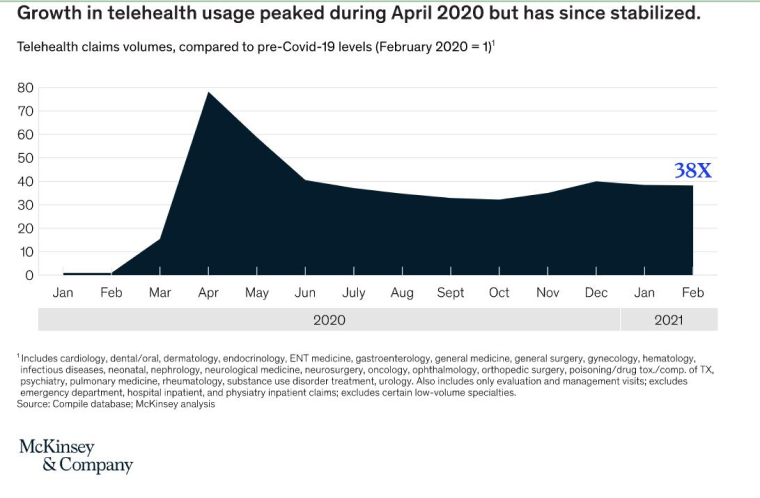
Virtual visits can also make health care far easier to reach. They can save patients from travel, waiting rooms and time away from work or caregiving. This is especially helpful for people in rural areas, those with limited mobility, and patients who must regularly check in for chronic conditions. A systematic review found generally high satisfaction with telemedicine, particularly because it reduced travel and waiting times. 2 Medicare use of telehealth rose sharply during the pandemic and remains higher than before, though use differs across services and groups of patients (see Figure 1).
For people with long-term illnesses, telehealth can support more continuous care. Regular remote check-ins, home measurements and digital communication may help patients manage their condition and allow clinicians to spot problems earlier. 3
There can be an environmental benefit as well. When a virtual appointment truly replaces a car trip or other travel, it can cut travel-related emissions and reduce the burden on patients. 4 But that gain is less clear if the patient must later make the same trip for an in-person follow-up, or if extra equipment and digital infrastructure add costs.
The case against
The main problem with replacing most in-person visits is straightforward: much of medicine still requires being in the same room. Doctors often need to examine a patient physically, order or perform tests, carry out procedures, or act quickly when someone’s condition worsens. Emergency telemedicine can help with triage and specialist advice, but it cannot provide a complete hands-on examination and must include a clear route to in-person care or transfer when needed. 5
Evidence showing that telehealth works is also too narrow to justify a broad replacement policy. Results vary by specialty, illness, patient group, outcome measured and how the service is designed. Some image-based problems can be assessed accurately at a distance, for example, but this depends on image quality, clinician experience and the ability to arrange an in-person assessment when there is doubt. A primary-care review found similar outcomes for some measured conditions, but also reported uneven evidence and important gaps. The successful psoriasis trial involved a population whose condition was especially suited to visual assessment. 6
A virtual-first mandate could also deepen existing health inequalities. Some patients do not have reliable broadband, appropriate devices, a private place to speak, language support or the skills and confidence to use digital tools. Research has linked telehealth access and use to income, demographic and infrastructure differences, with particular barriers reported among low-income racial and ethnic minority communities. 7
There are further risks. Uncertainty in a remote consultation can lead to a later in-person visit, turning telehealth into an extra step rather than a replacement. Virtual care also raises privacy and cybersecurity concerns involving medical data, online platforms, device security and whether a patient can speak confidentially at home. Those problems can be managed, but only through strong safeguards rather than an assumption that digital care is risk-free. 8 9
The bottom line
The evidence does not support replacing most in-person medical visits with telehealth. Confidence in that conclusion is high: research consistently finds real benefits for selected services, but also lasting limits involving examinations, testing, diagnostic uncertainty, equity and the need to escalate care quickly.
Telehealth should instead be expanded as part of a hybrid system. It can be the first option when a visit is clinically appropriate, patients have the needed technology and measurements, and clinicians can promptly switch to in-person care when risk or uncertainty appears. Patient satisfaction and convenience show that telehealth is useful and widely accepted, but they do not by themselves prove that virtual care is equally safe or effective across most of medicine.
Pros — Supporting Arguments
Cons — Opposing Arguments
Figures & data
All contributions are reviewed for clarity, balance, and evidence. The strongest insights are elevated into the argument graph — with credit to you.
Help improve this analysis →