The Falkland Islands (Malvinas) rightfully belong to Argentina
What's this about?
People disagree about whether the Falkland Islands, or Malvinas, belong to Argentina (a South American land) or Britain.
What supporters say
- Argentina says it took over Spain’s claim after it broke free from Spanish rule.
- Spain had run nearby lands, so Argentina says Spain’s island claim passed to it.
- Argentina says Britain took control in 1832–33 and pushed aside an earlier Argentine claim.
- The UN (a group of many lands) says both sides have a real dispute and should talk.
What critics say
- No court with the power to decide has said that Argentina owns the islands.
- The UN has not told Britain to give the islands to Argentina.
- The UN asks for talks, but talks do not prove that one side owns the land.
- The islands sit near Argentina, but being close does not by itself prove who owns them.
The bottom line
Argentina has a strong, long-running claim, based on Spain’s old claim and Britain’s move in 1833. But no final legal choice has given the islands to Argentina, so we cannot say its ownership is settled.
Argentina says the Falkland Islands, which it calls the Malvinas, are its territory. The evidence shows it has a serious, continuing claim—but it does not establish that Argentine ownership is a settled legal fact.
The case for
Argentina’s case begins with history. It argues that, after becoming independent, it inherited Spain’s claim to the islands along with other territory administered under Spanish colonial rule. This argument, based on succession from Spain, is the foundation of Argentina’s legal position. 1
Argentina also disputes Britain’s return to control of the islands in 1833. Historical research supports the narrower point that Britain re-established authority through an imperial action in 1832–33 and later built a colony there. That matters because Argentina sees the British move as the removal of an earlier authority, rather than the beginning of an uncontested British presence. 2
The United Nations gives Argentina’s position important international standing. In Resolution 2065, the UN recognized that there was a sovereignty dispute between Argentina and the United Kingdom and called on the two countries to negotiate. UN decolonization bodies have continued to treat the issue as unresolved, rather than as territory whose British status is beyond question. 3
Argentina also points to geography. The islands lie close to the Argentine mainland in the South Atlantic, and that regional link gives political and territorial context to its claim. But proximity alone does not decide who owns territory; Argentina’s argument ultimately depends more heavily on its claimed inheritance from Spain and its challenge to the events of 1833. 4
The case against
The most significant obstacle to the claim that the islands “rightfully belong” to Argentina is that no binding international ruling has awarded them to Argentina. The UN has acknowledged a dispute and urged talks, but it has not ordered Britain to hand over the islands or declared Argentine sovereignty. That leaves the legal question open, and makes a categorical conclusion difficult to support. 7
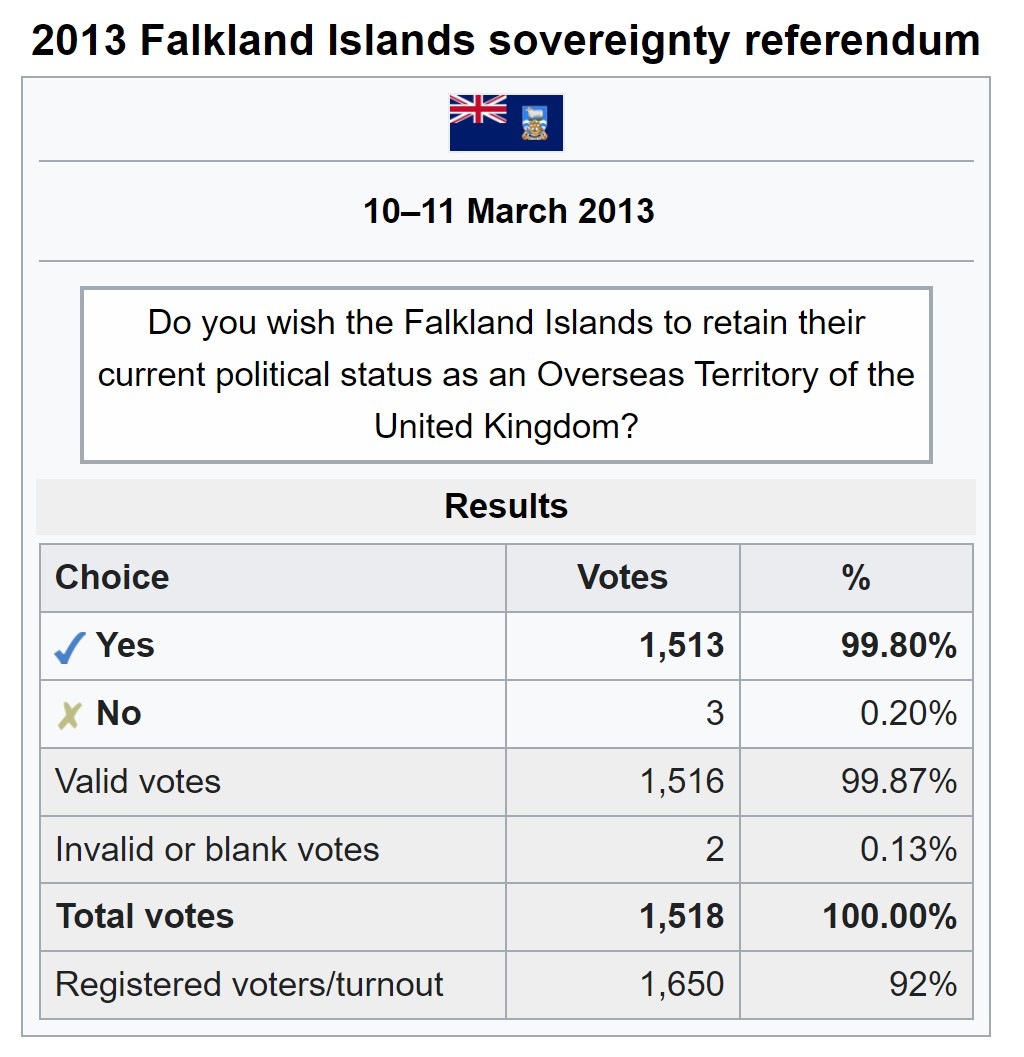
The wishes of the islanders are also a major factor. In a 2013 referendum, 99.8% of participating voters chose to remain a British Overseas Territory, with turnout above 90% (see Figure 1). Britain and the islanders argue that any settlement that ignored that preference would deny the residents their right to self-determination. 5
Argentina takes a different view, saying that a population formed under British administration should not be able to veto a decolonization settlement involving territorial integrity. The UN’s approach reflects the fact that neither side has won that argument outright: Resolution 2065 calls for negotiations while saying the interests of the island population must be taken into account.
Britain’s long record of governing the islands since 1833 also strengthens its competing case. Over that period, the islands have developed a distinct community under British administration. Effective control and long-term administration do not, by themselves, settle whether Britain’s original return was lawful, but they are relevant factors in a territorial dispute. 6
Nor did Argentina’s 1982 military action settle the issue in its favor. The UN Security Council called for an end to hostilities and for Argentine forces to withdraw. Legal accounts distinguish that war from the earlier, unresolved question of who had the stronger original claim to sovereignty. 8
The bottom line
The evidence supports a serious Argentine claim, not a settled Argentine right to the islands. Argentina can point to Spanish colonial succession, its objection to Britain’s 1833 return, geography, and the UN’s recognition that the dispute remains unresolved.
But those points do not amount to an international legal decision in Argentina’s favor. Britain’s long administration, the islanders’ overwhelming preference for British status, and the absence of any binding settlement or judgment all weigh heavily against saying the islands definitively “rightfully belong” to Argentina.
The central uncertainty remains unresolved: how much legal weight should be given to colonial succession and territorial integrity, compared with effective administration and the political wishes of the people who live on the islands. The claim is therefore too absolute, even though Argentina’s sovereignty case cannot reasonably be dismissed.
Figures & data
All contributions are reviewed for clarity, balance, and evidence. The strongest insights are elevated into the argument graph — with credit to you.
Help improve this analysis →