Student loan forgiveness programs have had limited impact on alleviating the broader student debt crisis
What's this about?
People disagree about whether student loan relief plans can fix the larger student debt problem in the United States. These plans can help some people a lot, but they may not solve the whole problem.
What supporters say
- Loan relief plans can erase or cut debt for people who meet the rules.
- Plans like Public Service Loan Forgiveness help workers in some public jobs after years of payments.
- Other plans can help people with a disability, school harm, or other serious problems.
- Help with loans can give families more money for food, rent, savings, and other needs.
What critics say
- These plans reach only some borrowers, while the nation still has a huge amount of student debt.
- Strict rules about jobs, loans, payments, and forms can keep eligible people from getting help.
- New students keep taking out loans, so new debt can replace debt that relief plans erase.
- Interest can make balances grow when people cannot pay enough each month.
The bottom line
Student loan relief can greatly help people who qualify. But it has limited power to end the wider debt crisis without lower college costs and less new borrowing.
Student-loan forgiveness programs can bring major relief to borrowers who qualify. But the evidence suggests they have limited power to solve the broader U.S. student-debt crisis on their own, because they reach only part of a vast and continuing system of borrowing.
The case for
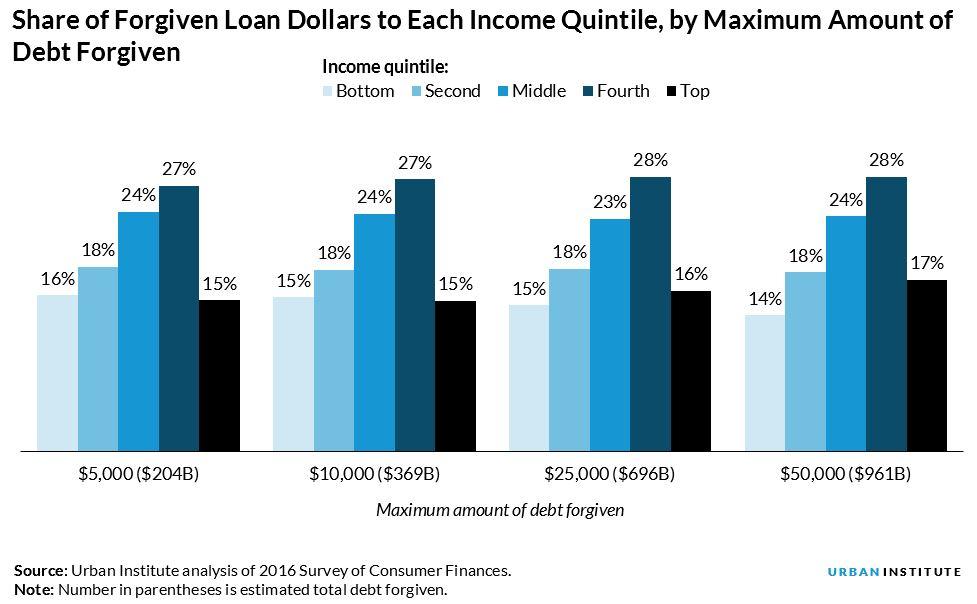
The strongest argument is one of scale. Federal education debt remains a huge national burden spread across a large borrower population, while existing forgiveness programs are targeted to particular groups. That means they can erase or reduce debts for many individuals without substantially ending the country’s overall stock of student loans (see Figure 1). Targeted cancellation is not the same as system-wide debt reform. 1
Programs such as Public Service Loan Forgiveness, or PSLF, have strict requirements. Borrowers must generally hold eligible loans, work in qualifying public-service jobs, make qualifying payments and provide the right documentation. Other discharge programs are similarly limited to specific circumstances, including disability, school misconduct or death. These rules direct aid to borrowers Congress or agencies have identified as needing it, but they also mean that most borrowers do not automatically receive relief. 1
Forgiveness also does little by itself to stop new borrowing or rising balances. Student debt can grow when payments fail to cover accumulating interest, especially for people with low incomes or breaks in repayment. Income-driven repayment plans can eventually lead to forgiveness, but often only after many years. Unless the underlying cost of college and the way higher education is financed change, new loans can offset debt that has been cancelled. 2
Administrative hurdles further limit the reach of these programs. A randomized field experiment found that borrowers were more likely to enroll in income-driven repayment when they received targeted information and assistance. That finding suggests that many eligible people do not automatically obtain protections already available to them. Communication, paperwork and enrollment systems matter as much as formal eligibility. 3
More broadly, forgiveness does not directly address why borrowers become deeply indebted in the first place. The evidence describes a highly uneven system: borrowers differ sharply in debt levels, income, education paths and repayment experiences. Research has not settled whether forgiveness itself changes tuition or college pricing, but it does show that debt problems cannot be reduced to a single policy lever. 4
The case against
Judging forgiveness only by the national debt total can miss its most important effects. For people who receive it, cancellation can remove a major financial burden and improve day-to-day security. Federal programs provide routes to relief through public-service work, income-driven plans and circumstance-specific discharges, even if each route comes with conditions related to employment, income, loan type, repayment history and documentation. A policy can be limited at the national level yet life-changing for individual borrowers. 5
Income-driven repayment also provides benefits before any final debt cancellation occurs. Peer-reviewed research finds that linking payments to income can protect borrowers against income shocks, lower required monthly payments and affect default and spending decisions. In this sense, repayment reform can act as financial insurance for borrowers whose earnings fall or fluctuate. 6
There may also be benefits that do not show up in the national loan balance. Research links student debt to financial stress, while a study of a specific historically Black college and university population found an association between debt and stress. An observational working paper on public-service workers reported suggestive links between PSLF and improved well-being. Wider research has also examined possible effects on homeownership, household formation, entrepreneurship and consumption, though results vary greatly among borrower groups. 7
Still, these findings do not prove that forgiveness produces broad economic gains for everyone. Evidence on well-being is often observational or focused on particular populations, and the effects of relief appear to depend on borrowers’ income, age, balance and when relief arrives (see Figure 2). Researchers also lack a single comprehensive causal study showing how forgiveness programs affect the national debt stock, future borrowing or long-term household outcomes.
The bottom line
The claim is well supported if the broader student-debt crisis means the nation’s total debt burden and the forces that keep producing new loans. Existing programs are targeted, conditional and sometimes difficult to access, so they cannot alone resolve a large and evolving debt system. 1
But the claim is incomplete if it implies that forgiveness has little value. For qualifying borrowers, cancellation and income-linked repayment can provide substantial payment relief, reduce exposure to income shocks and potentially improve financial well-being. 5 The clearest conclusion is that these programs are meaningful protections for recipients, but not a standalone solution to the broader debt crisis.
Figures & data

All contributions are reviewed for clarity, balance, and evidence. The strongest insights are elevated into the argument graph — with credit to you.
Help improve this analysis →