The US national debt is a genuine economic crisis
What's this about?
People disagree about whether the US national debt has become a true economic crisis. The debt keeps rising, but the US can still pay its bills today.
What supporters say
- Government debt could reach 166% of the whole economy by 2054 if laws stay the same.
- Budget gaps, more older people, and rising interest costs all push debt higher.
- Interest on debt uses money that could fund tax cuts, roads, schools, or disaster help.
- High debt may limit choices during wars, recessions, or natural disasters.
What critics say
- The US does not now face a near-term risk of failing to pay its bills.
- The US can still borrow money, so this does not look like an instant crash.
- Studies show debt harms can differ a lot between countries and times.
- No one knows exactly when high debt might raise loan costs or slow private business growth.
The bottom line
The evidence shows a serious long-term money problem, not an instant crisis. Leaders can act sooner to avoid harder choices later.
The United States is carrying a debt burden that official forecasts say will keep growing for decades. The evidence points to a serious long-term fiscal crisis, but not to an immediate inability to pay its bills or borrow money.
The case for
The clearest warning sign is the direction of federal debt. The Congressional Budget Office projects that debt held by the public will reach 166% of GDP by 2054 under current law, driven by continuing budget deficits, an aging population and rising interest costs. The Government Accountability Office has called the federal fiscal path unsustainable and urged earlier action to avoid harsher choices later. 1
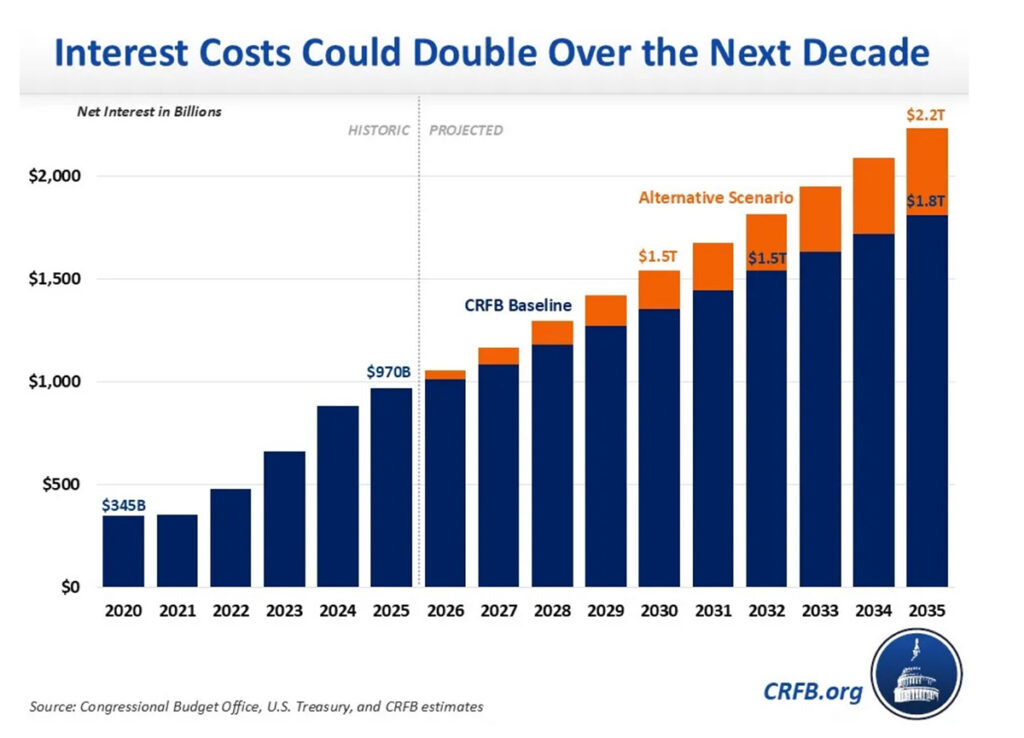
Interest payments are already making the problem more immediate. CBO’s 2025 outlook projects large deficits over the next decade and a growing share of federal resources going to net interest payments (see Figure 2). That can leave less room for tax cuts, public investment, emergency aid or other policy priorities. 2
High debt may also weaken the economy over time. It can reduce the government’s flexibility when recessions, wars or disasters strike, and it may push up borrowing costs or crowd out some private investment. Research supports concern about these risks, though it also finds that their size and timing differ widely across countries and economic conditions. 3
There is also a political danger separate from the debt’s underlying size. Repeated fights over the federal debt limit can disrupt government operations and unsettle Treasury markets, even if the United States is fully capable of paying its obligations. Research from the Chicago Fed and analysis by the GAO indicate that such brinkmanship can raise borrowing costs and damage market functioning. 4
Large deficits can add to inflation pressure when demand is already greater than the economy’s ability to produce goods and services. In a more extreme scenario, heavy government borrowing could make it harder for the Federal Reserve to set monetary policy freely. But the evidence does not show that current US inflation is mainly caused by debt, or that this form of fiscal control over monetary policy is already happening. 5
The case against
The strongest argument against calling this an immediate crisis is that the US has unusual financial strengths. It borrows in its own currency, meaning it is not exposed to the same kind of nominal default risk as a country that owes debt in foreign currency. Its real constraints are inflation, interest rates, available economic resources and political credibility—not simply running out of dollars. 6
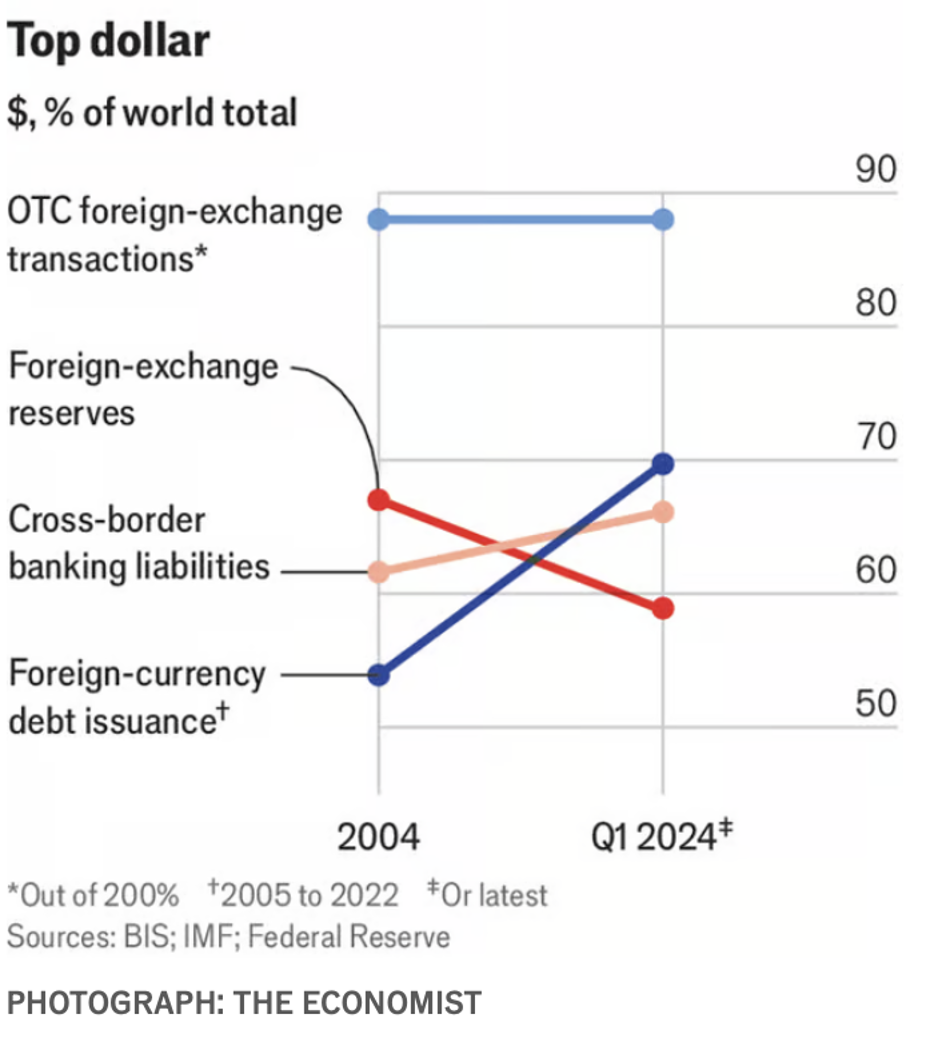
The dollar’s global role further strengthens US borrowing capacity. The Federal Reserve finds that the dollar remains central to global reserves, trade, cross-border finance and safe-asset markets, despite some movement toward diversification (see Figure 3). That creates steady worldwide demand for Treasury securities and makes a sudden loss of market access less likely. 9
Debt levels alone do not provide a clear alarm bell. There is no reliable, universal debt-to-GDP threshold at which economies automatically collapse. The once influential claim that growth drops sharply when public debt rises above 90% of GDP has been weakened by replication work and methodological criticism. Studies still find links between high debt and slower growth in some cases, but the cause-and-effect relationship remains disputed. 7
Treasuries also provide something valuable: safe, liquid assets used by investors and financial institutions around the world. And when interest rates remain below the economy’s growth rate, debt can be less costly than it appears under simpler calculations. That does not make borrowing free, and there is no guarantee that favorable rate-and-growth conditions will last. 8
The bottom line
The evidence supports calling US debt a serious, gradually developing fiscal-sustainability crisis, with high confidence. Official projections show debt rising for decades, while interest costs increasingly limit the government’s choices and leave it more exposed to future shocks.
But it is not an immediate conventional solvency or funding crisis. America’s ability to borrow in its own currency, the dollar’s global dominance and the market value of Treasury securities give it substantial protection against a sudden financing breakdown.
The central uncertainty is whether interest rates, economic growth, investor demand and fiscal policy remain favorable. Those factors will determine whether the debt problem can be managed through gradual policy changes—or becomes much more expensive under market or political pressure.
Figures & data

All contributions are reviewed for clarity, balance, and evidence. The strongest insights are elevated into the argument graph — with credit to you.
Help improve this analysis →