Standing desks measurably improve sustained attention and focus compared with seated desks
What's this about?
People disagree about whether standing desks help people keep their minds on work better than seated desks. The key question is whether standing gives a real focus boost over many hours.
What supporters say
- Some studies show that people feel more engaged and more productive when they use standing desks.
- One study found that standing did not harm most work tasks and may help with some signs of engagement.
- Desk converter plans linked to less sitting also linked to higher self-rated work output.
- Short tests suggest that standing for about 45 minutes can change mood, body signs, and some test scores.
What critics say
- Many studies ask how productive people feel, not how well they truly focus during a full workday.
- Short lab tests cannot show whether any focus gain lasts through emails, talks, and long hard tasks.
- A large check of many studies found no steady proof that standing desks improve work output or task skill.
- The clearest result shows that active desks usually do not harm work skill by much.
The bottom line
Standing desks may help some people feel more awake or engaged for short times. But the evidence does not show that they reliably improve long-term attention and focus over sitting.
Standing desks may help some workers feel more engaged or productive, but the evidence does not show that they reliably improve sustained attention and focus compared with sitting. The stronger conclusion is that standing generally allows people to maintain their performance, rather than boosting it.
The case for
Some research points to possible benefits from standing while working. Studies have reported improvements in engagement-related measures, perceived productivity and certain short-term cognitive or stress-related outcomes for people using standing desks or desk converters. One study found that standing did not broadly worsen task performance and suggested gains on some measures linked to engagement. Another found that a desk-converter program was associated with higher self-reported productivity and less time spent sitting. 1
Brief experiments also suggest that standing for about 45 minutes can change workers’ subjective feelings, physiological state and scores on some cognitive tests. These findings leave open the possibility that standing may help particular people, or particular kinds of work, in the short term.
But those results have important limits. Many measure how productive people feel, rather than tracking objective attention over a normal workday. Others focus on short laboratory tasks. That means they cannot show whether a brief lift in engagement lasts through hours of emails, meetings and concentrated desk work.
The case against
The broad evidence does not find a consistent cognitive advantage for standing desks. A systematic review of active and sit-stand workstations found that studies varied widely and did not provide sufficiently consistent evidence that these desks improve workplace productivity or performance. The review more clearly supported a different conclusion: active workstations generally do not substantially harm performance (see Figure 1). 2
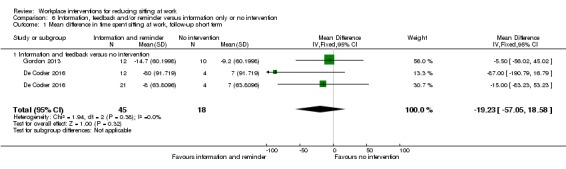
A separate review examining whether breaks from sitting improve cognition during an office day also found too little evidence to say such breaks reliably produce benefits that last all day. The Cochrane review similarly supports workplace measures, including sit-stand approaches, for reducing sitting time, but says broader effects on work and health outcomes — including cognitive performance — remain uncertain (see Figure 2).
Direct comparisons between seated and standing work have also failed to show a clear, general advantage for standing. These studies often use short, controlled tasks rather than measuring attention over a full day of ordinary office work. Being able to complete a cognitive test while standing is not the same as proving that standing improves objective, sustained focus over hours of work (see Figure 3). 3
The evidence is stronger for sit-stand desks as tools to reduce occupational sitting and encourage posture changes. That can be a useful health or comfort goal, but it should not be treated as proof that standing produces better concentration. Research on treadmill or cycling workstations is also only partly relevant, since those setups combine standing or sitting with movement rather than testing a static standing desk alone.
The bottom line
The claim that standing desks measurably improve sustained attention and focus over seated desks is not established. There is credible evidence that standing or sit-stand arrangements usually let workers maintain cognitive performance on many tasks, and some studies suggest limited, task-specific or short-term benefits. But the evidence does not show a durable, general improvement in attention across normal office days.
Confidence in that conclusion is high because both research reviews and direct experiments point to the same pattern: performance is commonly maintained, while clear improvements are inconsistent. The main unanswered question is whether longer studies using objective, all-day measures of attention might uncover benefits in particular settings or for particular workers.
Pros — Supporting Arguments
Figures & data
All contributions are reviewed for clarity, balance, and evidence. The strongest insights are elevated into the argument graph — with credit to you.
Help improve this analysis →