Renewed fighting in Tigray will significantly worsen Ethiopia’s political stability and humanitarian conditions
Bottom line (updated 2026-09-24): New fighting would likely cause serious harm to people in Tigray. The proof for this harm is stronger than the proof for a major crisis across all of Ethiopia.
What's this about?
People disagree about whether new war in Tigray, a region in Ethiopia, would hurt the whole country.
The key question is how large, long, and wide the fighting became.
What supporters say
- Large war would likely cause more deaths, wounds, hunger, lost homes, and harm to daily life.
- New fighting could deepen the crisis between Tigray, Ethiopia’s leaders, and nearby Eritrea.
- People in Tigray could again face killings, forced moves, sex crimes, and harm to homes.
What critics say
- The claim depends on the size and length of the new war.
- Ethiopia has many other causes of unrest, so Tigray alone may not cause a country-wide crisis.
How to read this
The number of points on each side does not show who is right; strong proof matters more than a long list.
The bottom line
New fighting would likely cause serious harm to people in Tigray.
The proof for this harm is stronger than the proof for a major crisis across all of Ethiopia.
Renewed fighting in Ethiopia’s Tigray region would probably cause serious humanitarian harm, but its effect on the country as a whole would depend heavily on how large, long and widespread the conflict became. The evidence is stronger for humanitarian damage than for a nationwide political crisis.
The case for
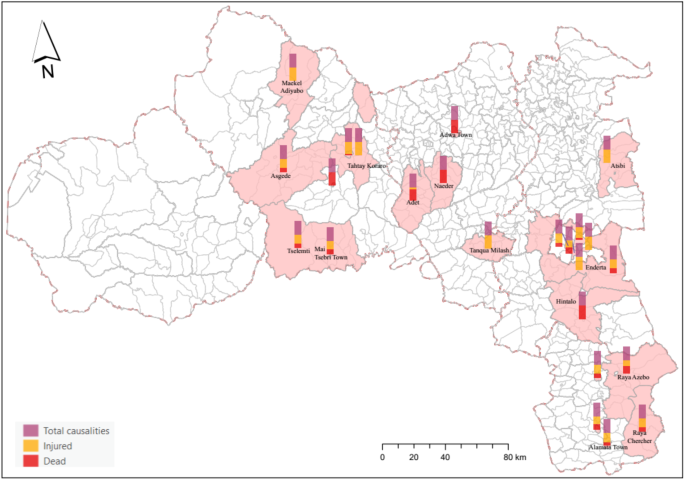
The clearest case concerns humanitarian conditions. Ethiopia’s 2020–2022 war produced very large numbers of conflict-related deaths, along with civilian deaths and injuries from airstrikes. Although the exact mortality estimates are uncertain because they rely on retrospective surveys and modeling, the overall conclusion is not: large-scale fighting caused severe civilian suffering. A similar conflict could again bring deaths, injuries, displacement and destruction. 1 (see Figure 1)
The damage would extend beyond direct violence. Fighting can disrupt hospitals, food and nutrition services, markets, supply routes and livelihoods, while also restricting humanitarian access. Studies of Ethiopian households link exposure to conflict with acute food insecurity, and research has documented harmful coping strategies in communities affected by war. These findings provide strong grounds for expecting sustained fighting to worsen hunger and living conditions.
Civilian protection risks would also return quickly if forces used tactics similar to those seen in the earlier war. A joint investigation by the United Nations human rights office and Ethiopia’s Human Rights Commission documented unlawful killings, displacement, sexual violence and destruction of civilian property. Research on airstrikes separately recorded civilian deaths and injuries. Renewed heavy fighting could therefore produce repeated abuses and fresh displacement. 3 (see Figure 2)
There is also a plausible path from renewed conflict to broader political instability. Tigray’s unresolved disputes are tied to relations among the region, Ethiopia’s federal government and Eritrea. Possible outside intervention, as well as links to the conflict in Amhara, could turn a regional crisis into a wider challenge for federal institutions and the implementation of the peace agreement. 2
The case against
The claim is too broad if it treats any renewed fighting as certain to produce a major national deterioration. The evidence supports a conditional forecast: consequences would depend on the conflict’s scale, duration, geographic spread and conduct. The Pretoria peace process reduced open warfare, even though territorial, security and governance disputes remain unresolved. Localized clashes or a short-lived escalation might cause serious regional harm without recreating the national impact of the previous war. 4
The political argument is also less firmly established than the humanitarian one. Existing analysis identifies possible escalation routes, but it does not quantify either the likelihood of a nationwide crisis or its likely size. There is no clear threshold showing when violence in Tigray would significantly change federal legitimacy, relations between governments, national displacement, aid access or the wider economy.
Ethiopia’s instability has several independent causes. Continuing violence in Amhara and Oromia, drought, food insecurity, health risks and governance pressures are already placing strain on the country. Human Rights Watch and other assessments have also described abuses, displacement and humanitarian needs since the Tigray agreement. Renewed fighting could worsen conditions in the north without being the main cause of any measurable nationwide decline. 5
The bottom line
The evidence strongly supports the view that a return to broad or prolonged warfare in Tigray would significantly worsen humanitarian conditions. The previous war shows the scale of the possible damage, including deaths, civilian injuries, displacement, hunger and disruption of essential services.
The evidence is more limited and conditional on national political stability. Renewed fighting could deepen Ethiopia’s wider crisis if it spreads, lasts or interacts with conflicts involving Amhara, Oromia, Eritrea or the federal government. But localized or rapidly contained clashes would not necessarily produce a significant nationwide deterioration.
The most defensible conclusion is therefore not that any renewed fighting would have that effect. Rather, large-scale or sustained fighting would carry a substantial probability of significantly worsening Ethiopia’s humanitarian situation and could materially deepen its political crisis. The main uncertainty is how far the violence would escalate and how it would interact with the country’s other conflicts.
Figures & data

All contributions are reviewed for clarity, balance, and evidence. The strongest insights are elevated into the argument graph — with credit to you.
Help improve this analysis →