Remote work has permanently restructured commercial real estate markets in major cities
What's this about?
People disagree about whether remote work has changed big-city business property markets for good. The proof suggests it has, but cities do not all face the same changes.
What supporters say
- City-center offices still get fewer workers each day than before the pandemic.
- Hybrid work, which splits time between home and work, can help firms keep workers without hurting results.
- Firms may rent less office space and choose rooms made for team talks.
- Fewer daily trips downtown can hurt shops, food places, trains, home demand, and land prices.
What critics say
- The drop in office use differs a lot from city to city.
- Some office-entry counts miss buildings, so they cannot show every workplace.
- Downtown areas have not all collapsed, and many still have busy parts.
- Some old office buildings can become homes, which may give empty areas new uses.
The bottom line
Remote and hybrid work seem to have made a lasting change in many big-city business property markets. Still, the change looks uneven, not like every downtown office area will fail.
Remote and hybrid work have permanently changed commercial real estate in many major cities, the evidence suggests. But the shift is uneven, and it does not amount to a universal collapse of downtown office districts.
The case for
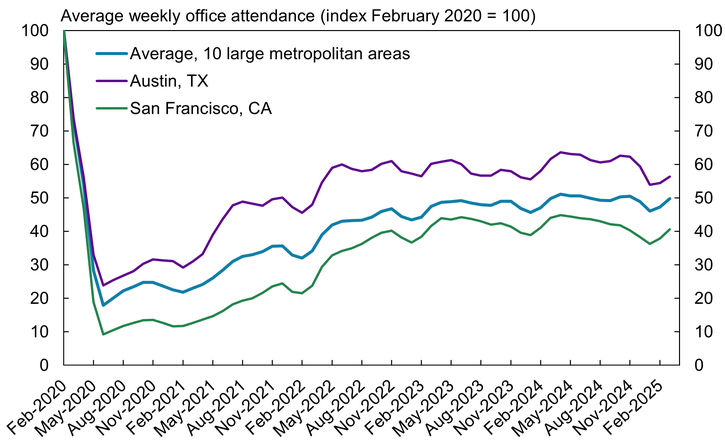
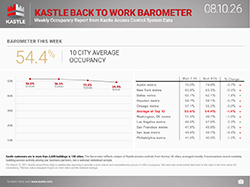
The clearest sign of a lasting change is that office use in city centers remains below pre-pandemic levels. Analysis from the Kansas City Fed finds that downtown office activity is still weaker across metropolitan areas, even though the size of the decline varies sharply by city. Access-control data from major U.S. metros also show only a partial return in office entries, though those figures do not cover every building (see Figure 1). Lower day-to-day office use is no longer simply a short-term pandemic effect 1.
Hybrid work also has foundations that could make the change endure. A large randomized study found that hybrid arrangements improved employee retention without reducing performance. Research on corporate real estate points to the likely result: firms may need less space overall, while putting more value on flexible layouts and offices designed for meetings and collaboration rather than routine desk work 4.
The impact reaches beyond office towers. Research has found demand shifting away from dense city centers toward suburbs and lower-density areas. When fewer people commute downtown each day, that can affect restaurants, shops, transit activity, housing demand and land values. In other words, remote work can reshape the wider commercial ecosystem of a central business district, not just the amount of office space firms rent 2.
Markets are already responding through prices, debt and redevelopment. An IMF analysis of property transactions found significant post-pandemic repricing and stress in commercial real estate. Meanwhile, federal housing officials have documented office-to-residential conversions as a policy and redevelopment response for outdated office buildings (see Figure 3). Because leases, refinancing and property sales unfold over years, these changes may continue to work their way through the market long after the initial shift to remote work 3.
Conversion pressure is particularly telling. It suggests that some buildings and neighborhoods are being reconsidered for a different mix of homes, offices, retail and leisure. That is evidence of a structural land-use response, even if conversion is only one option among several 5.
The case against
The claim can go too far if it implies that every major city is experiencing the same outcome. Research from the Kansas City Fed and Brookings points to large differences in office use, residential growth, transit recovery and local economic performance. Some metropolitan areas have held up better than others, meaning the experience of highly distressed downtowns cannot simply be applied everywhere 6.
Nor can all office-market weakness be blamed on remote work. Higher interest rates, tighter credit and broader economic shocks have also lowered property values and made refinancing more difficult. The IMF’s analysis identifies market stress but cautions that it is difficult to separate the effects of working from home from these other forces. Remote work is a major contributor, not the sole explanation 7.
It is also too soon to say that office demand has reached its final level. Leasing, rents, vacancies, construction and absorption are still changing, while building-entry data measure physical attendance rather than long-term leased demand or property values. Work patterns could continue to evolve, and some firms may bring employees back more often than current data imply 8.
Finally, office conversion is difficult to scale. Many buildings have layouts that do not suit housing, and projects can be blocked by cost, zoning, financing and local housing conditions. Conversion proposals and high-profile examples therefore do not prove that all struggling office districts can be remade quickly or comprehensively 9.
The bottom line
The evidence strongly supports a durable but uneven restructuring of commercial real estate in major cities linked to remote and hybrid work. Office utilization, the geography of demand, pricing risks and incentives to redevelop have all changed from their pre-pandemic patterns.
But the evidence does not support predictions of a uniform or complete urban-office collapse. The most likely outcome is segmentation: higher-quality, amenity-rich and adaptable offices may retain demand, while older or less flexible buildings face greater pressure. Central districts are more likely to develop a different balance of office, residential, retail and leisure activity than to lose their economic role altogether.
Pros — Supporting Arguments
Figures & data

All contributions are reviewed for clarity, balance, and evidence. The strongest insights are elevated into the argument graph — with credit to you.
Help improve this analysis →