Reforming agricultural practices will reduce global greenhouse gas emissions
What's this about?
People disagree about whether changing farms can greatly cut gases that warm our planet.
Evidence says these changes can help a lot, but farms cannot solve the whole problem alone.
What supporters say
- Food growing causes about one-third of all human-made heat-trapping gas releases.
- Farmers can use less extra nitrogen plant food and still grow as much, or sometimes more, food.
- Better animal feed, manure care, and rice field watering can cut methane, which warms Earth quickly.
- Agroforestry (growing trees with crops or animals) can store carbon in trees and soil.
What critics say
- Farm changes work best when wider food system changes happen too.
- Tree-and-soil carbon storage can differ a lot between places and farm types.
- Farmers must keep producing enough food while cutting gases.
- No single farm method can cut all food-related climate pollution.
The bottom line
Changing how we grow food and raise animals can greatly cut global heat-trapping gases.
Still, these farm reforms need other food system changes to make the biggest difference.
Changing how food is grown and livestock are raised can significantly cut global greenhouse-gas emissions, the evidence shows. But farm reforms work best as part of a wider overhaul of the food system, not as a solution on their own.
The case for
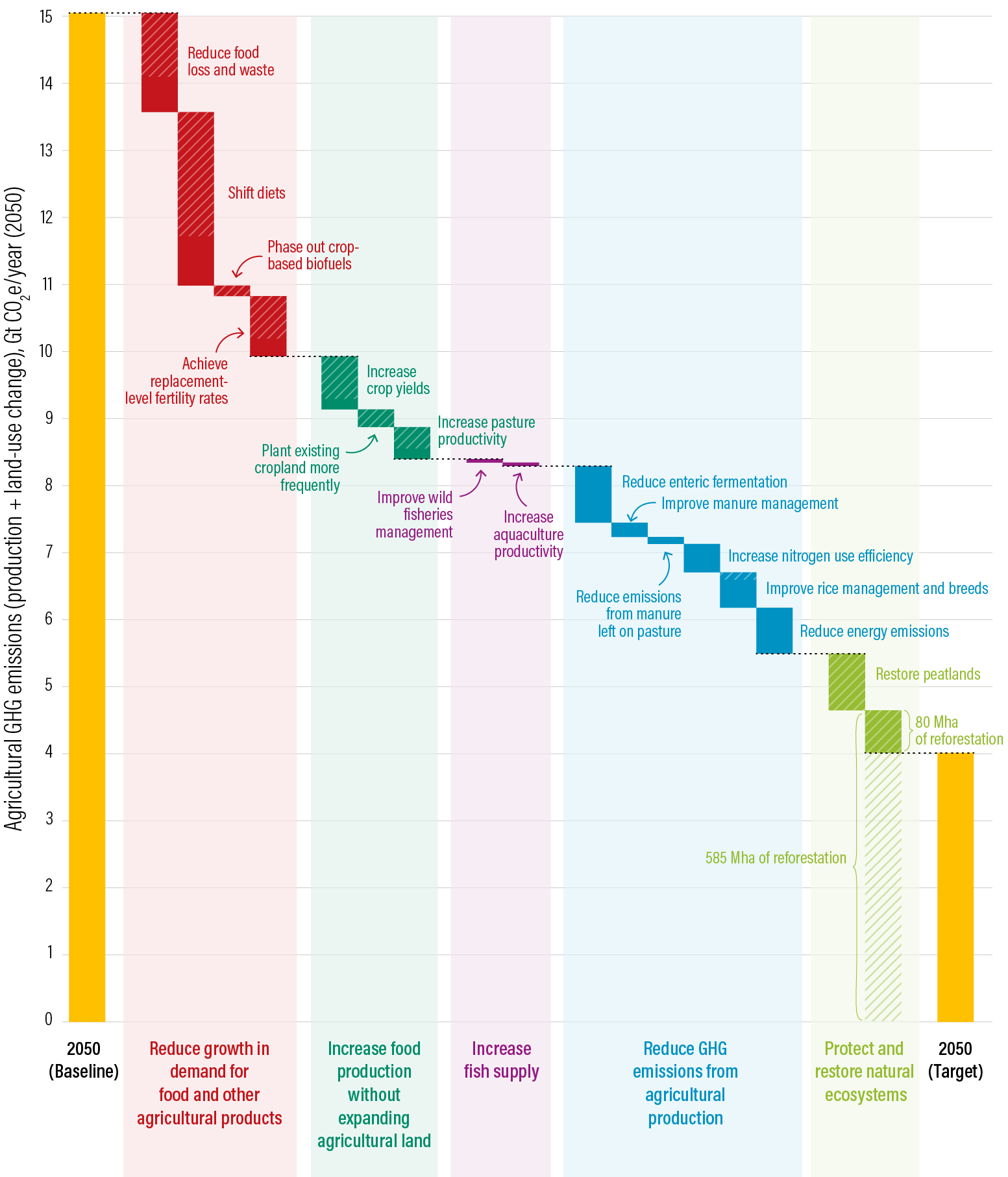
Food production has a large climate footprint. Food systems produce roughly one-third of human-caused greenhouse-gas emissions, with farming and land-use change making up major parts of that total. That gives changes in fields, pastures and forests meaningful potential to reduce emissions. The IPCC identifies improved crop and livestock management, better manure handling, restoration and agroforestry as important options (see Figure 1). 1
One of the clearest opportunities is using nitrogen fertilizer more efficiently. Excess fertilizer can release nitrous oxide, a powerful greenhouse gas. Studies reviewed in the analysis find that better nitrogen management can lower these emissions while generally maintaining, and sometimes improving, crop yields. That matters because climate gains are more credible when farmers do not have to produce less food to achieve them. 2
Methane reductions could also bring relatively fast climate benefits. Livestock, manure and rice cultivation are major sources of the gas. Available measures include improving animal productivity, changing feed, managing manure differently and altering how rice paddies are watered. Because methane does not persist in the atmosphere as long as carbon dioxide, cutting it can slow warming more quickly. 3
Agroforestry—integrating trees with crops or livestock—can add another layer of climate benefit. Trees and soils can store carbon, while tree cover may also strengthen farms’ resilience and improve how they use water and other resources. Research reviews support agroforestry’s ability to build these biological carbon stores, though results differ sharply from place to place. 4
The largest potential comes from combining farm reforms with other changes. Global modeling suggests that improved production, less food waste and shifts in diets together could substantially reduce the environmental pressures caused by food systems, including greenhouse-gas emissions (see Figure 2). 5
The case against
The central limitation is that agriculture does not account for every emission connected to food. Fertilizer manufacturing, farm energy, processing, transport, retail and food waste all add to the total. In many regions, these emissions before and after the farm gate have become increasingly important. Better farming alone cannot eliminate agrifood emissions. 6
Carbon stored in soil is also less certain than emissions that are directly avoided. Soil carbon gains vary by climate, soil type, farming method and how long they are measured. Storage can slow as soils approach saturation, and accumulated carbon can be released again if land management changes or is disrupted. That makes long-term accounting difficult. 7
There is also a risk that a reform which looks successful on one farm could have weaker results globally. Some fertilizer approaches involve trade-offs between soil health, yields and emissions. Likewise, agroforestry can be beneficial, but if adding trees reduces output and production moves elsewhere, the resulting land-use change may offset part of the gain. 8
Finally, technical potential is not the same as real-world results. Farmers need workable technology, finance, knowledge and supportive policies. The IPCC points to competing demands for land, governance problems and questions over permanence, while assessments of methane and nitrogen measures show that costs and feasibility differ widely. Adoption, local conditions and accurate accounting determine whether projected savings become durable cuts. 9
The bottom line
The evidence conditionally supports the claim: reforming agricultural practices can make a significant contribution to cutting global emissions. Confidence is high that agriculture and land use must be part of climate action, particularly through efficient fertilizer use, methane cuts and carefully designed land-management changes.
But these reforms are not a standalone climate solution. Their real impact depends on targeted local design, sustained adoption, reliable carbon accounting and protection against yield losses or production shifting elsewhere. The strongest case is for agricultural reform as one part of broader food-system change—alongside less waste, demand-side measures, land protection and action on emissions beyond the farm.
Pros — Supporting Arguments
Figures & data
All contributions are reviewed for clarity, balance, and evidence. The strongest insights are elevated into the argument graph — with credit to you.
Help improve this analysis →