Global cryptocurrency regulations are becoming increasingly fragmented due to divergent national policies
What's this about?
People disagree about whether crypto rules around the world are growing more different.
Countries already use very different rules for the same crypto work.
What supporters say
- A crypto coin may count as an investment in one country, money in another, or illegal elsewhere.
- These choices change who checks firms and which permits, reports, and safety steps they need.
- Global rule groups find uneven checks on licences, crime money, and data shared during crypto transfers.
- The EU uses one set of crypto rules, while countries outside it use many different plans.
What critics say
- The EU’s MiCA law gives many member countries shared rules for crypto firms and crypto assets.
- Global rule groups also ask countries to use similar checks, such as sharing transfer data.
- Shared rules may make some parts of the crypto market more alike over time.
- We do not have clear proof that the gaps grow steadily in every country.
The bottom line
Crypto rules differ widely across countries today.
But we are not sure if those differences keep growing, because EU and global rules push some countries closer together.
Cryptocurrency rules are widely fragmented across countries, as governments classify and regulate the same activities in sharply different ways. But the evidence is less clear that this divide is steadily growing everywhere over time, because international standards and the European Union’s MiCA rules are also pushing parts of the market toward greater alignment.
The case for
The strongest evidence shows that crypto businesses face very different legal systems depending on where they operate. One country may treat a token as a security, another as a commodity or payment instrument, while others may regard it as property or ban it outright. Those choices decide which regulator is in charge and what a firm must do to comply, from obtaining licences to meeting disclosure and consumer-protection rules. 1
This is more than a difference in language. International reviews by the Financial Stability Board, the International Organization of Securities Commissions and the Financial Action Task Force have found uneven national coverage and supervision. Gaps remain in areas such as registration and licensing, anti-money-laundering oversight and the “Travel Rule,” which requires crypto service providers to share information about transfers. 2
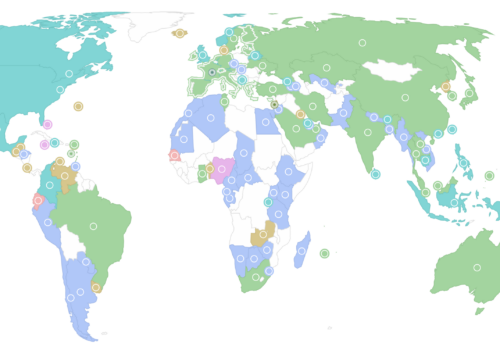
The divergence is especially clear when comparing the European Union with the rest of the world. The EU’s Markets in Crypto-Assets regulation, known as MiCA, sets common rules for many crypto assets and service providers across its member states. Outside the bloc, countries have taken a far broader range of approaches, including outright restrictions, stand-alone licensing systems, taxation-focused policies and reliance on older financial laws. These differences match the broad variation in crypto legality and official policy across countries (see Figure 1). 3
Such gaps can give firms an incentive to base parts of their operations in friendlier jurisdictions. If one country imposes tougher rules on custody, licensing, disclosure or anti-money-laundering controls than another, businesses may seek the lighter-touch option. But this point should be treated cautiously: the evidence supports it as a logical consequence of differing rules, rather than as a directly measured global pattern. 4
The case against
There is also significant movement toward shared global standards. The FSB, IOSCO, the International Monetary Fund and the G20 have built increasingly similar expectations around financial stability, investor protection, stablecoins, information-sharing and cross-border supervision. These efforts show that regulators broadly agree on the main risks crypto markets pose and on the safeguards they want in place. 5
However, these standards generally depend on countries to turn them into domestic law. They do not create one binding worldwide rulebook. As a result, governments can agree on broad goals while still adopting different legal definitions, licensing systems, enforcement practices and institutional arrangements.
MiCA provides the clearest example of genuine harmonization. It is designed to create a more unified EU market for crypto services, reducing uncertainty between member states through common rules on authorization, business conduct and stablecoins. 6 That is substantial progress in one of the world’s major markets.
Yet MiCA’s reach is regional, not global. It weakens any claim that every country is simply drifting farther apart, but it does not erase the major differences between the EU and other jurisdictions.
The bottom line
The evidence strongly supports the view that global cryptocurrency regulation is currently fragmented by divergent national policies. Different classifications, licensing requirements, supervisory systems and anti-money-laundering controls mean that comparable crypto businesses can face very different obligations across borders.
Still, the claim needs an important qualification. The available record shows persistent and possibly worsening differences, but it does not provide a standardized global measure proving that fragmentation is increasing steadily over time everywhere. International standard-setting and MiCA have created meaningful convergence in broad principles and, within the EU, in enforceable rules.
The clearest conclusion is that crypto regulation is moving in two directions at once: convergence on high-level goals, but fragmentation in legal detail and national implementation.
Pros — Supporting Arguments
Cons — Opposing Arguments
Figures & data
All contributions are reviewed for clarity, balance, and evidence. The strongest insights are elevated into the argument graph — with credit to you.
Help improve this analysis →