Climate change and economic instability are major drivers of recent shifts in global migration patterns
What's this about?
People disagree about whether climate change and money problems drive most new moves around the world.
The answer changes by place, move type, and the other risks people face.
What supporters say
- Storms, floods, heat, and dry spells can force people to leave their homes.
- Lost jobs, low pay, poor crops, and unsafe homes can push people to move.
- Climate harm and money stress can join together and make each problem worse.
What critics say
- War and other fights cause much of today’s forced movement.
- Many things shape moves across borders, such as jobs, family, laws, and safety.
How to read this
The number of points on each side does not show which side wins; check the strength of the proof.
The bottom line
Climate change and money stress clearly help drive moves in some places.
But the claim goes too far if it says they cause most migration worldwide; war and many other forces matter too.
The claim that climate change and economic instability are major drivers of recent global migration is partly supported—but it is too broad if it suggests they are the main causes worldwide. The evidence is strongest for specific regions, types of movement and interacting pressures, not for assigning them the largest share of all recent migration.
The case for
Climate hazards clearly cause displacement and migration in exposed areas. The IPCC says, with high confidence, that climate and weather extremes are increasingly contributing to displacement. Research links climate change to movement through crop losses, water shortages, disasters and the loss of places where people can safely live. Monitoring recorded tens of millions of disaster-related internal displacements in 2023, many caused by storms and floods. Those figures show that climate-sensitive hazards are already linked to substantial movement, although they do not by themselves prove that human-caused climate change was responsible for every case. 1
Economic conditions provide another important route. People are more likely to move when jobs, wages, farm incomes and household security deteriorate. At the same time, stronger labor demand and higher wages elsewhere can make migration possible and attractive. Analyses by the OECD and World Bank identify employment prospects, wage gaps, livelihoods and institutions as significant influences on migration. Economic weakness can encourage people to leave, but only when they have enough money, information and networks to do so. 2
Climate and economic pressures often operate together rather than separately. A drought can reduce harvests, cut rural incomes and increase competition for water. Those effects may then contribute to conflict, weak governance or further loss of livelihoods. This makes “climate migration” and “economic migration” difficult to separate in practice: the evidence more clearly supports compound risks, in which environmental and financial pressures reinforce each other. 3
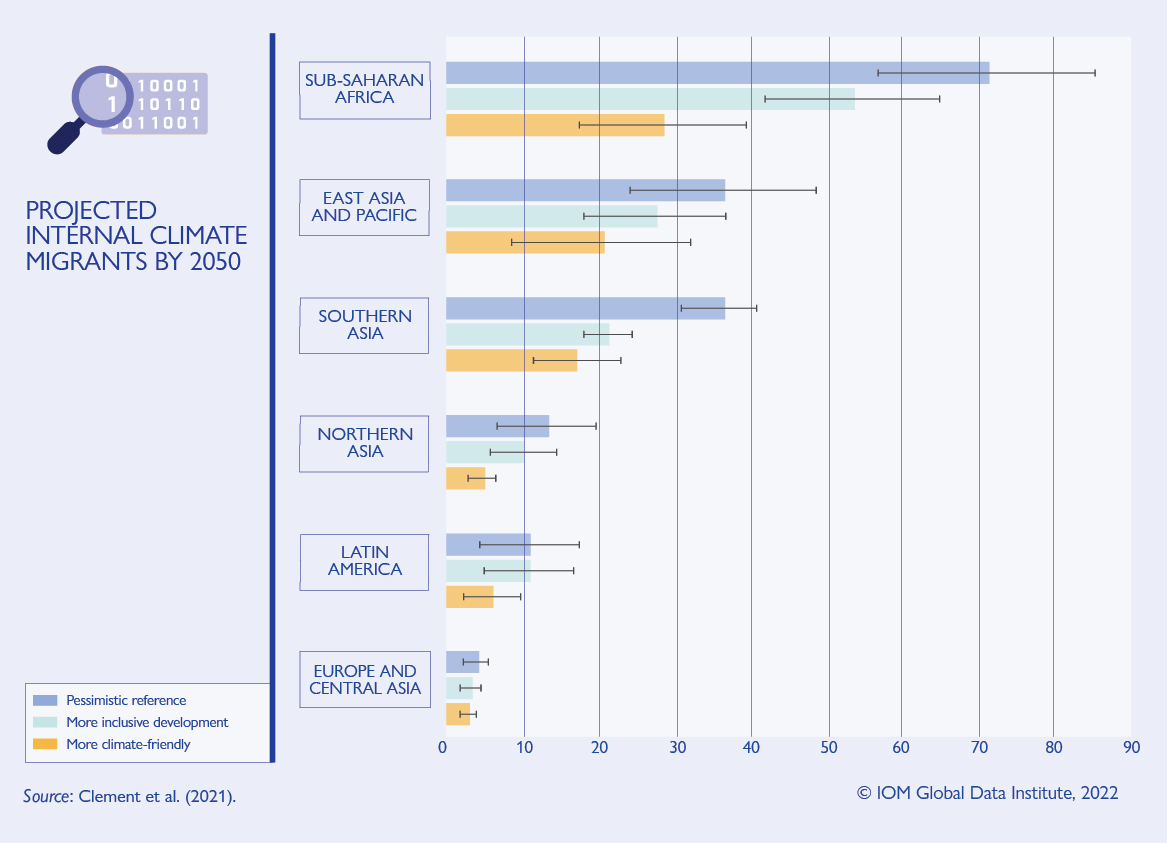
Long-term projections also point to potentially large future effects. Under a pessimistic scenario, the World Bank projected as many as 216 million internal climate migrants across six regions by 2050 (see Figure 2). But that is a projection based on assumptions about emissions, development, adaptation, water, crops, sea-level rise and internal movement—not a count of people already displaced.
The case against
The strongest challenge is that recent forced displacement has been driven mainly by conflict and persecution. UNHCR’s 2023 figures reached a record level largely because of wars in Sudan, Ukraine and Syria. This does not make climate or economic pressures unimportant, but it weakens the case that they are the dominant explanations for global movements observed in recent years. 4
International migration also has many major drivers. Labor demand, family reunification, education, demographic change, migration networks and visa rules can all shape where people move and whether they can move. The IOM treats employment, family, education, conflict, disasters, inequality and policy as connected influences rather than assigning priority to climate change and economic instability. The World Bank similarly distinguishes economic migration from forced displacement and stresses the roles of skills, destination demand, conflict, policy and institutions. 5
Economic instability can push migration in opposite directions. A downturn in an origin country may increase the desire to leave, while a recession in a destination can reduce jobs, wages and access to housing. Climate stress also does not always produce long-distance migration. Depending on resources, institutions and migration costs, it may lead to internal relocation, short-distance movement—or no movement at all. Poor households may be trapped in place because they cannot afford to leave, while climate impacts can reduce the resources needed for international migration.
The bottom line
The evidence moderately supports a qualified version of the claim. Climate hazards and economic stress are well-established causes of movement in particular settings, and they can intensify each other through livelihood loss, conflict and governance failures.
But the evidence is weaker for saying they are the predominant drivers of recent global migration overall. The available studies combine different categories—forced displacement, disaster-related internal movement, international migration and future projections—that cannot be treated as interchangeable. Conflict, labor demand, family, education, demographic change, policy and institutions materially shape the global picture.
The main uncertainty is therefore not whether climate change and economic instability matter. It is how much of recent migration they explain compared with other interacting causes.
Figures & data
All contributions are reviewed for clarity, balance, and evidence. The strongest insights are elevated into the argument graph — with credit to you.
Help improve this analysis →