China will overtake the US as the dominant global power
What's this about?
People disagree about whether China will become the world’s top power before the United States. China has gained ground, but the result remains unsure.
What supporters say
- China now produces more science papers and more top-rated science work than the United States.
- Strong science work could lead to better products, new tools, and a stronger army over time.
- Many Americans and people in other lands think China will someday pass the United States.
- Nations and firms may move closer to China if they think China keeps growing stronger.
What critics say
- The United States still has wide and deep strengths that help it stay powerful.
- More science papers do not always lead to the best new tools, products, or army gear.
- China must turn its science work into real strength in key new tools.
- China must also help set world rules through groups where nations work together.
The bottom line
China has real strength and could gain a long-term edge. But the facts do not show that China will surely pass the United States within one generation.
China is already a global power on a scale that can challenge the United States. But the evidence does not show that it is certain to replace America as the single dominant power worldwide.
The case for
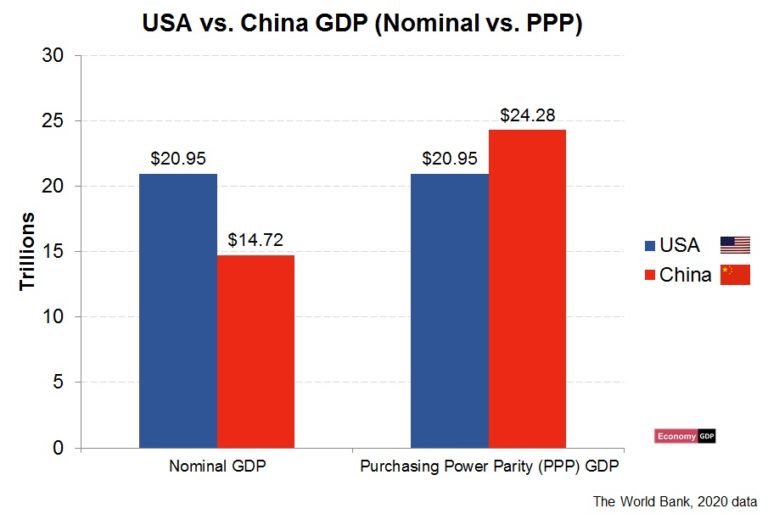
China has become a peer competitor to the United States in several major areas. Measured by purchasing-power parity, which adjusts for what money can buy in each country, China’s economy is already larger than America’s. It has also built major strength in industry, technology and the military, making it plausible that it could overtake the United States in some areas of national power. 1
China’s military buildup is particularly important in its home region. The Pentagon has reported fast progress in Chinese naval, missile, space, cyber, nuclear and defense-industrial capabilities. Those advances have increased China’s ability to challenge US forces in the Indo-Pacific, the strategically vital region stretching from East Asia across the Pacific.
Its huge industrial base could also give Beijing greater influence abroad. China has expanded its economic, military and technological role internationally, while seeking to shape information environments overseas. It has improved in soft-power surveys, even though the United States still ranked first. China’s advances in semiconductor production and manufacturing scale offer another path toward greater influence if that progress continues. 2
A shift in the balance of power would not require China to become stronger than the United States in every field. It could happen if American advantages weaken over time. Long-term forecasts point to factors such as productivity, exchange rates, debt, demographics and domestic policy choices in both countries. These variables could reshape their relative position, though they do not point to one guaranteed outcome. 3
The case against
The main obstacle to a Chinese takeover is that its rise faces serious internal limits. China is aging rapidly, its population is declining, and its working-age population is shrinking. It also faces high debt, trouble in its property sector, slower productivity growth and risks from a less globalized economy. These pressures do not prevent China from remaining powerful, but they make a rapid or inevitable march to global primacy much less certain. 4
The United States also retains advantages that matter greatly for worldwide power. America’s economy remains larger when measured in current-dollar, or market-exchange-rate, terms. The dollar is still by far the world’s leading reserve currency, while China’s renminbi plays a much smaller role. That gives Washington financial reach and influence that Beijing has not matched.
America’s alliance network is another major advantage. The United States has formal allies and security partners across the world, providing military bases, intelligence sharing, coordinated planning, economic ties and diplomatic backing. China’s overseas military access remains far more limited (see Figure 2). 5 That distinction matters because regional strength is not the same as global dominance. China may be increasingly able to contest US power in the Indo-Pacific, but it cannot yet project military power around the world in the same way.
China’s technology gains are substantial, but they are not complete. It remains dependent on foreign technology in some critical areas, especially leading-edge semiconductor production. Its industrial scale is impressive, yet this continuing dependence makes it harder to assume that manufacturing strength will automatically produce broad technological leadership. 6
The bottom line
The strongest reading of the evidence is that China is likely to surpass the United States in some dimensions of power, but is not clearly on course to become the single dominant global power. China leads in purchasing-power-parity output and is increasingly formidable in its region. Yet the United States still holds major advantages in nominal economic size, the global role of its currency, alliances, overseas access and parts of advanced technology.
Long-range forecasts remain highly uncertain because they depend on assumptions about growth, demographics, technology, debt, domestic policy and how other countries respond. Scenario studies point more toward a prolonged, contested rivalry—or coexistence between two major powers—than toward an uncontested Chinese takeover. 7
Confidence in that limited conclusion is high: the available evidence consistently shows a mixed balance of strengths rather than a clear, predetermined transfer of global leadership.
Figures & data


All contributions are reviewed for clarity, balance, and evidence. The strongest insights are elevated into the argument graph — with credit to you.
Help improve this analysis →