Banning social media under 13 improves wellbeing more than supervised access
What's this about?
People disagree about whether banning social media for children under 13 helps them more than careful adult help.
What supporters say
- A ban could lower children’s contact with bullying, bad posts, sleep loss, social pressure, and hard-to-stop use.
- Adult help may fail when dangers stay hidden, change fast, or happen in private chats.
What critics say
- No direct study shows that a ban improves well-being more than supervised use.
- Age bans may be hard to enforce, and children may move to other sites with similar dangers.
- Supervised use can help some children keep friendships, find support, and gain useful skills online.
How to read this
The number of points on each side does not show who is right; the strength of the proof matters more.
The bottom line
A ban could lower some online dangers, especially for children at high risk.
But we are not sure it works better than supervised use, because no direct test compares them.
The claim is that banning social media for children under 13 would improve their wellbeing more than allowing access under active supervision. The evidence gives a plausible case for restrictions, but it does not establish that a ban works better than supervised use.
The case for
A ban could reduce children’s exposure to several well-documented or plausible online risks, including cyberbullying, harmful content, social comparison, sleep disruption and compulsive use. Public-health reviews identify these as possible routes through which social media can affect mental health and daily functioning, although the effects vary by the child, the content and the way the service is used. (see Figure 3) 1
A clear age limit could also protect children from dangers that parents may not see. Some risks are private, change quickly or occur in interactions that are difficult to monitor. Evidence connecting negative online behaviour with problematic use, along with the known limits of parental controls and age-checking systems, suggests that supervision may not prevent every harmful experience. 2
For children who are especially vulnerable, or already showing compulsive patterns of use, removing access could be a simpler preventive measure than expecting families to identify and manage each new risk. This is a plausible argument for a ban, particularly where supervision is inconsistent or the child’s online activity is hard to observe.
The case against
The strongest problem is that there is no direct evidence showing that an under-13 ban improves wellbeing more than supervised access. Existing research is mostly observational, covers different age groups and types of use, or examines individual risks rather than comparing these two policies. The policy reviews do not amount to an outcome study of a ban. 3
Supervised use may also preserve benefits that a blanket prohibition would remove. Online communication can help some children maintain relationships, express themselves, learn, find information and take part in social life. The research generally treats the quality and context of online activity as important, rather than treating all screen or social-media use as equally harmful. That supports approaches such as co-use, communication and targeted monitoring instead of total exclusion. (see Figure 4) 4
A legal ban may not reliably keep every child off social media. Age checks are difficult, children may evade restrictions, and some may move to less regulated services. Policy analyses also raise possible privacy, social-exclusion and displacement costs. The results would therefore depend heavily on how the rules were enforced and how children responded to them. 5
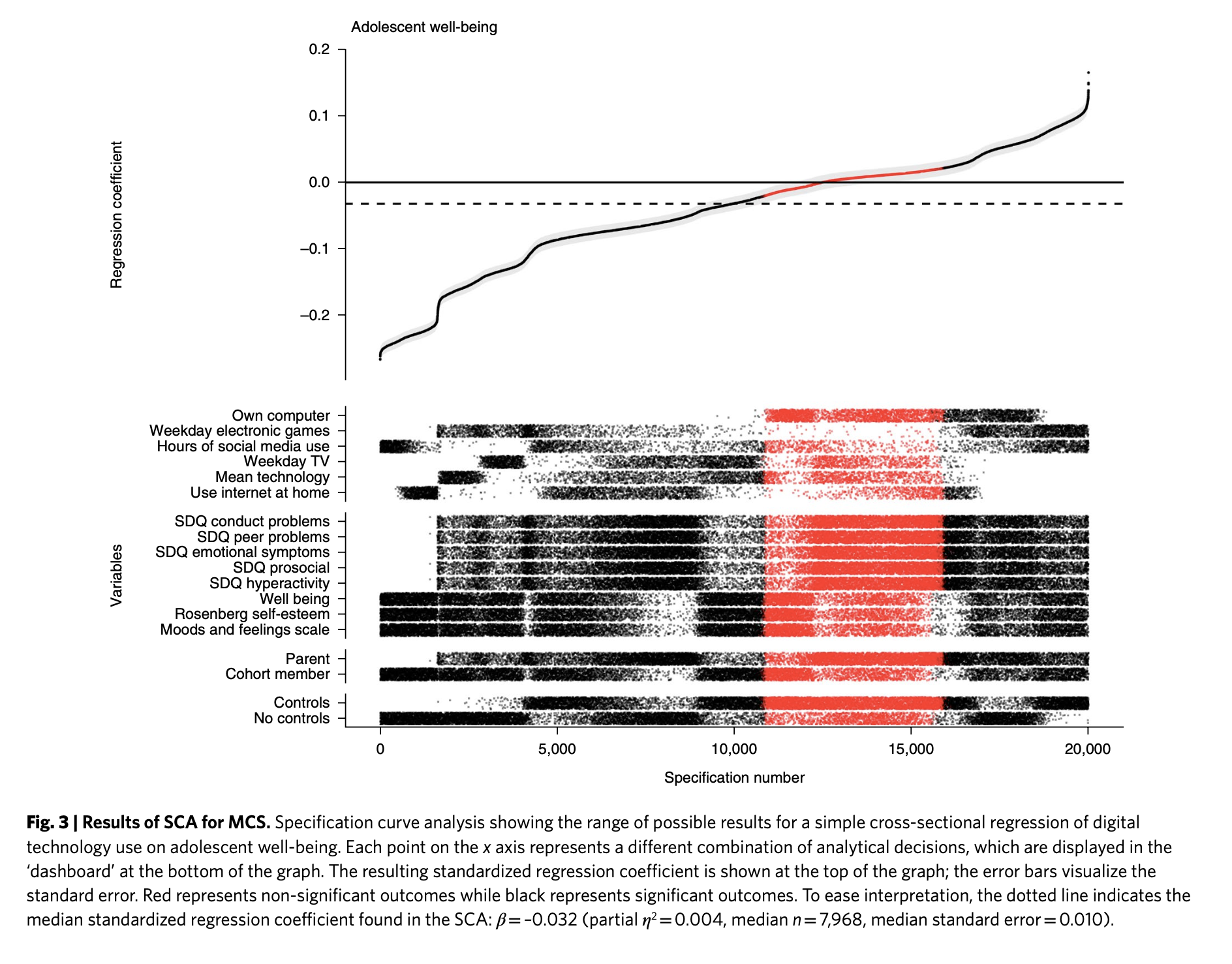
More broadly, average links between social-media use and wellbeing are generally small, even though harms may be much greater for particular children, types of use or circumstances. (see Figure 2) That weakens the expectation of a large improvement across the population from removing access altogether, while leaving open the possibility of important benefits for children exposed to severe harm or compulsive engagement.
The bottom line
The claim is not established. The evidence more strongly supports the existence of risks that a ban might reduce than it supports the specific conclusion that banning social media works better than supervised access. But that is not the same as evidence that supervised use is superior.
The decisive gap is comparative: there is no robust trial or natural experiment testing an under-13 ban against supervised access and measuring wellbeing. The available evidence comes mainly from reviews, observational studies, policy analyses and indirect findings about online benefits. Implementation differences and unresolved conflicts of interest in the wider research and policy debate add further caution.
The fairest conclusion is that the evidence is even on which intervention is better, with high confidence that the comparison remains unresolved. Age-appropriate limits, active supervision, platform safeguards and stronger protection for children at high risk may need to work together rather than being treated as mutually exclusive choices.
Pros — Supporting Arguments
Figures & data

All contributions are reviewed for clarity, balance, and evidence. The strongest insights are elevated into the argument graph — with credit to you.
Help improve this analysis →