Banning minors from social media would reduce teenage mental-health harms
What's this about?
People disagree about whether keeping teens off social media would lower harm to their mental health.
The key question asks if less online risk matters more than lost help and friendship.
What supporters say
- Problem use, such as hard-to-stop use, links with worse mental health.
- A ban could cut risks from online hate, bad sleep, body stress, and harmful posts.
What critics say
- A full ban could remove ways teens find friends, support, news, and help.
- Most links seem small, and we are not sure social media causes the harm.
How to read this
The number of points on each side does not show who is right; strong proof matters more.
The bottom line
The claim has some good sense, but proof does not show that a full ban would help all teens.
The best case supports limits for teens at high risk, not a clear gain for everyone.
The claim that banning minors from social media would reduce teenage mental-health harms has a plausible basis, but the evidence does not show that a blanket ban would clearly improve mental health overall. The key question is whether reducing online risks would outweigh the social and practical benefits that teenagers would lose.
The case for
A ban could cut off several ways in which social media may contribute to harm. Public-health reviews identify cyberbullying, harmful or self-harm-related content, social comparison, pressure over appearance and disrupted sleep as possible links between online experiences and poorer mental health. If a restriction genuinely prevented access, rather than simply pushing teenagers to other services, it could reduce some of these exposures.1
The argument is strongest for teenagers who use social media in particularly harmful ways. Research reviews and long-term studies associate problematic or intensive use with mental-health symptoms. The relationship may work in both directions: distress can lead to heavier or more compulsive use, while that use can deepen distress. A ban might interrupt this cycle for some vulnerable adolescents.2
But this is a narrower argument than saying all teenagers would benefit from losing access. Problematic use is not the same as ordinary use, and the available evidence does not directly measure what happened to teenage mental health after a real-world age ban. The strongest case for restrictions is therefore as a precaution for high-risk users, rather than proof of a large, uniform benefit across the whole population.
The case against
Studies of social media and adolescent well-being often find small and uneven average effects. Large analyses suggest that digital-technology use accounts for only a small share of the differences in teenagers’ well-being—an effect comparable in size to those linked with ordinary teenage activities. Researchers also warn that other factors may explain the relationship, or that poor mental health may cause heavier use in the first place. This makes it uncertain how much improvement a ban would actually produce.3
A blanket ban could also remove benefits that matter to some teenagers. Social platforms help young people maintain friendships, find peer support and health information, explore their identities and connect with communities that may not exist nearby. Those losses could be especially serious for isolated, disabled or marginalized adolescents, for whom online contact may be an important source of support.4
The policy’s real-world impact would also depend on enforcement. Teenagers might evade age checks, move to less-regulated services or lose access without receiving replacement support. Age-verification systems could raise privacy concerns, while the effects of moving from one platform to another would be difficult to predict.
Professional guidance points to this uncertainty. The American Psychological Association recommends safeguards suited to children’s development rather than treating all teenage use as harmful. The U.S. surgeon general has likewise identified meaningful risks but says there is not enough evidence to conclude that social media is safe—or uniformly unsafe—for all young people. More targeted measures, such as stronger privacy settings, better moderation of harmful content, limits on persuasive design and support from parents and schools, could address specific risks without removing every online benefit. The evidence does not yet prove that these alternatives would outperform a ban.
The bottom line
The evidence leans against confidence in a blanket ban, though not against restrictions in every circumstance. There is strong reason to believe that some content and patterns of use harm some teenagers, and a successful restriction could reduce those particular risks. But evidence that a ban would reduce mental-health harms across teenagers as a whole is substantially weaker.
The main unanswered questions concern enforcement, evasion, movement to other services and the benefits teenagers would lose. The overall effect could be positive, negative or close to zero depending on the young people affected and what replaces social media. A ban may help adolescents facing intensive or acutely harmful use, but the current evidence supports a conditional, targeted approach rather than a clear population-wide verdict.
Figures & data
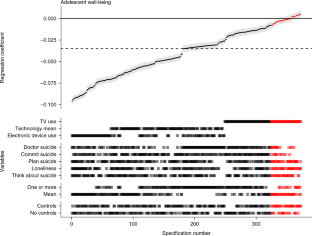
All contributions are reviewed for clarity, balance, and evidence. The strongest insights are elevated into the argument graph — with credit to you.
Help improve this analysis →