U.S. economic sanctions against Iran are an effective means of changing Iranian government behavior
What's this about?
People disagree about whether U.S. trade limits can make Iran’s government change its actions. The best proof comes from a 2015 deal about Iran’s nuclear work.
What supporters say
- Trade limits hurt Iran’s oil sales, banks, jobs, imports, and the value of its money.
- In 2015, Iran agreed to limits on nuclear work after years of pressure and talks.
- Iran wanted the chance to sell more goods and gain access to money again.
- The deal gave Iran a clear choice: accept checks, then gain trade relief.
What critics say
- Trade limits did not alone make Iran agree to the 2015 deal.
- Talks, Iran’s own politics, and help from other nations also shaped the deal.
- After 2018, the United States left the deal and brought back harsh trade limits.
- Iran then followed fewer deal rules and grew more of its nuclear work.
The bottom line
Trade limits can help push Iran toward a deal, especially when talks offer a clear reward. On their own, trade limits do not reliably change Iran’s actions.
U.S. economic sanctions can help change Iranian government behavior, but the record suggests they work best as part of a wider diplomatic deal—not as a stand-alone tool of pressure.
The case for
The strongest example is the 2015 nuclear agreement, known as the JCPOA. After years of coordinated international sanctions and negotiations, Iran accepted verifiable limits on its nuclear program in return for sanctions relief. That outcome shows that economic pressure can help create conditions in which Iranian leaders see a deal as preferable to continued isolation. 1
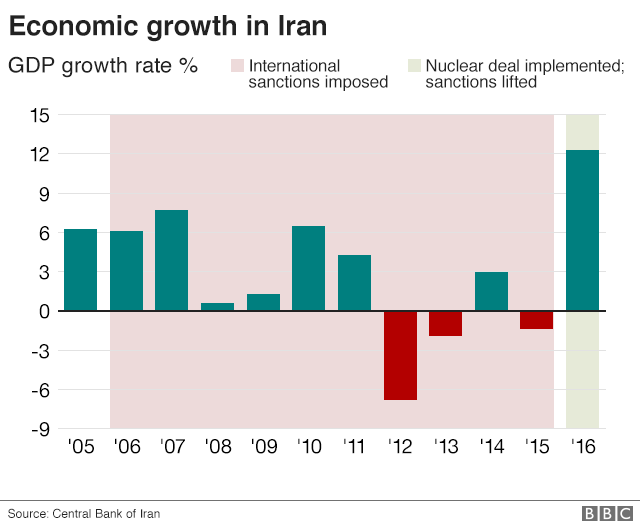
Sanctions gave negotiators leverage because they imposed real costs across Iran’s financial system, oil trade, imports and wider economy. Studies link the restrictions to inflation, a falling currency, unemployment and reduced access to imports. When relief from those pressures is seen as credible and valuable, it can give leaders an incentive to negotiate. 2
But sanctions were not the only reason Iran agreed in 2015. Diplomacy, Iranian domestic politics and international cooperation also played important roles. The evidence therefore supports the view that sanctions were a contributing factor, rather than proof that pressure alone forced Iran to change course.
The details of the 2015 deal matter. It paired coordinated pressure with a clear offer: Iran would accept nuclear restrictions that could be checked, and sanctions would be lifted in return. That is different from simply imposing penalties and waiting for concessions.
The case against
The years after 2018 offer a major warning against treating sanctions as a reliably coercive tool. When the United States left the JCPOA and restored sanctions under its “maximum pressure” campaign, Iran did not return to the earlier nuclear limits. Instead, it later reduced its compliance with the agreement and expanded nuclear activities (see Figure 2). 3
That sequence does not prove sanctions alone caused Iran’s later actions. But it also provides no evidence that renewed, largely unilateral pressure won the concessions Washington sought. The contrast with 2015 suggests that sanctions without a durable diplomatic route and credible relief may not produce the same results.
Iran has also shown an ability to adapt. It has used sanctions evasion, alternative trading partners, changed export patterns, economic substitutions and informal networks to limit the impact on the state and preserve regime resilience (see Figure 1). 4 Severe economic harm, in other words, does not automatically become decisive political leverage.
Much of the burden can fall on ordinary people rather than on decision-makers. Research links sanctions to weaker household buying power, problems affecting health and medicines, and reduced access to services. Comparative studies also find that governments can survive this pressure by shifting costs onto the population and portraying sanctions as foreign aggression. 4
There is less direct Iran-specific evidence that this dynamic strengthens hard-line institutions or blocks compromise. Still, the broader pattern gives weight to the concern that sanctions can reinforce hard-line political narratives rather than weaken them. 5
The bottom line
The evidence supports a conditional, not general, verdict: U.S. sanctions can contribute to changes in Iranian policy when they are backed by other countries, linked to a specific negotiated bargain and matched by credible reciprocal relief. The 2015 nuclear agreement is the clearest case, but it was the result of sanctions working alongside diplomacy and international coordination—not coercion alone. 1
By contrast, the post-2018 experience indicates that unilateral renewed pressure did not reproduce that outcome. Sanctions clearly caused substantial economic disruption, but economic damage and political success are not the same thing. Evidence is strongest for the limited 2015 nuclear outcome and much weaker for wider goals involving Iran’s regional policies, its government’s conduct or internal political change.
There remains an important uncertainty: it is difficult to separate the effect of sanctions from diplomacy, coalition politics and decisions inside Iran. Even so, the overall record gives high confidence that sanctions are useful leverage under narrow, negotiated conditions, while rejecting the broader claim that they are generally effective or reliably force Iran to comply on their own.
Figures & data


All contributions are reviewed for clarity, balance, and evidence. The strongest insights are elevated into the argument graph — with credit to you.
Help improve this analysis →