Telehealth adoption will not meet initial pandemic-era projections
What's this about?
People disagree about whether online doctor visits will reach the very high levels some people predicted early in the pandemic. Use has dropped from its 2020 high, but it remains above where it started.
What supporters say
- Online visits rose fast in 2020 because urgent rules made them easier for doctors and patients.
- Use then fell far below its peak, so early hopes may have guessed too high.
- Many people lack fast internet, devices, tech skills, or help in their own language.
- Doctors cannot do body checks, tests, or many treatments through a screen.
What critics say
- Online care still plays a lasting part in health care, even after the worst part of the crisis.
- It can work well for checkups, follow-up visits, mental health care, and some basic care.
- Online visits can save travel time, especially for people who live far from clinics.
- Keeping online care as one choice may help some patients get care more easily.
The bottom line
The evidence suggests online care will not reach the huge levels predicted during the early pandemic. Still, it has not gone away and will likely stay more common than before COVID-19.
Telehealth use is unlikely to match the most ambitious forecasts made during the height of the COVID-19 emergency. But the evidence also shows that virtual care has settled at a lasting level well above its pre-pandemic role, rather than fading away.
The case for
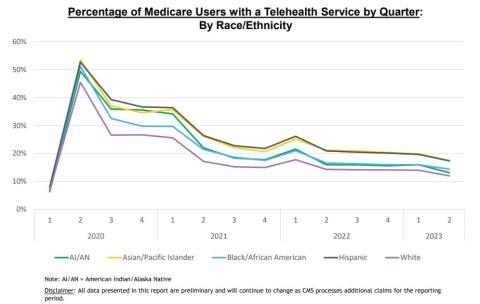
The strongest reason to expect a shortfall is that many early projections were based on an extraordinary moment. Medicare telehealth use surged when lockdowns, infection risks and emergency rules pushed patients and clinicians online. As in-person appointments returned, use fell substantially from its 2020 peak, though it did not disappear. CMS snapshots from 2022 and 2023 show this pattern of post-peak normalization, undermining the idea that emergency-level use would continue indefinitely (see Figure 1). 1
Those peak numbers also depended on unusual support from policymakers and health systems. Emergency waivers, expanded reimbursement and rapid changes to clinical workflows helped make high-volume telehealth possible. Longer-term use depends on more durable conditions: payment rules, licensing, prescribing regulations, privacy requirements, staffing, technology and whether providers can fit virtual visits into ordinary care. These factors mean adoption is shaped by policy and implementation, not just by patient demand.
There are also practical limits to how much healthcare can move online. Telehealth can deliver outcomes comparable to in-person care in some situations, but results differ by illness, how a service is run and what outcome is being measured. Many appointments still need a physical exam, testing, hands-on treatment or a procedure. The evidence therefore supports telehealth for selected services, not as a universal replacement for conventional care. 3
A widely cited estimate that as much as roughly $250 billion in U.S. healthcare spending could potentially be handled virtually should not be read as a forecast of actual online visit volumes. That estimate was based on which care might be clinically suitable, and assumed changes in payment policy, regulation and provider behavior. Potential does not guarantee that care will shift online.
Access barriers further limit broad adoption. Research points to gaps in broadband access, devices, digital skills, language services, disability accommodations and provider capacity. Nationally representative evidence also finds differences in telehealth use between metropolitan and nonmetropolitan communities. These obstacles make it harder for an emergency-era surge to become a universal, long-term pattern. 2
The case against
The main objection is important: telehealth has not returned to its pre-COVID status quo. The same Medicare data that show a decline from the 2020 spike also show continuing use above the old baseline. Post-pandemic studies similarly find that virtual care remains part of routine healthcare delivery, particularly where it is convenient and clinically appropriate. 4
Patients and clinicians may help sustain this higher baseline. Evidence on patient preferences finds meaningful interest in keeping virtual visits, especially for routine and convenient care. A post-pandemic rural study found greater comfort with telehealth and some preference for virtual primary-care appointments, though its local findings cannot establish a national trend.
Still, those preferences are not uniform. Many patients prefer in-person care for particular services, and preferences vary with the type of visit and the patient’s circumstances. This points toward a hybrid model—virtual care alongside traditional appointments—rather than wholesale replacement of face-to-face medicine. 5
There is also no single measure that can settle the question for every forecast. “Adoption” can mean share of visits, spending, patients, services or providers, and estimates vary depending on coding rules and data sources. Much of the clearest trend evidence comes from Medicare, which is useful but does not represent every insurer, age group or clinical setting.
The bottom line
The claim is well supported if “initial pandemic-era projections” means the aggressive expectations that extended emergency or peak telehealth use into the future. Available evidence shows that use dropped from its exceptional 2020 level as in-person care resumed, while remaining above pre-pandemic levels. 1
That is not a story of telehealth failure. Virtual care appears to have won an enduring but selective place in healthcare, supported by continued patient interest and useful applications in appropriate settings. Confidence is high in that overall direction, although an exact scorecard remains impossible without a single defined forecast, population and measure of adoption.
Pros — Supporting Arguments
Cons — Opposing Arguments
Figures & data
All contributions are reviewed for clarity, balance, and evidence. The strongest insights are elevated into the argument graph — with credit to you.
Help improve this analysis →