Restrictions on mail-in voting reduce voter fraud
What's this about?
People disagree about whether making mail-in voting harder stops voter fraud.
The evidence supports a smaller claim: smart safety rules may help, but broad limits lack proof.
What supporters say
- Checks on names and marks may stop people from copying voters or changing ballots.
- Mail ballots have risks, such as pressure, tampering, and poor care that focused rules can limit.
What critics say
- Very strict signature rules can reject real ballots from people who voted lawfully.
- Cases of proven fraud with mail ballots are rare, even though fraud can happen.
- Limits may make voting harder for people without clear proof that they improve safety.
How to read this
The number of points on each side does not show who is right; the strength of the proof matters more.
The bottom line
Smart rules aimed at known risks may help protect mail ballots.
But broad limits have not shown that they lower fraud overall, and some may block real votes.
Restrictions on mail-in voting are often promoted as a way to prevent fraud. The evidence, however, supports a narrower conclusion: targeted safeguards may address real vulnerabilities, but broad limits on mail voting have not been shown to reduce fraudulent ballots overall.
The case for
Mail ballots create specific opportunities for abuse, including impersonation, coercion, tampering and improper handling by third parties. Rules focused on those risks—such as chain-of-custody requirements, limits on ballot collection, witness rules and identity checks—are logically aimed at real weaknesses in the process 1.
A North Carolina investigation documented organized manipulation of absentee ballots serious enough to invalidate an election result. Guilty pleas in related cases confirmed that the collection and handling of mail ballots can be exploited. That episode provides concrete support for safeguards governing who may handle ballots and how they are tracked. But it does not show how much any one restriction reduced fraud.
Verification systems may also detect or discourage some forms of impersonation and tampering before ballots are counted. Election-administration reviews identify signature checks, ballot tracking and related procedures as security tools. Policy analyses have also pointed to identification numbers, witnesses and notarization as possible ways to address particular risks 2.
The strongest argument for the claim is therefore limited. Carefully designed safeguards can address documented vulnerabilities. The available evidence is much weaker for the broader idea that making mail voting harder, in general, has been shown to reduce fraudulent ballots.
The case against
The central problem is a lack of proof that restrictions reduce fraud overall. Reviews and prosecution records consistently indicate that proven mail-ballot fraud is uncommon 3. They show that fraud is possible, but they do not measure how often it occurs or compare fraud rates under different legal systems.
The strongest direct evidence against some restrictions concerns signature verification. Peer-reviewed studies find that judging whether a signature matches can be subjective and error-prone. Stricter or inconsistently applied standards can therefore reject valid ballots without showing that more fraudulent ballots have been stopped (see Figure 2) 4.
Additional requirements may also impose costs on voters, though the most direct research cited concerns identification rules for in-person voting rather than mail ballots. That evidence does not prove that mail restrictions have the same effect. It does, however, weaken the assumption that adding requirements automatically produces broad election benefits, especially when mail-specific reductions in fraud have not been demonstrated 5.
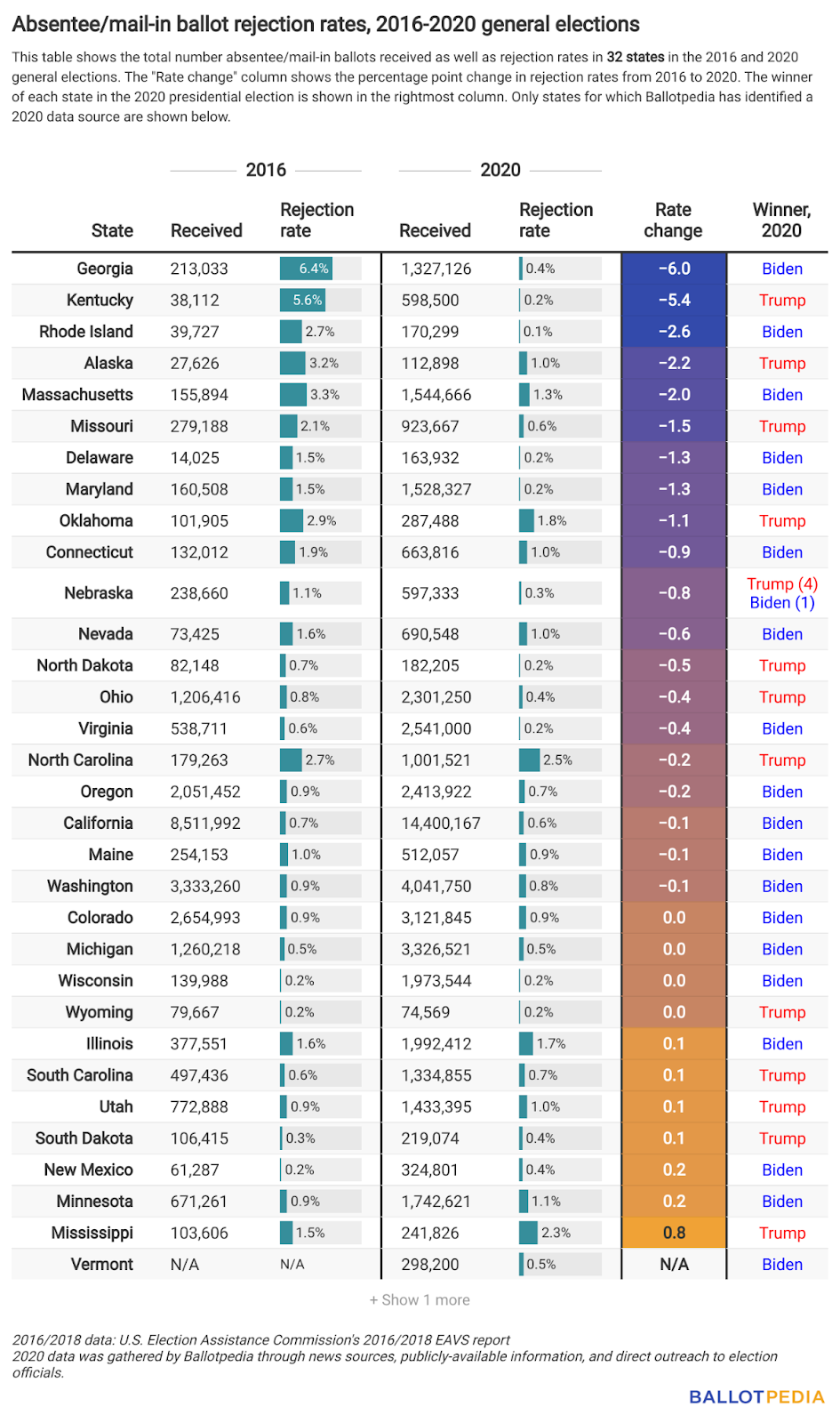
Administrative rejection rates and errors are generally low, but they vary according to verification and ballot-curing practices. That means election security must be judged alongside how officials handle valid ballots and correct mistakes (see Figure 3).
The bottom line
The evidence does not establish that restrictions on mail-in voting, as a general class, reduce voter fraud. It more strongly supports targeted controls—such as ballot tracking, custody rules and carefully designed identity checks—that address specific risks documented in exceptional cases.
The overall balance remains close because real vulnerabilities have been documented, but the evidence for a population-wide reduction in fraud is missing. The main uncertainty is the lack of reliable before-and-after or cross-jurisdiction comparisons showing how many fraudulent ballots a particular restriction prevents versus how many valid ballots it wrongly blocks.
The most defensible conclusion is conditional: policymakers should judge each rule by its demonstrated effect on a specific vulnerability, as well as its error and participation costs. Restrictiveness by itself is not evidence that fraud will fall.
Figures & data
All contributions are reviewed for clarity, balance, and evidence. The strongest insights are elevated into the argument graph — with credit to you.
Help improve this analysis →