Efforts to reform lobbying practices in the United States have been ineffective, even though there is widespread public backing for such reforms
What's this about?
People disagree about whether U.S. rules have stopped rich groups from having too much sway in politics.
The rules have made some things clearer, but they have not fixed every part of the problem.
What supporters say
- Lobby rules have gaps, and weak checks may let some groups hide work or avoid signing up.
- Many people fear that rich donors, firms, and groups have too much sway over law and rule makers.
- Groups still spend huge sums to win time, care, and a voice from law makers.
What critics say
- New rules made groups list their work, share key facts, and follow some limits.
- A group having sway does not prove it fully controls laws or gets all it wants.
How to read this
The number of points on each side does not show who is right; look at how strong the proof is.
The bottom line
The claim is partly right: reforms have not ended the sway of rich and well-run groups.
Still, the rules made real gains in public records and limits, so calling them fully useless goes too far.
The claim that U.S. lobbying reforms have failed is partly supported, but only if “failure” means that reforms have not removed the influence of wealthy and well-organized interests. The evidence shows meaningful gains in transparency and formal restrictions, alongside continuing gaps in access, enforcement and influence.
The case for
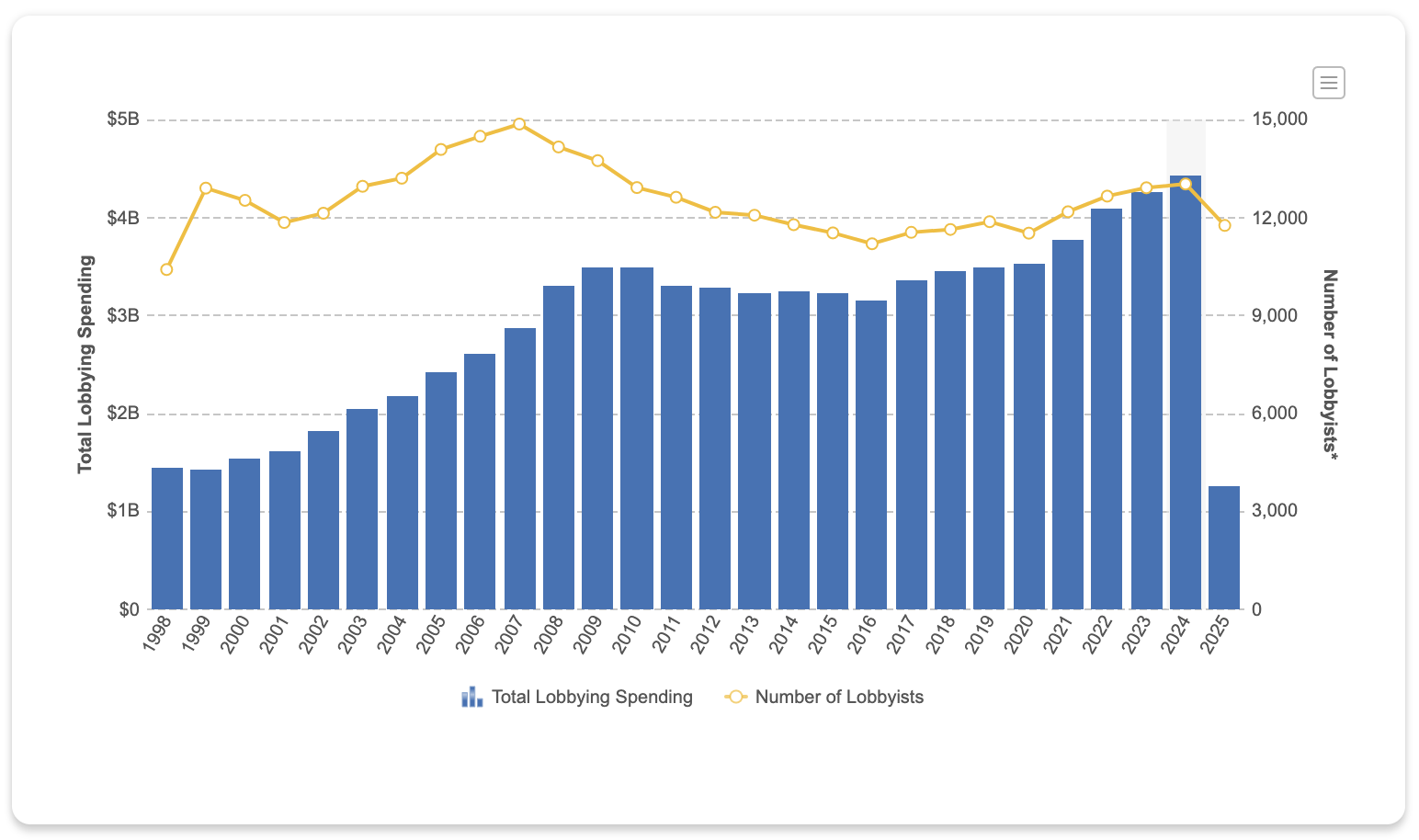
Lobbying remains a powerful and well-funded activity. Reported federal lobbying spending rose from about $1.45 billion in 1998 to more than $4 billion a year in recent years. That trend cannot by itself prove that lobbying changes policy, but it shows that organizations continue to see value in paying for expertise, access and political representation (see Figure 2). Research has also found that organized interests can affect legislative outcomes when they have sufficient resources and favorable political conditions. 1
The rules also leave important openings. Federal regulation relies on technical definitions, registration thresholds and accurate self-reporting. Studies of accountability have identified incomplete registration, uncertainty over which activities must be reported and limited enforcement resources as recurring weaknesses. Legal analyses further argue that campaign-finance rules and constitutional protections can weaken some post-2007 restrictions, allowing influence to move through channels that lobbying laws do not fully cover. 2
There is broad public concern about this problem. Pew surveys have found widespread fears that wealthy donors, corporations and special interests have too much political influence. Gallup has reported low confidence in Congress and significant concern about political institutions and special interests. But these findings show public unease more clearly than they show support for one specific lobbying-reform plan. 3
The case against
Calling the reforms “ineffective” across the board goes too far. The Lobbying Disclosure Act established registration and reporting requirements, while the Honest Leadership and Open Government Act strengthened disclosure rules and added restrictions involving gifts, travel and the time former officials must wait before lobbying. The Senate’s searchable database now provides quarterly information on registrants, clients, issues and spending—records that would not exist under a system with no transparency requirements (see Figure 1). 4
These measures may not have eliminated influence, but they have created real public information and procedural limits. A lack of evidence that lobbying has disappeared is not the same as proof that the rules had no effect.
Nor does lobbying spending automatically determine government decisions. Research finds that lobbying success depends on the issue, lawmakers’ existing views, the quality of information provided, access to decision-makers and the ability to mobilize support. Interest groups may win attention without winning policy changes. Lobbying activity alone therefore cannot establish policy capture or prove that reforms failed. 5
A major limitation is the lack of a comprehensive study comparing today’s system with a credible alternative in which these reforms had not been adopted. Existing evidence combines spending figures, legal analysis, administrative records, research on lobbying and public-opinion surveys. Each sheds light on a different part of the question, but none shows precisely how much influence reforms prevented, displaced or merely made more visible. Public surveys also often combine lobbying with campaign finance, ethics and general corruption, making it difficult to measure support for any particular lobbying proposal.
The bottom line
The evidence moderately favors a narrower version of the claim. Reforms have been more successful at producing records and imposing formal procedures than at reducing the structural advantages of well-resourced interests or their access to policymakers. 12
That does not make transparency and procedural reforms worthless, or show that every lobbying rule failed. Nor does continuing influence prove that lobbying alone controls policy. The strongest conclusion is that the United States has made genuine regulatory changes, but those changes have not demonstrably removed unequal access and influence. Public backing is broadest as opposition to excessive influence by wealthy or special interests, not as a clearly measured majority for one defined reform package.
Pros — Supporting Arguments
Cons — Opposing Arguments
Figures & data

All contributions are reviewed for clarity, balance, and evidence. The strongest insights are elevated into the argument graph — with credit to you.
Help improve this analysis →