Divisions within the U.S. Democratic Party over support for Israel reduce its electoral performance in subsequent national elections
What's this about?
People disagree about whether fights in the Democratic Party over Israel hurt the party in later U.S. elections.
The evidence shows a smaller effect in key places, but not a clear drop across the whole country.
What supporters say
- Public fights inside the party can make it harder to get supporters to vote.
- The issue hurt groups that Democrats need, such as young, Muslim, and Arab American voters.
- Gaza policy may have pushed some voters to stay home, back another party, or vote for Trump.
What critics say
- Other issues, such as prices, jobs, and the economy, likely mattered more in national elections.
- Anger in a few places does not prove that the issue hurt Democrats across the whole country.
How to read this
The number of points on each side does not show who is right; the stronger evidence matters more.
The bottom line
The evidence shows that Israel policy may have hurt Democrats among some voters in close states.
But we're not sure yet that party fights over Israel caused a nationwide loss.
The claim is that visible Democratic disagreements over U.S. support for Israel hurt the party’s performance in later national elections. The evidence supports a narrower conclusion: the issue may have mattered in key places and among particular voters, but it has not been shown to have caused a nationwide decline.
The case for
The strongest evidence comes from Arab American voters in strategically important areas. Polling by the Arab American Institute, along with reporting and election analysis from Dearborn and southeast Michigan, links dissatisfaction with the Biden-Harris administration’s Gaza policy to abstention, third-party voting and, for some voters, support for Donald Trump 1. Arab American voters are concentrated in competitive states, so even a relatively small shift could affect Electoral College results (see Figure 3).
The evidence does not show that these voters changed their choices solely because of Democratic infighting. But it does indicate that the party’s handling of Gaza contributed to defections in an important constituency. That makes the issue potentially significant in close races, even if its effect was small across the country as a whole.
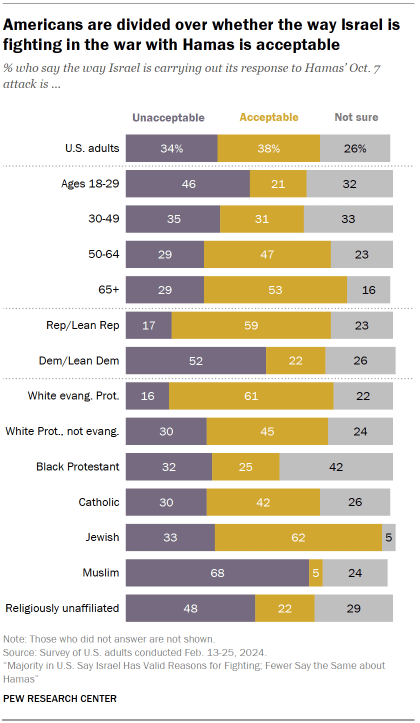
A second possible route is through party unity and voter motivation. Brookings and Pew have documented sharp differences among Democratic constituencies over Israel and U.S. military support. Other research suggests that voters can respond negatively when a party appears divided, and that disunity may reduce enthusiasm or weaken party ties 2.
Protests, primary protest votes, disputes at party gatherings and public criticism may therefore have discouraged some Democratic voters. The mechanism is plausible, but the available studies do not measure the national electoral effect of Democratic divisions over Israel directly. The issue also affected groups Democrats depend heavily on, including Arab American, Muslim and younger voters, making the potential political risk greater than the issue’s share of national attention might suggest 3.
The case against
Other issues dominated voters’ national priorities. Surveys by Pew and other organizations consistently placed the economy, inflation, immigration and domestic concerns above Israel and Gaza. Pew’s comparison of the 2020 and 2024 electorates also points to changes in turnout and demographic composition as major factors in Democratic losses, without attributing those changes to Gaza policy 4.
This makes it difficult to say that disagreements over Israel were a main cause of overall Democratic performance. Voters may have opposed the administration’s Gaza policy, but they were also judging candidates on economic conditions, immigration, leadership and other issues.
The clearest evidence of backlash is local, especially in Dearborn and parts of southeast Michigan. A localized reaction does not establish a nationwide electoral effect 5. Local results can also reflect demographics, turnout, candidate quality, economic conditions and broader dissatisfaction. The available reporting and election analysis cannot separate those influences from the effects of Gaza policy or from the party’s internal disagreements.
There is also an important distinction between the policy itself and the public conflict around it. Surveys show concern about Palestinian civilian suffering and disagreement over U.S. support for Israel, but they often measure those views alongside vote intentions. They do not show whether voters were responding to the administration’s policy, visible Democratic division, or both.
The bottom line
The evidence favors a limited, conditional version of the claim, but only weakly. Gaza policy and Democratic divisions appear to have contributed to defections and lower enthusiasm among some constituencies, and those shifts may have mattered in close states or jurisdictions.
But there is no credible national estimate showing that divisions over Israel reduced the Democratic vote share, turnout or Electoral College performance overall. Stronger national evidence says other issues mattered more, while the most direct evidence is localized and cannot isolate cause. The overall confidence is therefore low: the case for a targeted electoral effect is plausible, but the broader claim of a nationwide Democratic penalty remains unproven.
Figures & data
All contributions are reviewed for clarity, balance, and evidence. The strongest insights are elevated into the argument graph — with credit to you.
Help improve this analysis →