AI tutoring tools outperform human tutors in standardized test preparation
What's this about?
People disagree about whether AI study tools beat skilled human tutors for big tests like the SAT and ACT.
AI can give practice and fast tips, but can it raise scores more than a person?
What supporters say
- AI can change each question’s level to match what a student needs to work on.
- It gives quick feedback and lets students practice at any time, even late at night.
- AI tools often cost less than one-on-one tutoring and can help students far from good tutors.
- AI can guide human tutors during lessons and may help new tutors give better support.
What critics say
- We do not have strong proof that AI alone beats skilled human tutors on SAT or ACT scores.
- Most AI studies compare AI with normal class work, not with expert one-on-one tutors.
- A small study found AI could help with a work exam, but it did not test SAT or ACT scores.
- AI can help people tutor better, yet a human still led the lesson in that study.
The bottom line
AI can give useful, made-for-you practice and fast feedback.
But the proof does not show that AI tutors beat skilled human tutors for major test prep.
AI tutoring tools can offer personalized practice, instant feedback and round-the-clock access. But the evidence does not show that they outperform skilled human tutors in preparing students for major standardized tests such as the SAT or ACT.
The case for
The strongest evidence in favor of AI comes from studies of so-called intelligent tutoring systems, which adapt lessons and questions to each learner. Reviews of this research generally find that these systems can raise academic achievement compared with conventional teaching. Their advantages are straightforward: AI can provide repeated practice, adjust the difficulty of questions and give immediate feedback at a scale no human tutoring service could match. Adaptive practice can be effective, especially when students need large amounts of targeted review. 1
AI may also make test preparation more available and more consistent. It is cheaper than one-to-one tutoring in many settings, can be used at any hour, and does not depend on finding a qualified tutor nearby. Research on Tutor CoPilot, a system that gives real-time guidance to human tutors, found improved tutoring quality and better student outcomes, particularly among less experienced tutors. That suggests AI can help make support more reliable, even if a person remains in charge of the session. 2
There is also evidence that AI can help with exam-style practice. A small randomized study involving preparation for a professional exam found that an AI chatbot could support simulated practice compared with peer role-play. This does not prove that AI raises SAT or ACT scores, but it does show that AI-led interactions can have value in test-related learning and feedback. 3
The case against
The central problem for the claim is that there is no strong direct evidence comparing autonomous AI tutors with skilled one-to-one human tutors for major standardized-test results. Most studies of AI compare it with regular classroom teaching, active-learning classes, peer role-play or other nonexpert alternatives. Those are useful comparisons, but they do not answer whether AI beats an experienced human test-prep tutor. 4
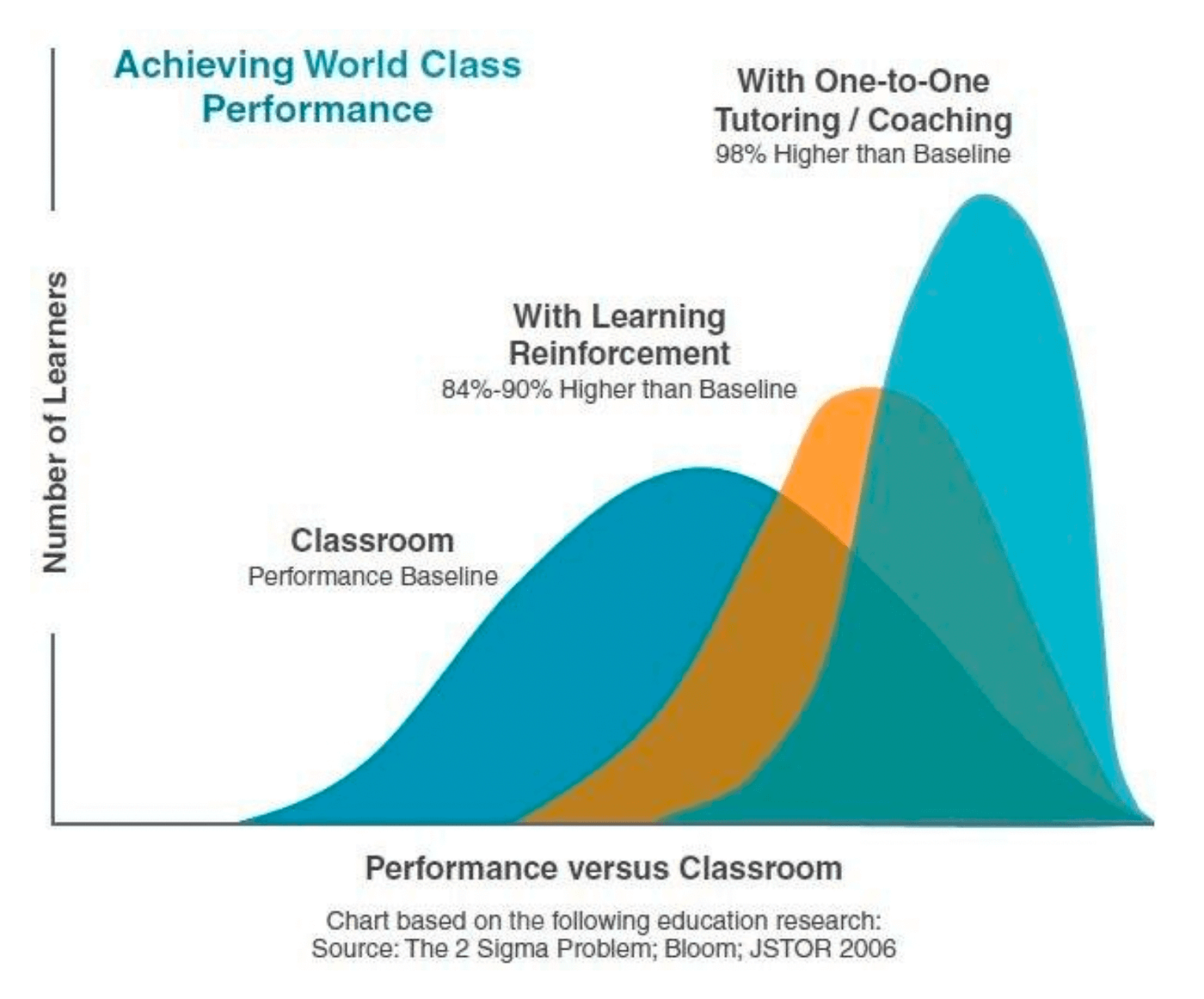
Human tutoring remains a high bar. Classic research by Benjamin Bloom found very large gains from individual human tutoring compared with standard group instruction. Later reviews have likewise found that human tutoring is generally highly effective, although its impact differs by subject and by how it is delivered. Research also supports meaningful gains from intelligent tutoring systems, but it does not show a general pattern of those systems surpassing human tutors (see Figure 1). 5
Generative AI creates another concern: it can give answers that sound confident but are inaccurate or fabricated. A systematic review has flagged questions about accuracy and the limited evidence base, while UNESCO has urged human oversight and fact-checking when these systems are used in education. In high-stakes test preparation, bad advice about content, strategy or scoring could undermine the benefits of fast feedback. 6
AI also may not handle the parts of tutoring that extend beyond academic content. A human tutor can notice when a student is discouraged, struggling with time management or facing other barriers that affect learning. The available studies vary widely in the systems they tested, the students involved and the settings in which they were used. That makes it difficult to predict whether results from supported research programs will carry over to ordinary test-prep use.
The bottom line
AI tutoring is a potentially effective aid, not a proven replacement for skilled human test-prep tutors. It can deliver personalized practice, simulations and feedback at scale, and it may improve access and support human tutors. But the evidence most directly relevant to the claim is missing: high-quality, head-to-head trials measuring standardized-test outcomes for AI tutors versus expert human tutors.
The conclusion is therefore firm but limited. AI can help students prepare, and hybrid models in which AI assists a human tutor appear especially promising. Yet current research does not establish that AI tutoring tools outperform human tutors in standardized-test preparation.
Figures & data

All contributions are reviewed for clarity, balance, and evidence. The strongest insights are elevated into the argument graph — with credit to you.
Help improve this analysis →